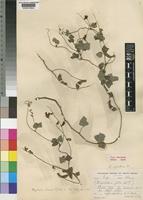
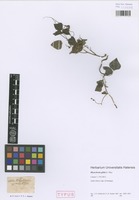
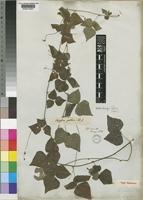
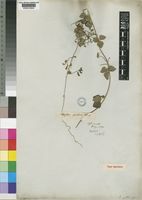
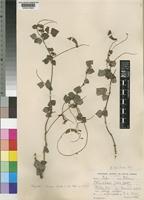
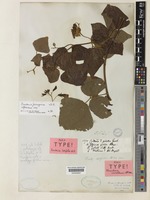
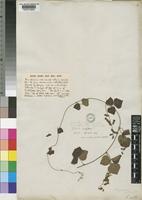
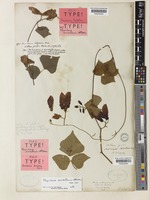
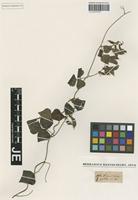
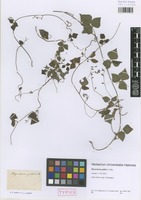
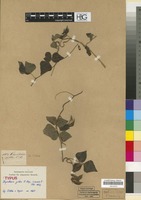
voluble or prostrate, thinly pubescent; petioles longish, leaflets ovato-rhomboid, acute or obtuse, membranous; stipules minute; racemes longer than the leaves, laxly several flowered; upper calyx-segments short and broad, acute, lowest conspicuously longer, subulate; vexillum glabrous; legume falcate, much longer than the calyx, thinly pilose (or hirsute). Stems several, climbing or trailing, elongate, slender, mostly densely and shortly pubescent. Petioles uncial, the terminal leaflet remote. Leaflets very variable in form, sometimes almost orbicular and very obtuse, sometimes rhomboid-acuminate, the lateral very unequal-sided, 1/2–1 1/2 inch long and broad, pale or darkish green. Peduncles 3–4 inches long, floriferous above the middle; flowers 6–8 lines long, the ovate vexillum streaked with brown. Ovary very hairy. Legume 12 lines long, 4 lines wide, acute at each end. The common form is well characterized by its calyx. Glycine trilobaand G. secunda, Thunb.! both seem to belong to this species, but the specimens in Herb. Upsal are very imperfect. β. has thicker, somewhat rugulose leaflets, pale underneath, and the upper calyx-lobes are longer and narrower. It closely approaches R. argentea, but differs in the vexillum.