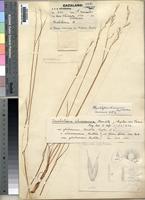
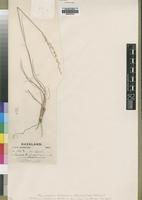
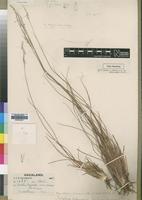
A cæspitose perennial. Culms erect or very slightly geniculate, 1–1 1/2 ft. high, up to 1/2 lin. in diameter at the base, terete, slender, glabrous and smooth, simple, 2-noded with the nodes pubescent. Leaf-sheaths smooth, finely striate, the lowest persistent, moderately loose, silvery-pilose at the base, the upper tight, shorter than the internodes, glabrous, the uppermost elongated up to the base of the panicle and about 6 in. long; ligule reduced to a densely ciliate rim up to 1/6 lin. long; blade narrowly linear to filiform, often convolute, flexuous, up to 3 in. long and 3/4 lin. wide when flattened, firm, glabrous and smooth or minutely pubescent on the upper surface. Panicle narrow, flexuous, more or less contracted, 3 1/2–4 in. long, 1/2– 3/4 in. wide; rhachis very slender, terete, sparsely and shortly pubescent at the nodes or all along, minutely asperulous; branches solitary, erect or spreading, filiform, sparingly branched; branchlets and pedicels capillary, flexuous, very shortly pubescent and asperulous, the latter 1/2–3 lin. long with a few short hairs up to 1/4 lin. long from below their discoid tips. Spikelets oblong, 2–2 1/4 lin. long, 3/4 lin. wide at the middle, softly silky-pilose above the middle. Glumes distant by 1/6 lin.; lower elliptic and obtuse to triangular and acute, up to 1/3 lin. long, hyaline, densely pilose and hidden by white hairs up to 1/2 lin. long; upper nearly 2 lin. long, semi-lanceolate-oblong in profile, very slightly gibbous in the lower two-thirds, minutely two-lobed, with an awn up to 1/2 lin. long from the sinus, firmly membranous to thinly chartaceous, 5-nerved, shortly pilose towards the margins with appressed white hairs and with longer hairs just below the glabrous apex, hairs scarcely or very slightly exceeding the tip of the glume, margins ciliate. Lower floret ♂: valve similar to the upper glume, but slightly shorter and narrower, with a slender awn up to 1 lin. long; valvule as long as the valve, lanceolate, shortly ciliate with appressed hairs on the keels above the middle; anthers linear-oblong, about 1 lin. long. Upper floret hermaphrodite: valve ovate-elliptic when flattened, obtuse, 1 1/4 lin. long, obscurely 3–5-nerved, thinly membranous, glabrous.