JSTOR Global Plants Home
  • Home
  • Browse
  • About
  • Access
  • Account
    • Saved Items
    • Profile
  • Log in

Global Plants

Skip to Main Content
  • JSTOR Global Plants Home
  • Global Plants

    • Browse
    • About
    • Access
    • Account
      • Saved Items
      • Profile
Log in
  • Browse
  • About
  • Access
  • Account
    • Saved Items
    • Profile
Advanced Search

Compilation
Rhus transvaalensis

6 Images see all

Rhus transvaalensis Engl.
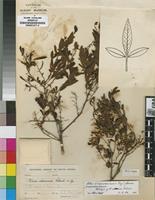
Holotype of Rhus eburnea Schonland [family ANACARDIACEAE]
Rhus eburnea Schönland [family ANACARDIACEAE]
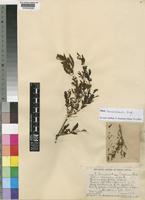
Rhus transvaalensis Engl.
Previous
Next

Name

Identification
Rhus transvaalensis Engl. [family ANACARDIACEAE ]
Related name
  • Rhus transvaalensis

Flora

Entry for Rhus transvaalensis [family ANACARDIACEAE]
Herbarium
South African National Biodiversity Institute, Compton Herbarium, Cape Town (SAM)
Collection
Flora of Southern Africa
Resource Type
Reference Sources
Entry From
Flora of South Africa, (2003) Author: Dr J.P. Roux
Names
Rhus transvaalensis [family ANACARDIACEAE]
Common names
Toxicodendron transvaalense (Engl.) Kuntze: 154 (1891). R. eburnea Schonl.: 67, t. p. 67 (1930); Burtt Davy: 504 (1932). Type: Transvaal, Pilgrim's Rest District, Mariepskop Forest Reserve, Keet 1457(1547 vide Schonl., sphalm.) (GRA, holo.!; K, iso.!).
Information
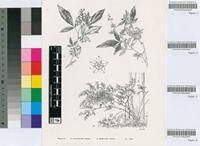
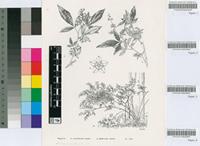
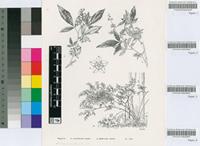
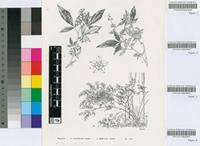
Lax, many-stemmed shrub up to 2 m high, rarely small tree up to 4 m with pendulous pale branches. Bark smooth; young branches tomen-tose or glabrescent. Leaves trifoliolate, petiolate; petiole shallowly canaliculate above, pilose or glabrous, (5—)16(—37) mm long; leaflets subses-sile, subcoriaceous, glabrous, dark green above, pale olive below, hypostomatous; lamina elliptic to narrowly elliptic, base cuneate to attenuate, apex acute, mucronulate; margin entire, weakly revolute; venation somewhat kladodromous; midrib yellow, prominent below, impressed above, other veins impressed above and below; terminal leaflets (12-)36(-60) x (3-)12(-19) mm, lateral leaflets (7-)23(-40) x (3-)9(-18) mm. Panicles numerous, relatively short (up to 50 mm long), mostly axillary, also terminal. Flowers normal. Drupe circular, globoid, gla­brous, shiny, yellowish becoming light brown when mature 3,9 x 3,4 to 4,9 x 4,8 mm. Fig. 8.
Habitat
Rhus transvaalensis occurs along the edges of forests and streams. In the Mariepskop Forest Reserve near Sabie, Keet (Keet 1457 in PRE) stated that it (R. eburnea Schonl.) formed one of the chief constituents of the 'fynbos'.
Use
4. Rhus transvaalensis Engl, in A. & C. DC, Monographiae phanerogamarum 4: 440 (1883); Schonl.: 53, t. p. 53 (1930); Burtt Davy: 497 (1932). Type: Transvaal, Houtbosch, Rehmann 5559 (Z, lecto.! here designated; GRA!, isolecto.).
Range
Common in the Soutpansberg and along the mountains of the north-eastern and eastern Transvaal reaching Swaziland and northern Natal. Also occurs in the eastern Transvaal Lowveld. Flowering recorded from October to December. Map 4.

Related Materials

  • Terms and Conditions
  • Privacy Policy
  • Cookie Policy
  • Cookie Settings
  • Accessibility
  • Help
  • Contact Us
  • Facebook
  • Twitter
ITHAKA

JSTOR is part of ITHAKA, a not-for-profit organization helping the academic community use digital technologies to preserve the scholarly record and to advance research and teaching in sustainable ways.

©2000-2026 ITHAKA. All Rights Reserved. JSTOR®, the JSTOR logo, JPASS®, Aluka®, and ITHAKA® are registered trademarks of ITHAKA.

╳