JSTOR Global Plants Home
  • Home
  • Browse
  • About
  • Access
  • Account
    • Saved Items
    • Profile
  • Log in

Global Plants

Skip to Main Content
  • JSTOR Global Plants Home
  • Global Plants

    • Browse
    • About
    • Access
    • Account
      • Saved Items
      • Profile
Log in
  • Browse
  • About
  • Access
  • Account
    • Saved Items
    • Profile
Advanced Search

Compilation
Rhus rogersii

7 Images see all

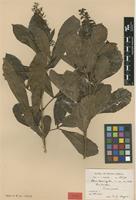
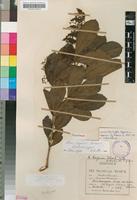
Isolectotype of Rhus rogersii Schönland [family ANACARDIACEAE]
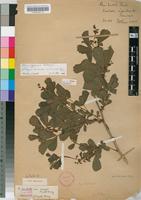
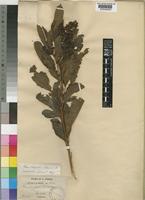
Holotype of Rhus dentata Thunb. var. truncata Burtt Davy [family ANACARDIACEAE]
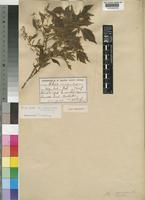
Rhus dentata Thunb. var. truncata Burtt Davy [family ANACARDIACEAE]
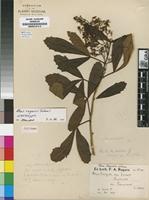
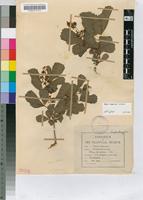
Lectotype of Rhus rogersii Schonland [family ANACARDIACEAE]
Isolectotype of Rhus rogersii Schönland [family ANACARDIACEAE]
Rhus rogersii Schönland [family ANACARDIACEAE]
Isotype of Rhus dentata Thunb. var. truncata Burtt Davy [family ANACARDIACEAE]
Previous
Next

Name

Identification
Rhus rogersii Sch”nland [family ANACARDIACEAE ] (stored under name); Verified by Not on sheet,
Related name
  • Rhus laevigata
  • Rhus dentata
  • Rhus sonderi
  • Rhus rogersii

Flora

Entry for Rhus rogersii [family ANACARDIACEAE]
Herbarium
South African National Biodiversity Institute, Compton Herbarium, Cape Town (SAM)
Collection
Flora of Southern Africa
Resource Type
Reference Sources
Entry From
Flora of South Africa, (2003) Author: Dr J.P. Roux
Names
Rhus rogersii [family ANACARDIACEAE]
Common names
R. dentata Thunb. var. truncata Burtt Davy: 501 (1932). Type: Transvaal, Lydenburg, The Downs, Rogers 25076 (PRE, holo.!).
Information
Suffrutex or slender, fastigiate shrub, 1,5—2 m high. Bark smooth, prominently lenticellate, dull grey-brown, young branchlets glabrous, some­times puberulous, chestnut-brown to grey. Leaves trifoliolate, petiolate; petiole semiterete, (6-) 23(-52) mm long; leaflets sessile, subcoria-ceous, concolorous, dark green, glabrous, hypo-stomatous; lamina narrowly elliptic to elliptic, obovate to widely obovate, base cuneate, apex extremely variable, acuminate, acute, truncate, mucronate; margin thickened, slightly revolute, whitish, markedly pauciserrate and teeth mucro-nulate towards apex; venation craspedodromous to kladodromous, midrib dull yellow to brown, slightly raised above, prominent below, secon­daries impressed above, slightly prominent below; terminal leaflets (17-)55(-121) x (9-) 19(-48) mm, lateral leaflets (15-)37(-91) x (5—)18(—40) mm. Panicles much branched, males longer than females, terminal up to 150 mm long, usually exserted from foliage, axillary shorter, usually within foliage. Flowers as for R. dentata (no. 7). Drupe circular, globoid, gla­brous, shiny, yellowish maturing dark brown, 4,1 x 4,1 to 5,6 x 5,4 mm.
Habitat
Plants from the type locality in the south as well as those from between Nelspruit and Machadodorp are easily recog­nized by the distinct long, obovate toothed leaflets. These leaflets however, become narrower and smaller further north­wards eventually being truncate in the Downs area north of Lydenburg. The northern specimens may easily be confused with R. dentata (no. 7) and the Zimbabwean specimens attributed to that species are probably better regarded as R. rogersii.
Use
9. Rhus rogersii Schonl. in Bothalia 3, 1: 42, t. p. 42 (1930); Burtt Davy: 501 (1932); R. & A. Fernandes: 190, t. 51 (1965a); R. & A. Fernandes: 613 (1966). Type: Transvaal, Bar-berton, 920 m, Dec, Rogers 18270 (GRA, lec-to.! here designated; G!, K!, PRE!, S!, Z!, isolecto.).
Range
Confined to the north-eastern and eastern Transvaal from north of Lydenburg to between Nelspruit and Barberton. Also occurs near the Swaziland border in Mozambique and prob­ably also in Zimbabwe (see next paragraph). Flowering record­ed from October to February. Map 8.

Related Materials

  • Terms and Conditions
  • Privacy Policy
  • Cookie Policy
  • Cookie Settings
  • Accessibility
  • Help
  • Contact Us
  • Facebook
  • Twitter
ITHAKA

JSTOR is part of ITHAKA, a not-for-profit organization helping the academic community use digital technologies to preserve the scholarly record and to advance research and teaching in sustainable ways.

©2000-2026 ITHAKA. All Rights Reserved. JSTOR®, the JSTOR logo, JPASS®, Aluka®, and ITHAKA® are registered trademarks of ITHAKA.

╳