JSTOR Global Plants Home
  • Home
  • Browse
  • About
  • Access
  • Account
    • Saved Items
    • Profile
  • Log in

Global Plants

Skip to Main Content
  • JSTOR Global Plants Home
  • Global Plants

    • Browse
    • About
    • Access
    • Account
      • Saved Items
      • Profile
Log in
  • Browse
  • About
  • Access
  • Account
    • Saved Items
    • Profile
Advanced Search

Compilation
Rhus ochracea

3 Images see all

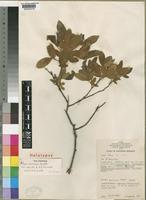
Holotype of Rhus ochracea Meikle var. saxixola R. & A.Fern. [family ANACARDIACEAE]
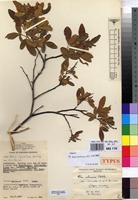
Isotype of Rhus ochracea Meikle var. saxicola R.Fern. & A.Fern. [family ANACARDIACEAE]
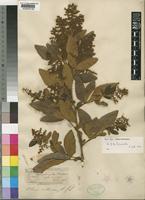
Rhus ochracea Meikle [family ANACARDIACEAE]
Previous
Next

Name

Identification
Isotype of Rhus ochracea Meikle [family ANACARDIACEAE ] (stored under name); Verified by Van der Veken P., 1965
Related name
  • Rhus ochracea
  • Rhus villosa

Flora

Entry for Rhus ochracea Meikle [family ANACARDIACEAE]
Herbarium
Royal Botanic Gardens, Kew (K)
Collection
Flora Zambesiaca
Resource Type
Reference Sources
Entry From
FZ, Vol 2, Part 2, page 550, (1966) Author: Rosette Fernandes and A. Fernandes
Names
Rhus ochracea Meikle [family ANACARDIACEAE], in Kew Bull. 8: 107 (1953). — White, F.F.N.R.: 213 (1962). Type: Nyasaland, Fort Hill, Whyte (K, holotype).
Information
Suffrutex or small branched shrub 0·6–1·2(3·6) m. tall. Branches reddish-brown, cylindric, ± densely puberulous with somewhat crisped hairs mixed with longer patent ones. Petiole 1–4 cm. long, robust, canaliculate above, ± densely hispidous or puberulous and scrofulous to glabrescent. Juvenile leaves papyraceous with faint venation, the adult ones subcoriaceous or coriaceous, discolorous when dried (dull green or brownish above, yellowish-green, ochraceous or ferrugineous beneath), sparsely to very densely hispid mainly on the midrib and lateral nerves on both surfaces, ± densely and softly scrofulous-glandular (glandular hairs small, many-branched, yellowish, shining) below and not so densely so above, entire, rarely crenate in the upper part; median-leaflet 3·8–11 × 1·7–5 cm., elliptic, obovate to broadly obovate, sometimes oblanceolate, obtuse or subobtuse or rounded or acute at the apex and cuneate at the base and sometimes petiolulate, the lateral ones 1·8–7·5 × 0·9–4 cm., sessile, obovate, obtuse at the apex and asymmetric at the base; midrib, lateral nerves and reticulation raised on both surfaces, more strongly so below. Panicles terminal and axillary (in the upper leaf-axils) usually longer than the leaves, making in all a large terminal leafy inflorescence up to 30 × 25 cm.; axis and pedicels hispid and lepidote-glandular. Male flowers: calyx-segments 0·75–1 mm. long, ovate, hispid; petals 1·5 mm. long, oblong. Drupe brown, shining, up to 4 mm. in diam., globose, glabrous.

Related Materials

  • Terms and Conditions
  • Privacy Policy
  • Cookie Policy
  • Cookie Settings
  • Accessibility
  • Help
  • Contact Us
  • Facebook
  • Twitter
ITHAKA

JSTOR is part of ITHAKA, a not-for-profit organization helping the academic community use digital technologies to preserve the scholarly record and to advance research and teaching in sustainable ways.

©2000-2026 ITHAKA. All Rights Reserved. JSTOR®, the JSTOR logo, JPASS®, Aluka®, and ITHAKA® are registered trademarks of ITHAKA.

╳