JSTOR Global Plants Home
  • Home
  • Browse
  • About
  • Access
  • Account
    • Saved Items
    • Profile
  • Log in

Global Plants

Skip to Main Content
  • JSTOR Global Plants Home
  • Global Plants

    • Browse
    • About
    • Access
    • Account
      • Saved Items
      • Profile
Log in
  • Browse
  • About
  • Access
  • Account
    • Saved Items
    • Profile
Advanced Search

Compilation
Rhus montana

5 Images see all

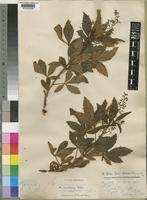
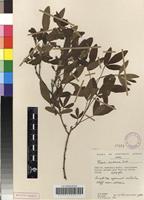
Rhus gerrardii (Harv. ex Engl.) Diels [family ANACARDIACEAE]
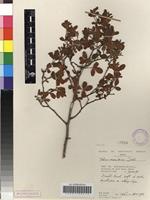
Filed as Rhus montana Diels [family ANACARDIACEAE]
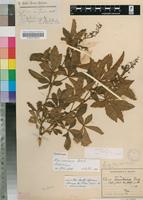
Isolectotype of Rhus montana Diels [family ANACARDIACEAE]
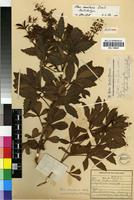
Filed as Rhus montana Diels [family ANACARDIACEAE]
Previous
Next

Name

Identification
Rhus montana Diels [family ANACARDIACEAE ] (stored under name); Verified by Moffett, R.O., 1986
Related name
  • Rhus montana
  • Rhus gerrardii

Flora

Entry for Rhus montana [family ANACARDIACEAE]
Herbarium
South African National Biodiversity Institute, Compton Herbarium, Cape Town (SAM)
Collection
Flora of Southern Africa
Resource Type
Reference Sources
Entry From
Flora of South Africa, (2003) Author: Dr J.P. Roux
Names
Rhus montana [family ANACARDIACEAE]
Common names
R. gerrardii (Harv. ex Engl.) Diels var. montana (Diels) Schonl.: 78, t. p. 78 (1930); Burtt Davy: 507 (1932).
Information
Slender, single to multistemmed deciduous shrub to small spreading tree up to 2,25 m high. Bark smooth, glabrous, grey-brown; young branchlets glabrous, pale brown. Leaves (3-)5(-7)-foliolate, petiolate; petiole terete to canaliculate above, (ll-)24(-34) mm long; leaflets sessile, membraneous, slightly dis-colorous, glabrous, dark green above, pale olive below, turning orange-red in autumn, hypostoma-tous; lamina elliptic to narrowly elliptic or obovate, base cuneate to attenuate, apex acute to acuminate, mucronulate; margins entire or prominently pauciserrate in upper half, teeth mucronulate; venation kladodromous to semi-craspedodromous in toothed leaflets, midrib pale, prominent below, other veins impressed yet still visible below; terminal leaflets (27-)44(-68) x (8-)12(-16) mm, lateral leaflets (19-)30(-42) x (6-)9(-14) mm. Panicles much branched, multiflorous, terminal and axillary, up to 100 mm long. Flowers normal. Drupe circular, obloid, glabrous, shiny, pale brown, 3,5 x 3,0 to 4,0 x 3,5 mm.
Habitat
The 5(-7)-foliolate plants are readily recognizable but as entire, toothed, 3- and 5-foliolate leaves sometimes occur on the same plant, each type usually on its own branch, the determination of isolated herbarium sheets is very difficult. Habit is of the utmost importance and to the trained eye the venation pattern below and the membranous leaflets are diagnostic. Trifoliolate specimens are however easily confused with either R. transvaalensis (no. 4), R. grandidens (no. 5), R. dentata (no. 7) or more rarely R. pyroides var. gracilis (no. 15c).
Use
6. Rhus montana Diels in Engl., Botanische Jahrbucher 40: 86 (1907); Schonl.: 247 (1911); Engl.: 215 (1921). Type: Transkei, near Engcobo, 1350 m, Bolus 8837 (Bf; K, lecto.! vide Fernandes: 131 (1967); BOL!, GRA!, PRE!, isolecto.).
Range
Occurs in scrub forest along the escarpment just north of Wakkerstroom, then in the higher foothills of the Qwa Qwa and Natal Drakensberg reaching as far south as the moun­tains near Engcobo west of Umtata. Flowering recorded in October and January. Map 6.

Related Materials

  • Terms and Conditions
  • Privacy Policy
  • Cookie Policy
  • Cookie Settings
  • Accessibility
  • Help
  • Contact Us
  • Facebook
  • Twitter
ITHAKA

JSTOR is part of ITHAKA, a not-for-profit organization helping the academic community use digital technologies to preserve the scholarly record and to advance research and teaching in sustainable ways.

©2000-2026 ITHAKA. All Rights Reserved. JSTOR®, the JSTOR logo, JPASS®, Aluka®, and ITHAKA® are registered trademarks of ITHAKA.

╳