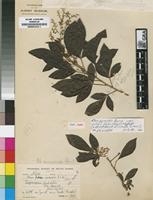
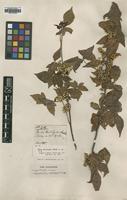
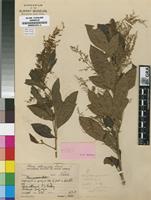
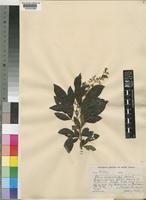
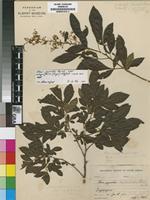
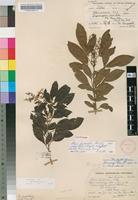
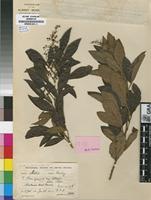
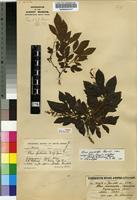
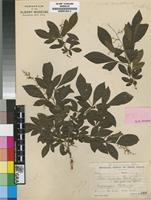
Shrub 2–6 m. high, sometimes thorny, the thorns c. 1 cm. long and uncinate; branches and branchlets pale yellowish-grey, cylindric, the latter ± densely pubescent and finally glabrescent or always glabrous and brownish. Petiole 1·5–4 cm. long, slender, canaliculate, pubescent to glabrescent or glabrous. Leaflets concolorous to slightly discolorous, papyraceous to coriaceous (in oldest leaves), entire or rarely with 1–2 teeth, the margin revolute, glabrous or ± sparsely pubescent to glabrescent, the hairs appressed, denser on the midrib and nerves; median leaflet (2·2)4–9(11) × 1·3–4 cm., usually 4·5–6 × 1·7–2·7 cm., obovate, rhombic to oblanceolate, rounded or generally acute to very shortly acuminate at the apex, the acumen folded and mucronate, cuneate to subpetiolulate at the base; lateral leaflets usually 3–3·5 × 1·3–2 cm., obovate or elliptic, obtuse or subacute, mucronate, not so cuneate as the median one; midrib, lateral and tertiary nerves raised on both surfaces. Male panicles axillary and terminal, the former equal to or longer than the leaves, the latter longer, pyramidal, multiflorous, with the axis and branches sparsely to densely pubescent; female panicles shorter and laxer than the male ones. Male flowers: calyx-segments 0·5 mm. long, triangular; petals cream or yellowish-green, c. 0·75 mm. long, ovate. Drupe red, turning blackish when mature, c. 2·5 mm. in diam., subglobose, edible.