JSTOR Global Plants Home
  • Home
  • Browse
  • About
  • Access
  • Account
    • Saved Items
    • Profile
  • Log in

Global Plants

Skip to Main Content
  • JSTOR Global Plants Home
  • Global Plants

    • Browse
    • About
    • Access
    • Account
      • Saved Items
      • Profile
Log in
  • Browse
  • About
  • Access
  • Account
    • Saved Items
    • Profile
Advanced Search

Compilation
Rhus engleri

9 Images see all

Rhus engleri Britten
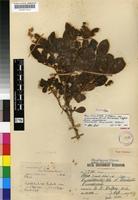
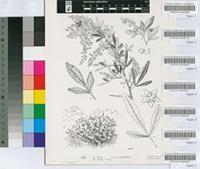
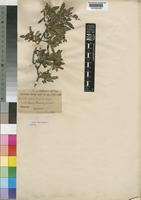
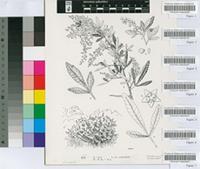
Isolectotype of Rhus engleri Britten [family ANACARDIACEAE]
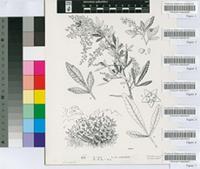
Rhus engleri Britten
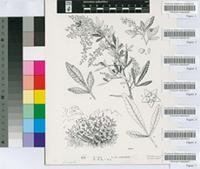
Rhus engleri Britten [family ANACARDIACEAE]
Rhus engleri Britten
Previous
Next

Name

Identification
Rhus engleri Britten [family ANACARDIACEAE ]
Related name
  • Rhus engleri

Flora

Entry for Rhus engleri [family ANACARDIACEAE]
Herbarium
South African National Biodiversity Institute, Compton Herbarium, Cape Town (SAM)
Collection
Flora of Southern Africa
Resource Type
Reference Sources
Entry From
Flora of South Africa, (2003) Author: Dr J.P. Roux
Names
Rhus engleri [family ANACARDIACEAE]
Common names
Toxicodendron incanum (Engl.) Kuntze: 154 (1891). R. incana Engl.: 428 (1883); Diels: 581, 630 (1898); non Mill.
Information
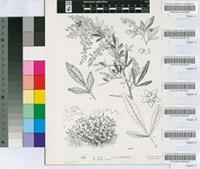
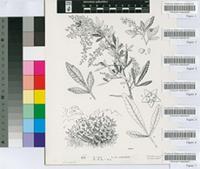
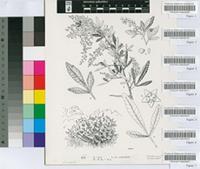
Spiny, much-branched shrub, usually 2 m high, occasionally up to 3 m. Bark smooth to granular, greyish white; young branches pubescent tomen-tose. Leaves trifoliolate, petiolate; petioles semi-terete, sometimes slightly winged, (4-)8(-14) mm long; leaflets sessile, submembranous, dis-colorous, dull green above, incanous below, hypostomatous; lamina widely oblanceolate to obovate, margin entire, slightly revolute, occa­sionally pauciserrate towards apex, base narrow to cuneate, apex obtuse, rounded or retuse; venation kladodromous-brochidodromous, midrib and sometimes secondaries dull yellow, prominent above, impressed below; terminal leaflets (13-)23(-36) x (4-)7(-ll) mm, lateral leaflets (8-)15(-22) x (4-)5(-9) mm. Panicles lax, up to 80 mm long, puberulous, axillary and terminal, both exposed. Flowers normal, styles separate, bent, persistent. Drupe rhombic, dis­coid, glabrous, shiny, chestnut brown, 4,5 x 1,4 to 5,2 x 1,8 mm. Fig. 18.
Habitat
Rhus engleri is a distinct species, unique in being the only discolorous (white) one to have a rhombic, discoid fruit. It is usually found only in calcareous substrates, such as the magnesite of the Springbok Flats, but also grows on the low­er slopes of chromite hills in Sekhukhuniland.
Use
23. Rhus engleri Britten in Journal of Botany 38: 316 (1900); Schonl.: 244 (1911); Schonl.: 66, t. p. 66 (1930); Burtt Davy: 504 (1932). Type: Transvaal, Klippan, Rehmann 5325 (Z, lecto.! here designated).
Range
Occurs in the central Transvaal in an area bounded roughly by Potgietersrus, Rust de Winter, Groblersdal, Steelpoort and Chuniespoort. Flowering recorded in March and April. Map

Related Materials

  • Terms and Conditions
  • Privacy Policy
  • Cookie Policy
  • Cookie Settings
  • Accessibility
  • Help
  • Contact Us
  • Facebook
  • Twitter
ITHAKA

JSTOR is part of ITHAKA, a not-for-profit organization helping the academic community use digital technologies to preserve the scholarly record and to advance research and teaching in sustainable ways.

©2000-2026 ITHAKA. All Rights Reserved. JSTOR®, the JSTOR logo, JPASS®, Aluka®, and ITHAKA® are registered trademarks of ITHAKA.

╳