JSTOR Global Plants Home
  • Home
  • Browse
  • About
  • Access
  • Account
    • Saved Items
    • Profile
  • Log in

Global Plants

Skip to Main Content
  • JSTOR Global Plants Home
  • Global Plants

    • Browse
    • About
    • Access
    • Account
      • Saved Items
      • Profile
Log in
  • Browse
  • About
  • Access
  • Account
    • Saved Items
    • Profile
Advanced Search

Compilation
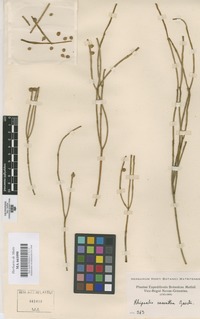
Rhipsalis cassutha

5 Images see all

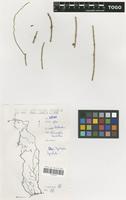
Filed as Rhipsalis cassutha Gaertn. [family CACTACEAE]
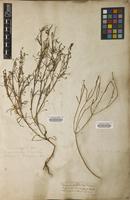
Filed as Cassytha baccifera J.S.Mill. [family LAURACEAE]
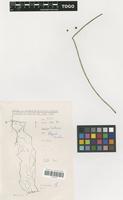
Filed as Rhipsalis cassutha Gaertn. [family CACTACEAE]
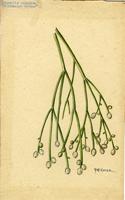
Rhipsalis cassutha
Original material of Rhipsalis cassutha Gaertn. [family CACTACEAE]
Previous
Next

Name

Identification
Rhipsalis cassutha Gaertn. [family CACTACEAE ]
Related name
  • Rhipsalis cassutha
Common name
  • igilligilli (AHU) (NIGERIA, YORUBA), Burkill, H.M. 1985. The useful plants of west tropical Africa, Vol. 1

Flora

Entry for RHIPSALIS baccifera (J. Mill.) W. T. Steam [family CACTACEAE]
Herbarium
Royal Botanic Gardens, Kew (K)
Collection
Flora of Tropical East Africa
Resource Type
Reference Sources
Entry From
Flora of Tropical East Africa, page 1, (1968) Author: R. Hunt
Names
RHIPSALIS baccifera (J. Mill.) W. T. Steam [family CACTACEAE], in adnot. Cact. Journ. 7: 107 (1939). Type: Represented by the description and plate, Class IX, Ord. 1 (1771) in J. Mill., Illustr. Sex. Syst. Linn. (1771–7)
Cassyt[h]a baccifera J. Mill. [family ], Illustr. Sex. Syst. Linn. Class IX, Ord. I (1771)
Rhipsalis cassutha Gaertn. [family CACTACEAE], Fruct. Sem. 1: 137, t. 28 (1788) (R. “cassytha” auct. mult.); Oliv., F.T.A. 2: 581(1871). Type: A specimen sent to Gaertner from Kew by Sir Joseph Banks, probably not preserved
Rhipsalis cassytha [family CACTACEAE], auct. mult.
?Rhipsalis zanzibarica Weber [family ], in Rev. Hort. 64: 425 (1892). Described from a living plant sent to the Jardin des Plantes in Paris from Zanzibar by Sacleux
Rhipsalis erythrocarpa K. Schum. [family CACTACEAE], in P.O. A. C: 282(1895). Type: Tanganyika, Kilimanjaro, Volkens 1581 (B, holo. f, K, iso.!)
Rhipsalis lindbergiana [family CACTACEAE], [sensu Rol. Goss. in Bull. Soc. Bot. Fr. 59: 100 (1912), saltern quoad syn. R. erythrocarpam K. Schum.]
Information
Much-branched pendent epiphytic shrub l–3(–9) m. long. Stems slender, cylindric, 2–8 mm. in diameter, sometimes slightly furrowed, arising in pairs or clusters from tips of older branches, pale green, occasionally producing adventitious roots. Areoles subtended by minute triangular scales, naked or with l(–2) short stiff bristles 1 mm. long. Flowers lateral, solitary, small, white or yellowish. Perianth-segments 9–12, outermost triangular, inner oblong, obtuse, 2–3 mm. long. Stamens ± 10–20, inserted at base of perianth, ± as long as perianth. Style thick; stigmas 3–5. Berry spherical or somewhat elongate, 5–8 mm. in diameter, pellucid, white, pink or red. Seeds black, glossy, subpyriform, ± 1 mm. long. Fig. 2, p. 6.
Range
DISTR. U2, 4; K1, 4–7; T1–3, 7; ?Z widespread in tropical Africa from Ivory Coast east to Ethiopia and as far south as Natal; Madagascar, Mascarene Is., Ceylon; Florida, West Indies, Central and tropical South America
Altitude range
550–2200 m.
Distribution
KENYA Northern Frontier Province Mt. Marsabit, July 1933, Gardner in F.D. 3216 in C.M. 13499!KENYA Kericho District SW. Mau Forest Reserve, Timbilil, Jan. 1961, Kerfoot 2723 !KENYA Teita Hills, 7 Feb. 1953, Bally 8794 in C.M. 20670 !TANGANYIKA Musoma District Mara R. Guard Post about 140 km. from Seronera, 4 Oct. 1961, Greenway 10234 !TANGANYIKA Moshi District Weru Weru R., 18 Nov. 1943, Moore in E.A:H. H79/43 !TANGANYIKA Lushoto District Amani, 19 Jan. 1950, Verdcourt 49 !UGANDA Kigezi District Kayonza, 23 July 1938, Wickham in A. S. Thomas 2327 !UGANDA Masaka District Nkose I., 22 Jan. 1956, Dawkins 863 !
Notes
Seedlings and juvenile growth bear little resemblance to the adult, having short 4(–7)-angled stems with abundant areoles on the angles bearing fine bristly hairs.Forms with pink or red berries, instead of white, have been described from East Africa (R. erythrocarpa K. Schum.) and tropical America (R. cassutha var. rhodocarpa Weber). This difference in fruit colour does not appear to be correlated with other characters. Nearly all the limited East African gatherings with pink or red berries are, however, from the foothills of Kilimanjaro, so that the variant may possibly be interpreted as a minor geographical race.

Related Materials

  • Terms and Conditions
  • Privacy Policy
  • Cookie Policy
  • Cookie Settings
  • Accessibility
  • Help
  • Contact Us
  • Facebook
  • Twitter
ITHAKA

JSTOR is part of ITHAKA, a not-for-profit organization helping the academic community use digital technologies to preserve the scholarly record and to advance research and teaching in sustainable ways.

©2000-2026 ITHAKA. All Rights Reserved. JSTOR®, the JSTOR logo, JPASS®, Aluka®, and ITHAKA® are registered trademarks of ITHAKA.

╳