JSTOR Global Plants Home
  • Home
  • Browse
  • About
  • Access
  • Account
    • Saved Items
    • Profile
  • Log in

Global Plants

Skip to Main Content
  • JSTOR Global Plants Home
  • Global Plants

    • Browse
    • About
    • Access
    • Account
      • Saved Items
      • Profile
Log in
  • Browse
  • About
  • Access
  • Account
    • Saved Items
    • Profile
Advanced Search

Compilation
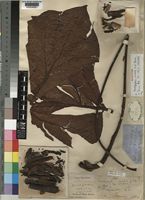
Rhektophyllum mirabile

9 Images see all

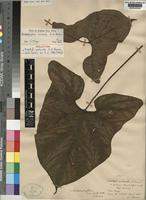
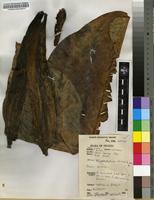
Cercestis mirabilis (N.E.Br.) Bogner [family ARACEAE]
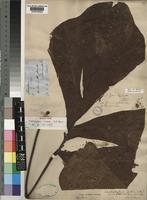
Syntype of Rhektophyllum mirabile N.E.Br. [family ARACEAE]
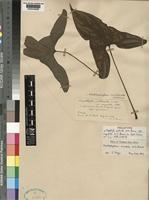
Paratype of Rhektophyllum camerunense Ntepe-Nyame [family ARACEAE]
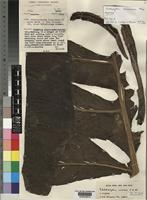
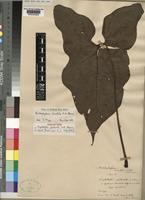
Filed as Rhektophyllum mirabile N.E.Br. [family ARACEAE]
Holotype of Nephthytis picturata N.E.Br. var. angustata N.E.Br. [family ARACEAE]
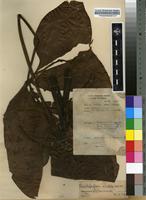
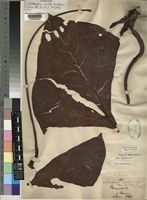
Syntype of Rhektophyllum mirabile N.E.Br. [family ARACEAE]
Cercestis mirabilis (N.E.Br.) Bogner [family ARACEAE]
Syntype of Rhektophyllum mirabile N.E.Br. [family ARACEAE]
Previous
Next

Name

Identification
Rhektophyllum mirabile N.E.Br. [family ARACEAE ] (stored under name); Verified by Daramola, B.O, 1973
Related name
  • Cercestis camerunensis
  • Cercestis mirabilis
  • Rhektophyllum camerunense
  • Nephthytis picturata
  • Rhektophyllum mirabile
Common name
  • ékò (AJC) (NIGERIA, IGBO (Onitsha)), Burkill, H.M. 1985. The useful plants of west tropical Africa, Vol. 1
  • bòù òdù = bush cocoyam (KW) (NIGERIA, IJO-IZON (Kolokuma)), Burkill, H.M. 1985. The useful plants of west tropical Africa, Vol. 1
  • kpakpari (Lowe) (NIGERIA, IGBO), Burkill, H.M. 1985. The useful plants of west tropical Africa, Vol. 1

Flora

Entry for RHEKTOPHYLLUM mirabile N. E. Br. [family ARACEAE]
Herbarium
Royal Botanic Gardens, Kew (K)
Collection
Flora of Tropical Africa
Resource Type
Reference Sources
Entry From
Flora of Tropical Africa, Vol 8, page 137, (1902) Author: (By N. E. Brown.)
Names
RHEKTOPHYLLUM mirabile N. E. Br. [family ARACEAE], in Journ. Bot. 1882, 195, t. 230. —Engl. & Prantl, Pflanzenfam. ii. iii. 128; Engl. Jahrb. xv. 450, and in Mitth. Deutsch. Schutzgeb. ii. 1889, 150; Durand & Schinz, Consp. Fl. Afr. v. 475, and Études Fl. Congo, i. 276; De Wild. & Durand, Contrib. Fl. Congo, i., fasc. 2, 65.
Nephthytis picturata N. E. Br. [family ARACEAE], in Gard. Chron. 1887, i. 476; Durand & Schinz, Études Fl. Congo, i. 277.
Information
Stem about an inch thick, climbing to a height of 30 ft., rooting. Leaves glabrous; petiole 3/4–2 ft. long, terete, grooved at the base in the adult stage, shortly sheathing; blade 6–18 in. long, 5–14 in. broad across the basal lobes, hastate or cordate-hastate, cuspidate-acuminate or shortly and rather abruptly acute, more or less sinuate along the margins, in young plants or young shoots entire, dark green, variegated with whitish between the primary veins in a pattern resembling the tips of a fern frond; in adult plants with large slit-like perforations between the primary veins on each side of the midrib, green, without variegation; front lobe ovate or oblong-ovate; basal lobes broadly rhombic-ovate, or somewhat hatchet-shaped, very obtuse, with a broad, open, very obtuse sinus between them; primary lateral veins 3–4 on each side of the midrib, stout, distant; basal nerve with 2–4 branches, denuded for 1–1 1/2 in. in the sinus. Peduncles terminal, 2–4 together, 1 1/2–2 in. long, stout. Spathe 4 in. long, fleshy, green. Spadix a little shorter than the spathe, about 1/2 in. thick. Berries red, not seen.
Distribution
Niger Upper Guinea Old Calabar, creeping on the ground, and climbing on trees, Monteiro!Congo Lower Guinea cultivated specimens!Congo South Central Monbuttu; in forest at Mbala stream north of the River Kibali, Schweinfurth, 3621 (ex Engler); Bamanga, Laurent (ex. De Wildeman & Durand).Cameroons Upper Guinea Rio del Rey, Johnston, 2! in forest west of Barombi-ba-Mbu, Preuss, 473 (ex Engler), Batanga, Braun (ex Engler).Fernando Po Upper Guinea Barter! Mann, 101!
Notes
A plant of Nephthytis picturata, cultivated at Kew, having developed a climbing habit and put forth the adult form of leaf, demonstrates that it is merely the juvenile state of Rhektophyllum mirabile, which with increasing age loses its remarkable variegation and develops the large slit-like perforations between the lateral veins of the leaves so characteristic of the latter plant.

Related Materials

  • Terms and Conditions
  • Privacy Policy
  • Cookie Policy
  • Cookie Settings
  • Accessibility
  • Help
  • Contact Us
  • Facebook
  • Twitter
ITHAKA

JSTOR is part of ITHAKA, a not-for-profit organization helping the academic community use digital technologies to preserve the scholarly record and to advance research and teaching in sustainable ways.

©2000-2026 ITHAKA. All Rights Reserved. JSTOR®, the JSTOR logo, JPASS®, Aluka®, and ITHAKA® are registered trademarks of ITHAKA.

╳