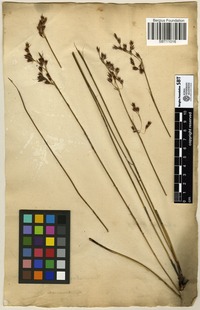
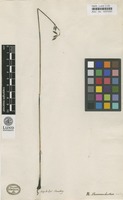
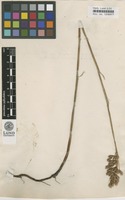
rootstock creeping, densely clad with deep chestnut-brown sheaths; sterile stems 6–8 in. long, much-branched; branchlets fascicled, filiform, purple-spotted; fertile stems 1 1/2–2 ft. high, erect, terete, covered with velvety pubescence, rarely glabrous, unbranched, or sometimes branching, as in the sterile stem; leaf-sheaths about 1–1 1/2 in. long, closely convolute, coriaceous, lanceolate, acute; smaller sheaths with two hyaline, membranous lobes near the apex, and with numerous cilia projecting from the inner surface; apex prolonged into a linear leaf; male spikelets numerous, in erect, loosely branched, panicled cymes 8–9 in. long; branches spreading or deflexed; spathe bract-like, lanceolate, acuminate; spikelets nearly 1/2 in. long, oblong, acute, flattened, sessile, or on a slender pedicel as long as itself; bracts lanceolate, acuminate, subcoriaceous, thinner at the edge; perianth-segments linear-oblong, acute; lateral slightly winged; wing glabrous; anthers apiculate; female plant as in the male; inflorescence less branched; spikelets 5–9 in erect, linear, spicate cymes about 2 1/2 in. long, sessile or pedunculate, erect or appressed, each about 1/2– 3/4 in. long; spathe lanceolate, longer than the spikelet; bracts lanceolate, coriaceous, membranous at the margins; perianth-segments rigid, linear-oblong, acute; outer lateral with a narrow, glabrous wing; ovary ovoid, with a single style. null