JSTOR Global Plants Home
  • Home
  • Browse
  • About
  • Access
  • Account
    • Saved Items
    • Profile
  • Log in

Global Plants

Skip to Main Content
  • JSTOR Global Plants Home
  • Global Plants

    • Browse
    • About
    • Access
    • Account
      • Saved Items
      • Profile
Log in
  • Browse
  • About
  • Access
  • Account
    • Saved Items
    • Profile
Advanced Search

Compilation
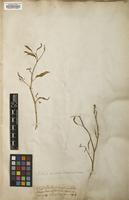
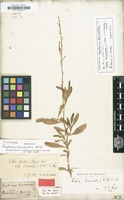
Raphanus lanceolatus

2 Images see all

Filed as Raphanus lanceolatus Willd. [family BRASSICACEAE]
Holotype of Raphanus lanceolatus Willd. [family CRUCIFERAE]
Previous
Next

Name

Identification
Raphanus lanceolatus Willd. [family BRASSICACEAE ] (stored under name); Cakile lanceolata (Willd.) O.E.Schulz [family BRASSICACEAE ] Verified by J.E. Dandy,
Related name
  • Raphanus lanceolatus
  • Cakile lanceolata

Flora

Entry for Cakile lanceolata (Willdenow) O. E. Schulz [family CRUCIFERAE]
Herbarium
Flora of North America (FNA)
Collection
Flora of North America
Resource Type
Reference Sources
Entry From
Flora of North America, Vol 7,
Names
Cakile lanceolata (Willdenow) O. E. Schulz [family CRUCIFERAE], in I. Urban, Symb. Antill., 3: 504. 1903
Raphanus lanceolatus Willdenow [family CRUCIFERAE], Sp. Pl., 3: 562. 1800
Treatment Author(s)
James E. Rodman
Information
Annuals, (usually sprawling). Stems erect to prostrate, (much-branched), often 5+ dm. Cauline leaves (shortly petiolate or sessile); blade broadly ovate to ovate-lanceolate, or (distal) oblanceolate, (not especially fleshy, smaller distally), margins entire, dentate, or pinnatisect. Racemes often 3+ dm; rachis straight. Fruiting pedicels 1.5–4 mm. Flowers: sepals 3.5–5 mm, lateral pair saccate basally; petals usually white, rarely lavender, 4.9–9.4 × 3–4.5 mm, claw distinct. Fruits (weakly 4-angled to terete, striate or sulcate), fusiform or lanceoloid [turbinate], 15–31 × 3–4 mm; proximal segment terete, (5–10 mm); terminal segment slenderly conical, (9–18 mm), apex usually acute. Seeds: cotyledons accumbent or, occasionally, incumbent.
Distribution
s United StatesMexicoWest IndiesCentral America.
Discussion
Subspecies alacranensis is known from the Yucatán Peninsula.

Related Materials

  • Terms and Conditions
  • Privacy Policy
  • Cookie Policy
  • Cookie Settings
  • Accessibility
  • Help
  • Contact Us
  • Facebook
  • Twitter
ITHAKA

JSTOR is part of ITHAKA, a not-for-profit organization helping the academic community use digital technologies to preserve the scholarly record and to advance research and teaching in sustainable ways.

©2000-2026 ITHAKA. All Rights Reserved. JSTOR®, the JSTOR logo, JPASS®, Aluka®, and ITHAKA® are registered trademarks of ITHAKA.

╳