JSTOR Global Plants Home
  • Home
  • Browse
  • About
  • Access
  • Account
    • Saved Items
    • Profile
  • Log in

Global Plants

Skip to Main Content
  • JSTOR Global Plants Home
  • Global Plants

    • Browse
    • About
    • Access
    • Account
      • Saved Items
      • Profile
Log in
  • Browse
  • About
  • Access
  • Account
    • Saved Items
    • Profile
Advanced Search

Compilation
Pteleopsis barbosae

6 Images see all

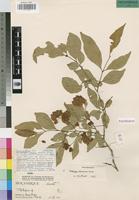
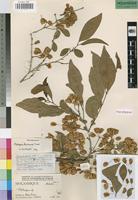
Paratype of Pteleopsis barbosae Exell [family COMBRETACEAE]
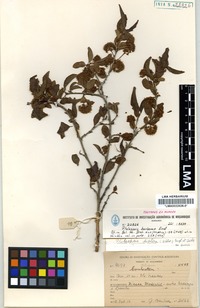
Isotype of Pteleopsis barbosae Exell [family COMBRETACEAE]
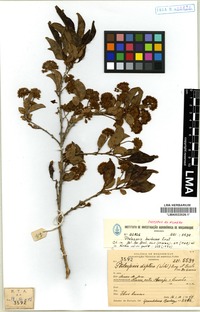
Holotype of Pteleopsis barbosae Exell [family COMBRETACEAE]
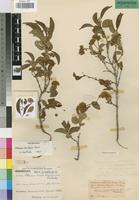
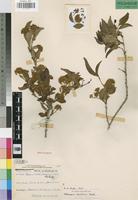
Paratype of Pteleopsis barbosae Exell [family COMBRETACEAE]
Holotype of Pteleopsis barbosae Exell [family COMBRETACEAE]
Previous
Next

Name

Identification
Pteleopsis barbosae Exell [family COMBRETACEAE ] (stored under name); Verified by Exell, A.W., 1967
Related name
  • Pteleopsis barbosae

Flora

Entry for Pteleopsis barbosae Exell [family COMBRETACEAE]
Herbarium
Royal Botanic Gardens, Kew (K)
Collection
Flora Zambesiaca
Resource Type
Reference Sources
Entry From
FZ, Vol 4, Part 0, page 100, (1978) Author: A. W. Exell
Names
Pteleopsis barbosae Exell [family COMBRETACEAE], in Bol. Soc. Brot., Sér. 2, 42: 28 (1968); in Kirkia, 7, 2: 228 (1970).—Faria in Mem. Inst. Invest. Agron. Moçamb. 4: 116 (1973). Type: Mozambique, Mossuril, between Monapa and Lumbo, Barbosa 2466 (LISC, holotype).
Information
Tree up to 10 m. high; branchlets sparsely pilose when young, soon glabrescent. Leaves opposite or subopposite; lamina up to 10 x 3·8 cm., papyraceous with ± translucent dots, elliptic, glabrous except for a few reddish hairs on the midrib beneath, apex blunt and slightly acuminate, base cuneate; lateral nerves 5–8 nerves usually with 2 conspicuous subcircular glands (? extra-floral nectaries) with a central pit situated on or near the 4th or 5th pair of nerves (from the base) c. halfway between the midrib and the margin; petiole 5–7 mm. long, slender. Inflorescences of terminal and axillary subcapitate racemes 2–4 cm. long; rhachis pilose and sericeous-pubescent. Flowers white, hermaphrodite and male in the same inflorescence, pedicellate, sericeous-pubescent. hermaphrodite flowers: lower receptacle c. 3–5 mm. long, sericeous-pubescent; upper receptacle 1·5 x 3 mm., broadly campanulate, sparsely sericeous-pubescent, with a slender stalk-like portion at the base c. 0·5 mm. long; disk pilose; style 3 mm. long. male flowers similar to the hermaphrodite ones but with the ovary not developed and the style vestigial. Fruit (2)3-winged, 1–1·5 x 0·8–1·2 cm., obovate-elliptic in outline, appressed-pubescent, stipe up to 1·2 cm. long, slender, densely appressed-pubescent.
Habitat
Tree or shrub savanna of Acacia spp. and in secondary bush
Range
Unknown elsewhere.
Altitude range
at low altitudes.
800
0
inferred from low
Distribution
Mozambique N Nacala, 15 km. from Nacala Nova towards Nacala Velha, c. 10 m alt., fr. 3.xii.1963, Torre & Paiva 9390 (LISC).
Notes
P. barbosae has rather thin translucent leaves which, when held up to the light and looked at with a lens, show both a translucent reticulation and numerous pin-point translucent dots. P. diptera Engl. & Diels and P. hylodendron Mildbr., both of which have hairy flowers and fruits, differ from P. barbosae in that P. diptera has much thicker opaque leaves and P. hylodendron does not show the gland-dots characteristic of P. barbosae.

Related Materials

  • Terms and Conditions
  • Privacy Policy
  • Cookie Policy
  • Cookie Settings
  • Accessibility
  • Help
  • Contact Us
  • Facebook
  • Twitter
ITHAKA

JSTOR is part of ITHAKA, a not-for-profit organization helping the academic community use digital technologies to preserve the scholarly record and to advance research and teaching in sustainable ways.

©2000-2026 ITHAKA. All Rights Reserved. JSTOR®, the JSTOR logo, JPASS®, Aluka®, and ITHAKA® are registered trademarks of ITHAKA.

╳