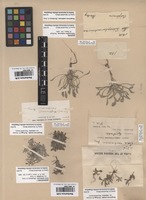
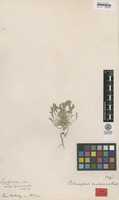
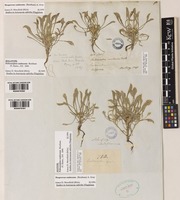
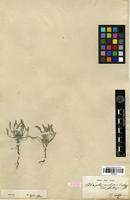
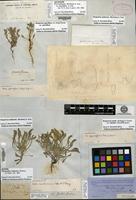
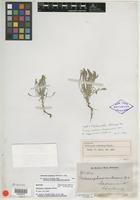
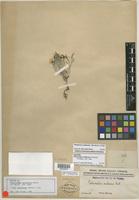
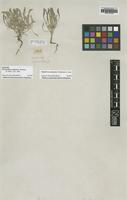
Entry for Hesperevax caulescens (Bentham) A. Gray [family COMPOSITAE]
Entry From
Flora of North America, Vol 19,
Names
Hesperevax caulescens (Bentham) A. Gray [family COMPOSITAE], Proc. Amer. Acad. Arts, 7: 356. 1868
Psilocarphus caulescens Bentham [family COMPOSITAE], Pl. Hartw., 319. 1849
Evax caulescens (Bentham) A. Gray [family COMPOSITAE]
Evax caulescens var. humilis (Greene) Jepson [family COMPOSITAE]
Evax involucrata Greene [family COMPOSITAE]
Discussion
Hesperevax caulescens occurs mainly in the Sacramento and northern San Joaquin valleys, with southern outliers in the southern San Joaquin and upper Salinas River valleys and the Otay Mesa area of San Diego County. The Otay Mesa populations are thought to have been naturalized (R. M. Beauchamp 1986) and are now considered extirpated. An 1869 specimen from northern Oregon is likely either mislabeled or from an introduction that did not persist.
Caulescent forms are scattered among predominantly stemless populations throughout the northern range of Hesperevax caulescens. The tallest forms (Evax involucrata) are often grayer and more densely lanuginose. The various growth forms appear to be environmentally induced and taxonomically insignificant. Plants from the southern outliers are all stemless, tend to be smaller in sizes and numbers of structures, and may warrant varietal status (J. D. Morefield 1992c). A malformed plant from Merced County appears to have been a hybrid between H. caulescens and Psilocarphus oregonus.
Hesperevax caulescens may soon be of conservation concern in California as its vernal pool habitats continue to decline. The vernacular “hogwallow starfish” is widely used for H. caulescens by students and enthusiasts of California’s vernal pools.