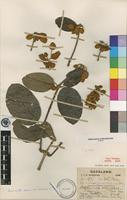
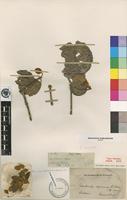
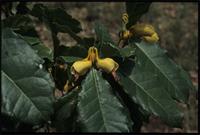
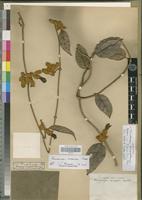
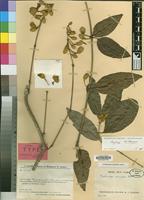
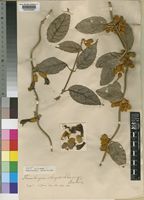
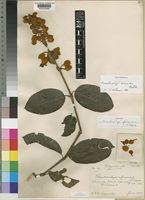
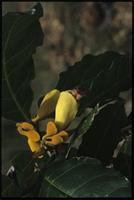
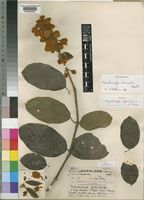
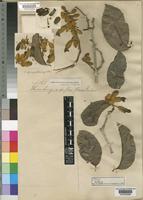
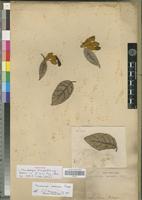
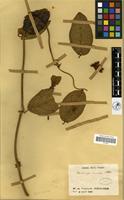
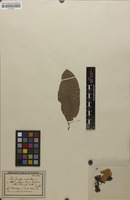
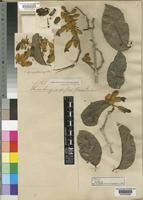
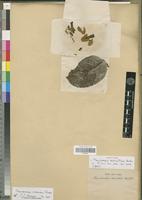
Strong scandent shrub or woody twiner to 15 m or more; young stems terete or quadrangular, densely yellowish to reddish stellate-pubescent, glabrescent. Petiole 0.5–2 cm long, stellate-pubescent; lamina elliptic to obovate, largest 7.5–13≈4–9 cm, apex acute to acuminate or obtuse with a mucronate tip, base cuneate to subcordate, margin entire to crenate-dentate, above subglabrous to stellate-pubescent, densest along midrib, glabrescent, below similar or denser. Flowers solitary or in 2–3-flowered axillary fascicles, often merging towards apex into pseudo-racemes up to 15(–20) cm long with leafy bracts gradually decreasing in size upwards; flowers erect in bud, pendulous when open and becoming erect in fruit; pedicels 0.5–2.7 cm long, densely yellowish to reddish stellate-pubescent, some hairs with a stalk up to 1 mm long and a “crown” of hairs; bracteoles broadly ovate, 1.3–1.8≈1.1–1.7 cm, broadly rounded, densely orange to reddish stellate-pubescent outside, glabrous or with scattered stellate hairs inside. Calyx an undulate rim, ± 2 mm high, densely yellowish stellate-pubescent. Corolla pink to reddish purple, paler on the inside, covered with a dense floccose-stellate yellowish indumentum which rubs off easily; tube 1.4–2 cm long, widening slightly upwards; lobes 5–7≈4–8 mm, broadly ovate-reniform. Anthers 7–8 mm long, with bulbous-based hairs and sessile glands along their whole length. Disc slightly lobed, ± 1 mm high. Ovary ± 5 mm long, densely yellowish stellate-pubescent; style ± 1.5 cm long, glabrous; stigma with 2 equal lobes ± 1 mm long. Capsule broadly triangular in outline, acute, beak not defined, 2.5–3≈1.5–2 cm, when young densely floccose-stellate, glabrescent. Seed dark grey to blackish, finely hairy with simple hairs when young, 6–8 mm in diameter. Fig. 5, p. 25.