JSTOR Global Plants Home
  • Home
  • Browse
  • About
  • Access
  • Account
    • Saved Items
    • Profile
  • Log in

Global Plants

Skip to Main Content
  • JSTOR Global Plants Home
  • Global Plants

    • Browse
    • About
    • Access
    • Account
      • Saved Items
      • Profile
Log in
  • Browse
  • About
  • Access
  • Account
    • Saved Items
    • Profile
Advanced Search

Compilation
Protea leucoblepharis

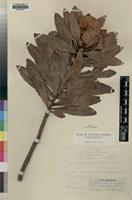
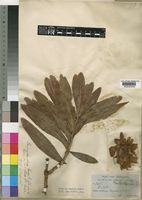
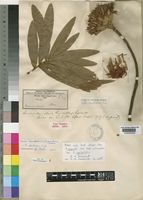
7 Images see all

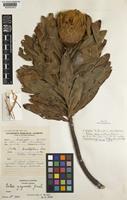
Type of Protea asymmetrica Beard [family PROTEACEAE]
Type of Protea leucoblepharis (Hiern) Baker [family PROTEACEAE]
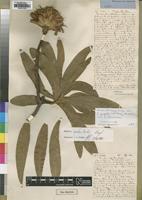
Isotype of Leucadendron leucoblepharum Hiern. [family PROTEACEAE]
Lectotype of Protea leucoblepharis (Hiern) Baker [family PROTEACEAE]
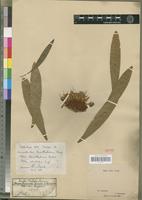
Protea welwitschii Engl. [family PROTEACEAE]
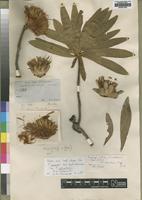
Syntype of Protea leucoblepharis Baker [family PROTEACEAE]
Protea welwitschii Engl. [family PROTEACEAE]
Previous
Next

Name

Identification
Protea leucoblepharis (Hiern) Baker [family PROTEACEAE ] Protea welwitschii Engl. [family PROTEACEAE ] (stored under name);
Related name
  • Protea gaguedi
  • Protea leucoblepharis
  • Protea welwitschii
  • Protea asymmetrica
  • Leucadendron leucoblepharum

Flora

Entry for PROTEA leucoblepharis Baker [family PROTEACEAE]
Herbarium
Royal Botanic Gardens, Kew (K)
Collection
Flora of Tropical Africa
Resource Type
Reference Sources
Entry From
Flora of Tropical Africa, Vol 6, Part 1, page 193, (1913) Author: (By J. G. Baker, with additions by C. H. Wright.)
Names
PROTEA leucoblepharis Baker [family PROTEACEAE]
Leucadendron leucoblepharum Hiern. [family PROTEACEAE], in Cat. Afr. Pl. Welw. i. 919.
Information
A tree 12–15 ft. high. Branches ascending, dusky, glabrate, at first pubescent and leafy at the tip. Leaves oblanceolate or oblong-lanceolate, 5 in. long, 1 in. wide, obtuse, slightly tapering towards the base, straight or slightly curved, hairy on both surfaces, sometimes glabrescent, parchment-like; nerves obvious on both surfaces, marginal ones distinct; midrib whitish-rosy or yellowish (Welwitsch). Heads terminal with one or two lateral, about 2 in. in diam.; outer bracts broadly ovate, gradually becoming larger inwards, densely white-silky on the back, shaggy on the margins; inner bracts spathulate-oblong, 1 1/2 in. long, 4 lin. wide, at first silky on the back, at length glabrescent except at the apex. Perianth about 1 1/2 in. long, rosy, densely shaggy throughout; lobes linear, about 1/2 in. long. Anthers about 1/2 in. long. Style 1 1/2–1 3/4 in. long, white, sulcate along one side, slightly curved below the stigma; stigma 4 lin. long, subclavate at the apex, sometimes gibbous at the base.
Distribution
Angola Lower Guinea Huilla; in the more open of the Monino forests, Welwitsch, 1599! in open mixed forests between Lopollo and the Monino, in company with other forms of this or allied species, Welwitsch, 1601!

Related Materials

  • Terms and Conditions
  • Privacy Policy
  • Cookie Policy
  • Cookie Settings
  • Accessibility
  • Help
  • Contact Us
  • Facebook
  • Twitter
ITHAKA

JSTOR is part of ITHAKA, a not-for-profit organization helping the academic community use digital technologies to preserve the scholarly record and to advance research and teaching in sustainable ways.

©2000-2026 ITHAKA. All Rights Reserved. JSTOR®, the JSTOR logo, JPASS®, Aluka®, and ITHAKA® are registered trademarks of ITHAKA.

╳