JSTOR Global Plants Home
  • Home
  • Browse
  • About
  • Access
  • Account
    • Saved Items
    • Profile
  • Log in

Global Plants

Skip to Main Content
  • JSTOR Global Plants Home
  • Global Plants

    • Browse
    • About
    • Access
    • Account
      • Saved Items
      • Profile
Log in
  • Browse
  • About
  • Access
  • Account
    • Saved Items
    • Profile
Advanced Search

Compilation
Prosartes parvifolia

3 Images see all

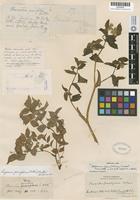
Isotype of Prosartes parvifolia S. Watson [family LILIACEAE]
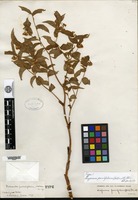
Type of Prosartes parvifolia S. Watson [family LILIACEAE]
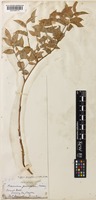
Disporum parvifolium (S.Watson) Britton [family CONVALLARIACEAE]
Previous
Next

Name

Identification
Isotype of Prosartes parvifolia S. Watson [family LILIACEAE ] (stored under name); Verified by Not on sheet,
Related name
  • Prosartes parvifolia
Common name
  • Fairy-bells, Flora of North America Vol. 26

Flora

Entry for Prosartes hookeri Torrey [family ]
Herbarium
Flora of North America (FNA)
Collection
Flora of North America
Resource Type
Reference Sources
Entry From
Flora of North America, Vol 26,
Names
Prosartes hookeri Torrey [family ], Pacif. Railr. Rep., 4(5): 144. 1857
Disporum hookeri (Torrey) G. Nicholson [family CONVALLARIACEAE]
Disporum hookeri var. oblongifolium (S. Watson) Britton [family CONVALLARIACEAE]
Disporum hookeri var. oreganum (S. Watson) Q. Jones [family CONVALLARIACEAE]
Disporum hookeri var. trachyandrum (Torrey) Q. Jones [family CONVALLARIACEAE]
Disporum oreganum (S. Watson) W. T. Miller [family CONVALLARIACEAE]
Disporum parvifolium (S. Watson) Britton [family CONVALLARIACEAE]
Disporum trachyandrum (Torrey) Britton [family CONVALLARIACEAE]
Prosartes oregana S. Watson [family ]
Prosartes parvifolia S. Watson [family ]
Treatment Author(s)
Frederick H. Utech
Information
Plants 3–10 dm, roughly pubescent. Stems sparingly branched. Leaves 3–9(–14) × 1.5–5 cm; blade ovate to lanceolate, rounded to obliquely subcordate, adaxial surface glabrate or sparsely pubescent, abaxial surface scabrous or puberulent especially on veins, margins minutely pubescent to scabrous, hairs pointed sharply forward, apex long-acuminate to acute. Flowers 2–3(–4); perianth turbinate, narrowed basally; tepals spreading, dull or creamy white to greenish white, oblanceolate, 8–18 mm, apex short-acuminate; stamens included or exserted, 8–15 mm; filaments filiform, 6–15 mm; anthers 3–5 mm, glabrous or minutely sharp-bristled; ovary ellipsoid, glabrous or somewhat pubescent, ovules 2 per locule, pendulous; styles glabrous or basal 1/2 pubescent; stigma not lobed or rarely weakly 3-lobed. Berries bright red, 4(–6)-seeded, ovoid to obovoid, beaked with persistent style bases, 8–16 mm. Seeds 5–6 mm. 2n = 18.
Phenology
mar-may (spring), jun-aug (summer)
Altitude range
100–2000 m;
Distribution
USA Calif.USA IdahoUSA Mich.USA Mont.USA Oreg.USA Wash.Canada Alta.Canada B.C.
Discussion
The three geographical races recognized as varieties by Q. Jones (1951), i.e., var. hookeri (coastal California northwards), var. oreganum (northern California north and northwestward), and var. trachyandrum (Sierra Nevada northwest to Oregon), are highly variable and intergrade with respect to their purportedly diagnostic differences in pubescence on the anthers, ovaries, and styles, and in the degree of stamen exsertion. This is especially true in their overlapping ranges in northern California and southern Oregon. Whereas the extremes may be distinctive, overall the varieties so intergrade that they are not here recognized.
From this same area, where the Coastal, Sierra, and Cascade ranges meet, the purported, sterile hybrid Prosartes parvifolia was first reported. The few older collections attributed to P. parvifolia and recent dwarf ones of P. hookeri from this area are similar, especially those from serpentine substrata, and the known variation in P. hookeri unquestionably encompasses the morphology described for P. parvifolia.
The recently discovered population of Prosartes hookeri in the Porcupine Mountains of upper Michigan (E. G. Voss 1972–1985, vol. 1) is a noteworthy disjunction for this otherwise western species.

Related Materials

  • Terms and Conditions
  • Privacy Policy
  • Cookie Policy
  • Cookie Settings
  • Accessibility
  • Help
  • Contact Us
  • Facebook
  • Twitter
ITHAKA

JSTOR is part of ITHAKA, a not-for-profit organization helping the academic community use digital technologies to preserve the scholarly record and to advance research and teaching in sustainable ways.

©2000-2026 ITHAKA. All Rights Reserved. JSTOR®, the JSTOR logo, JPASS®, Aluka®, and ITHAKA® are registered trademarks of ITHAKA.

╳