

Compilation
Pouzolzia erythraeae
2 Images see all
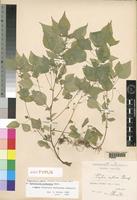
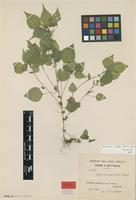
Name
Identification
Didymodoxa caffra (Thunb.) Friis & Wilmot-Dear [family URTICACEAE ] (stored under name); Verified by Data not digitized, Pouzolzia erythraeae Schweinf. [family URTICACEAE ] Verified by Data not digitized,
Related name
- Pouzolzia erythraeae
- Australina caffra
- Didymodoxa caffra
Flora
Entry for Didymodoxa caffra Thunb. Friis & Wilmot-Dear [family URTICACEAE]
Herbarium
Royal Botanic Gardens, Kew (K)
Collection
Flora Zambesiaca
Resource Type
Reference Sources
Entry From
FZ, Vol 9, Part 6, page 79, (1991) Author: I. Friis
Names
Pouzolzia piscicelliana Buscalioni & Muschler [family URTICACEAE], in Engl., Bot. Jahrb. 49: 465 (1913). —Piscicelli, Noll. Rog. Laghi. Equat.: 108 (1913). —Rendle in F.T.A. 6, 2: 294 (1917). —Hauman in F.C.B. 1: 215 (1948). Type: Zambia/Zaire, between Bwana Mkubwa (Buana Mukuba) and Secontwe (Sekontui), 1200 m., 30.i.1910, Hélene d'Aosta 512 (holotype B,†).
Australina caffra Thunb. Prain [family URTICACEAE], in Ann. Bot. 27: 388 (1913). Type as above.
Droguetia umbricola Engl. [family URTICACEAE], in Pflanzenw. Ost-Afr. C: 164 (1895). Type from Tanzania.
Urtica caffra Thunb. [family URTICACEAE], Prodr. Pl. Cap. 1: 31 (1794). Type as above.
Didymodoxa caffra Thunb. Friis & Wilmot-Dear [family URTICACEAE], in Bol. Soc. Brot. ser. 2, 58: 210 (1985). —Friis in F.T.E.A., Urticaceae: 60 (1989). TAB. 34. Type from South Africa (Cape Province).
Pouzolzia erythraeae Schweinf. [family URTICACEAE], in Bull. Herb. Boiss. 4, Appendix 2: 146 (1896). —Rendle in F.T.A. 6, 2: 294 (1917). Type from Ethiopia.
Didymodoxa cuneata Wedd. [family URTICACEAE], in DC., Prodr. 16, 1: 235/62 (1869) nom. illegit, superfl., based on Australina acuminata Wedd.
Didymodoxa acuminata Wedd. Wedd. [family URTICACEAE], in Archiv. Mus. Nat. Hist Nat., Paris 9 (Monogr. Urtic.): 549 (1856). Type as above.
Australina acuminata Wedd. [family URTICACEAE], in Ann. Sci. Nat., Bot. Sér. 4, 1: 212 (1854). —Rendle in F.T.A. 6, 2: 306 (1917). —N.E. Br. in F.C. 5, 2: 555 (1925). —Merxm. in Prodr. Fl. SW. Afr. 17, Urtic.: 2 (1967). —Friis & Jellis in Kew Bull. 39: 600 (1984). Type from S. Africa.
Information
Erect annual herbs to c. 30(80) cm. tall, sometimes branched from the base, sometimes stems or branches rooting at the lower nodes, puberulous. Leaves alternate, lower 1–2 pairs opposite, 2–4(7.5) x 1–2.5(4) cm., ovate; apex long acuminate; base cuneate to rounded; margin crenate; lamina sparsely pilose above, and on the nerves beneath, hairs appressed. Petiole 0.8–4.7 cm. long, puberulous; stipules up to 2–5 mm. long, lanceolate. Inflorescences usually bisexual, consisting of a dense, ebracteate cluster of male flowers in the axil of one stipule and a bracteate cluster of female flowers in the axil of the other stipule; sometimes also a few flowers on a short axillary branch with much reduced leaves, or only female flowers in a cluster in the leaf axil. Bracts narrowly lanceolate, often crowned by bristles. Male perianth c. 1 mm. long, with 2–3 apical bristles. Female flower c. 2 mm. long, stigma c. 1 mm. long, sessile, filiform. Achene ovoid, brownish, c. 2 mm. long.
Habitat
High rainfall woodland, in shade amongst rocks.
Range
south to Namibia, and S. Africa (Transvaal, Natal, Cape Province)
Distribution
Zambia W Zambia/Zaire border, between Bwana Mkubwa (Buana Mukuba) and Secontwe (Sekontui), 1200 m., 30.i.1910, Hélene d'Aosta 512 (B,†); Between Kabwe (Broken Hill) and Bwana Mkubwa, 18.i.1910, Piscicelli s.n., not traced at BOLO and FT.
Distribution (external)
Ethiopia
Kenya
Tanzania
Zaire
Notes
I have found no other specimens of this species from the Flora Zambesiaca area, and it could therefore be argued that the species should not be included in the account, especially because the publication by Buscalioni & Muschler contains species based on notorious falsifications by Muschler who took material from other herbaria, e.g. the herbarium of Schweinfurth, and published this material as if it were collected by the Duchess of Aosta's party. However, the species is badly under-collected in the major pan of its range, and occurs widespread both to the north and the south of the Flora Zambesiaca area. It is therefore very likely that more material will be collected in the Flora Zambesiaca area.