JSTOR Global Plants Home
  • Home
  • Browse
  • About
  • Access
  • Account
    • Saved Items
    • Profile
  • Log in

Global Plants

Skip to Main Content
  • JSTOR Global Plants Home
  • Global Plants

    • Browse
    • About
    • Access
    • Account
      • Saved Items
      • Profile
Log in
  • Browse
  • About
  • Access
  • Account
    • Saved Items
    • Profile
Advanced Search

Compilation
Portulaca tenera

4 Images see all

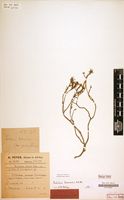
Isotype of Portulaca tenera Peter [family PORTULACACEAE]
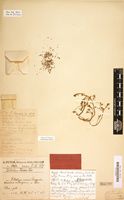
Paratype of Portulaca tenera Peter [family PORTULACACEAE]
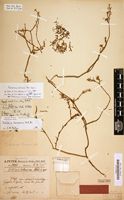
Holotype of Portulaca tenera Peter [family PORTULACACEAE]
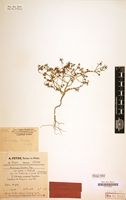
Paratype of Portulaca tenera Peter [family PORTULACACEAE]
Previous
Next

Name

Identification
Portulaca tenera Peter [family PORTULACACEAE ] Verified by Not on sheet., Portulaca kermesina N.E.Br. [family PORTULACACEAE ] (stored under name); Verified by Not on sheet.,
Related name
  • Portulaca kermesina
  • Portulaca tenera

Flora

Entry for PORTULACA kermesina var. kermesina [family PORTULACACEAE]
Herbarium
Royal Botanic Gardens, Kew (K)
Collection
Flora of Tropical East Africa
Resource Type
Reference Sources
Entry From
Flora of Tropical East Africa, page 1, (2002) Author: SYLVIA M. PHILLIPS
Names
PORTULACA kermesina var. kermesina [family PORTULACACEAE]
Portulaca holosericea Peter [family PORTULACACEAE], F.D.-O.A., Descript.: 36, t. 42/1 (1938) & F.D.-O.A.: 271 (1938); Poelln. in F.R. 48: 181 (1940). Types: Tanzania, Lushoto District, Buiko to Manka L., Peter 41045 & near Buiko, Peter 41168 (both B!, syn., K!, photo.)
Portulaca tenera Peter [family PORTULACACEAE], F.D.-O.A., Descript.: 36, t. 39/1 (1938) & F.D.-O.A.: 271 (1938); Poelln. in F.R. 48: 188 (1940). Type: Tanzania, Lushoto District, Umba Steppe, Kigale, Peter 13375 (B!, holo., K!, photo.)
Portulaca rubriflora Poelln. [family PORTULACACEAE], in F.R. 50: 104 (1941). Type: Ethiopia, near Harar or Djebel Hakim, Ellenbeck 940 (B, holo.)
Portulaca sp. B [family PORTULACACEAE], U.K.W.F., ed. 2: 65 (1994)
Information
Nodal axillary hairs conspicuous; petals red, orange-red or rose-pink, 3–8 mm long.
Range
DISTR. U 1, 2; K 1, 2, 4, 7; T 1–3, 7, 8 Eritrea, Ethiopia, Somalia, and southwards to South Africa
Altitude range
0–1300 m
Distribution
KENYA Northern Frontier District Ngurunit, hill N of mission station near E end of Ndoto Mts, 1°45' N 37°20' E, 5 June 1979, Gilbert et al. 5523!;KENYA Teita District Tsavo National Park E, Irima Rock, 6 May 1974, R. B. & A. J. Faden 74/538!KENYA Tana River District Tana River National Primate Reserve, lodge turnoff 0.6 km W, 13 Mar. 1990, Luke et al. TPR 253!TANZANIA Shinyanga District Seseku, 13 June 1931, Burtt 3317!;TANZANIA Mbulu District Tarangire National Park, 14 Feb. 1970, Richards 25414!;TANZANIA Iringa District Ruaha National Park, Msembe, Park headquarters, 16 May 1968, Renvoize & Abdallah 2151!UGANDA Karamoja District Kacheliba, 20 May 1940, Thomas 3400!;UGANDA Toro District Kasenyi, 20 Aug. 1935, Johnston 1076!;
Notes
P. kermesina is a variable species, typically with an erect habit, narrow terete sharply acute leaves, long spreading involucral leaves, bright crimson-red flowers and a metallic-grey seed, but including forms with flowers grading to orange or pink, involucral leaves not much longer than the flower cluster, and silvery seeds. Both flower and seed size are particularly variable, and possibly a complex with differing chromosomal levels is involved. A form from the Kacheliba area has short (7 mm long) narrowly elliptic leaves, rather inconspicuous axillary hairs, and smaller flowers (petals up to 4 mm) than usual e.g. Tweedie 3338 & Mortimer T169 (bothK2); Thomas 3400 (U1). Specimens from coastal sand south of the Tana River approach P. coralloides in their slender habit and high stamen number (15–19) e.g. Graham 1623, Rawlins 185 & 807 (allK7).Specimens have often been misidentified as P. foliosa Ker Gawl., but this has notched petals and a black seed.

Related Materials

  • Terms and Conditions
  • Privacy Policy
  • Cookie Policy
  • Cookie Settings
  • Accessibility
  • Help
  • Contact Us
  • Facebook
  • Twitter
ITHAKA

JSTOR is part of ITHAKA, a not-for-profit organization helping the academic community use digital technologies to preserve the scholarly record and to advance research and teaching in sustainable ways.

©2000-2026 ITHAKA. All Rights Reserved. JSTOR®, the JSTOR logo, JPASS®, Aluka®, and ITHAKA® are registered trademarks of ITHAKA.

╳