JSTOR Global Plants Home
  • Home
  • Browse
  • About
  • Access
  • Account
    • Saved Items
    • Profile
  • Log in

Global Plants

Skip to Main Content
  • JSTOR Global Plants Home
  • Global Plants

    • Browse
    • About
    • Access
    • Account
      • Saved Items
      • Profile
Log in
  • Browse
  • About
  • Access
  • Account
    • Saved Items
    • Profile
Advanced Search

Compilation
Polytrichum alpestre

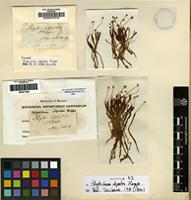
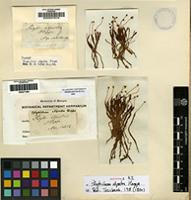
2 Images see all

Isotype of Polytrichum alpestre Hoppe [family POLYTRICHACEAE]
Previous
Next

Name

Identification
Polytrichum alpestre Hoppe [family POLYTRICHACEAE ] Verified by Not on sheet, Polytrichum strictum Brid. [family POLYTRICHACEAE ] (stored under name); Verified by Not on sheet, Isotype of Polytrichum alpestre Hoppe [family POLYTRICHACEAE ] Verified by Not on sheet,
Related name
  • Polytrichum alpestre
  • Polytrichum strictum

Flora

Entry for Polytrichum juniperinum Hedwig [family ]
Herbarium
Flora of North America (FNA)
Collection
Flora of North America
Resource Type
Reference Sources
Entry From
Flora of North America, Vol 27,
Names
Polytrichum juniperinum Hedwig [family ], Sp. Musc. Frond., 89, plate 18, figs. 6–10. 1801,
Polytrichum alpestre Hoppe [family ]
Polytrichum juniperinum var. alpestre (Hoppe) Röhling [family ]
Polytrichum juniperinum var. waghornei Kindberg [family ]
Treatment Author(s)
Gary L. Smith Merrill
Information
Plants small to medium to fairly robust, gray-green to bluish green to reddish brown with age, in loose tufts, often forming extensive patches. Stems (1–)4–5(–10) cm, simple, brownish tomentose only near the base. Leaves 3–6(–8) mm, densely imbricate, ± erect and almost straight when dry, erect-spreading to widely spreading when moist; sheath oblong-rectangular, yellowish, tapering to the blade; blade slender, bluish green and nitid, rather flat, with sharply infolded margins; marginal lamina 5–7 cells wide, 1-stratose, entire or minutely crenulate, membranous and transparent, enclosing the lamellae and overlapping towards the apex; costa usually somewhat toothed distally, excurrent, forming a subulate, toothed awn, the awn reddish brown throughout or slightly decolorate at tip; lamellae bluntly crenate in profile, 6–8 cells high, the marginal cells in cross-section ovate to pyriform, thick-walled, ending in a distinct knob, smooth or rarely faintly papillose, the marginal cells of lateral lamellae (enclosed by the overlapping margins) ovoid and less strongly thickened; sheath cells 70–100 × 6–10 µm, narrowly rectangular (4–6:1), narrower toward the margin; cells of the broad marginal lamina transversely elongate, very thick-walled. Sexual condition dioicous; perigonial rosettes yellowish to reddish green; perichaetial leaves longer than the foliage leaves, long-sheathing, the blade almost obsolete, ending in a slender yellowish or hyaline awn. Seta (1–)3–5 cm, stout, yellowish to reddish brown. Capsule 2.5–5 mm, rectangular, longer than wide (1.5–2:1), reddish brown to dark brown, glaucous when fresh, suberect, becoming horizontal when mature, sharply 4-angled and prismatic; peristome 200–240 µm, divided to 0.6–0.8, the teeth 64, keeled at back. Calyptra whitish to light brown, covering the capsule. Spores 6–10(–12) µm.
Altitude range
low to high elevations;
Distribution
GreenlandN. Mex.MexicoWest IndiesCentral Americas South AmericaEuropen, c AsiaAtlantic Islands (Macaronesia)AustraliaAntarctica.USA Ala.USA AlaskaUSA Ariz.USA Ark.USA Calif.USA Colo.USA Conn.USA Del.USA Ga.USA IdahoUSA Ill.USA Ind.USA IowaUSA Kans.USA Ky.USA MaineUSA Md.USA Mass.USA Mich.USA Minn.USA Mo.USA Mont.USA Nebr.USA Nev.USA N.H.USA N.J.USA N.Y.USA N.C.USA OhioUSA Okla.USA Oreg.USA Pa.USA R.I.USA S.C.USA S.Dak.USA Tenn.USA UtahUSA Vt.USA Va.USA Wash.USA W.Va.USA Wis.USA Wyo.USA Pacific Islands (New Zealand)Canada Alta.Canada B.C.Canada Man.Canada N.B.Canada Nfld. and Labr.Canada N.W.T.Canada N.S.Canada NunavutCanada Ont.Canada P.E.I.Canada Que.Canada Yukon
Discussion
Polytrichum juniperinum occurs on a variety of substrates, but primarily in dryer situations than P. commune or P. strictum. It often forms extensive pure stands of a distinctive pale bluish green color from the reflection of light off the thin, membranous margins of the leaves. The narrow leaf blades are widely spreading and have short, reddish awns. Polytrichum juniperinum is common and generally distributed throughout continental North America. In the high Arctic, however, the species is rare and many older reports of it actually pertain to 5. P. hyperboreum (D. G. Long 1985).

Related Materials

  • Terms and Conditions
  • Privacy Policy
  • Cookie Policy
  • Cookie Settings
  • Accessibility
  • Help
  • Contact Us
  • Facebook
  • Twitter
ITHAKA

JSTOR is part of ITHAKA, a not-for-profit organization helping the academic community use digital technologies to preserve the scholarly record and to advance research and teaching in sustainable ways.

©2000-2026 ITHAKA. All Rights Reserved. JSTOR®, the JSTOR logo, JPASS®, Aluka®, and ITHAKA® are registered trademarks of ITHAKA.

╳