JSTOR Global Plants Home
  • Home
  • Browse
  • About
  • Access
  • Account
    • Saved Items
    • Profile
  • Log in

Global Plants

Skip to Main Content
  • JSTOR Global Plants Home
  • Global Plants

    • Browse
    • About
    • Access
    • Account
      • Saved Items
      • Profile
Log in
  • Browse
  • About
  • Access
  • Account
    • Saved Items
    • Profile
Advanced Search

Compilation
Polystachya armeniaca

2 Images see all

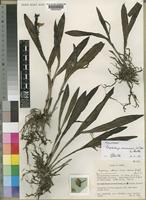
Holotype of Polystachya armeniaca la Croix & P.J.Cribb [family ORCHIDACEAE]
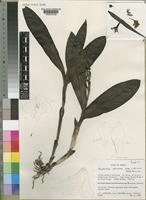
Polystachya armeniaca la Croix & P.J.Cribb [family ORCHIDACEAE]
Previous
Next

Name

Identification
Polystachya armeniaca la Croix & P.J.Cribb [family ORCHIDACEAE ] (stored under name); Verified by Cribb, P.J., Polystachya albescens Ridl. [family ORCHIDACEAE ]
Related name
  • Polystachya armeniaca
  • Polystachya caloglossa
  • Polystachya albescens

Flora

Entry for Polystachya armeniaca la Croix & P.J. Cribb [family ORCHIDACEAE]
Herbarium
Royal Botanic Gardens, Kew (K)
Collection
Flora Zambesiaca
Resource Type
Reference Sources
Entry From
FZ, Vol 11, Part 2, (1998) Author: I. la Croix & P.J. Cribb
Names
Polystachya armeniaca la Croix & P.J. Cribb [family ORCHIDACEAE], in Kew Bull. 51: 573 (1996). TAB. 109. Type: Zambia, Mwinilunga, West Lunga R., 23.i.1975, Brummitt, Chisumpa & Polhill 14019 (K, holotype; NDO; SRGH).
Polystachya laxiflora [family ORCHIDACEAE], sensu Williamson, Orch. S. Centr. Africa: 117, pl. 95 (1977). —sensu Geerinck in Fl. Afr. Centr., Orchidaceae pt. 2: 415 (1992), non Lindl.
Information
Erect, epiphytic herb up to c. 40 cm tall.Stems clustered on a short rhizome, cylindrical, not swollen at the base, 2–3 mm in diameter, 2–3-leaved.Roots c. 1 mm in diameter.Leaves suberect, 5.5–21 × 1.8–4.2 cm, narrowly lanceolate, acute, articulated to sheathing leaf bases.Inflorescence (floral axis) shorter than the leaves, simple or with a few short branches up to 2.5 cm long; peduncle glabrous, covered with a few loose sheaths; rhachis glabrous; bracts 2–3.5 mm long, glabrous.Flowers orange, yellow or cream-coloured, the lip slightly darker, with an orange callus, the side lobes with reddish veins.Pedicel and ovary 5–10 mm long, glabrous.Dorsal sepal 11 × 3.2–5 mm, ovate; lateral sepals 13–14 × 8–9 mm, obliquely ovate, forming with the column foot a distinct, obliquely conical mentum.Petals 9–11 × 3.5–4.5 mm, oblanceolate.Lip 3-lobed in the middle, 11 × 10 mm, with some clavate hairs on the inner surface; mid-lobe ovate, 6 × 5 mm long; side lobes rounded; callus a longitudinal ridge from the base of the lip to the base of the mid-lobe.Column short, whitish with a red spot on the anther.Capsule c. 3 cm long.
Habitat
Epiphytic in dense riverine forest and evergreen forest
Altitude range
1200–1400 m.
1400
1200
Distribution
Zambia W Mwinilunga Distr., West Lunga R., 8 km north of Mwinilunga, 1300 m, fl. 23.i.1975, Brummitt, Chisumpa & Polhill 14019 (K; NDO; SRGH); Matonchi R., near Matonchi Farm, fl. 15.x.1937, Milne-Redhead 2786 (K).
Distribution (external)
Zaire
Notes
This species is related to P. laxiflora Lindl., in sect. Caulescentes, but differs in having a shorter, glabrous, simple or only shortly branched inflorescence (floral axis), always shorter than the leaves. The flowers are glabrous, orange or cream-coloured, similar in colour to those of P. laxiflora but are much larger, with the lateral sepals almost twice as long as those of P. laxiflora.

Related Materials

  • Terms and Conditions
  • Privacy Policy
  • Cookie Policy
  • Cookie Settings
  • Accessibility
  • Help
  • Contact Us
  • Facebook
  • Twitter
ITHAKA

JSTOR is part of ITHAKA, a not-for-profit organization helping the academic community use digital technologies to preserve the scholarly record and to advance research and teaching in sustainable ways.

©2000-2026 ITHAKA. All Rights Reserved. JSTOR®, the JSTOR logo, JPASS®, Aluka®, and ITHAKA® are registered trademarks of ITHAKA.

╳