JSTOR Global Plants Home
  • Home
  • Browse
  • About
  • Access
  • Account
    • Saved Items
    • Profile
  • Log in

Global Plants

Skip to Main Content
  • JSTOR Global Plants Home
  • Global Plants

    • Browse
    • About
    • Access
    • Account
      • Saved Items
      • Profile
Log in
  • Browse
  • About
  • Access
  • Account
    • Saved Items
    • Profile
Advanced Search

Compilation
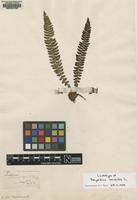
Polypodium lonchitis

5 Images see all

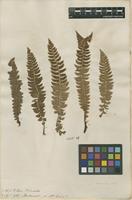
Filed as Polypodium lonchitis L. [family POLYPODIACEAE]
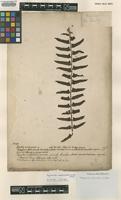
Lectotype of Polypodium lonchitis L. [family DRYOPTERIDACEAE]
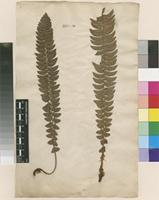
Original material of Polypodium lonchitis L. [family DRYOPTERIDACEAE]
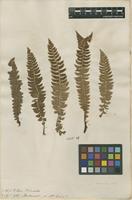
Filed as Polypodium lonchitis L. [family POLYPODIACEAE]
Previous
Next

Name

Identification
Polypodium lonchitis L. [family DRYOPTERIDACEAE ] (stored under name); Polystichum auriculatum (L.) C.Presl [family DRYOPTERIDACEAE ] Polystichum acrostichoides (Michx.) Schott [family DRYOPTERIDACEAE ] Verified by A. M. Paul,
Related name
  • Polystichum auriculatum
  • Polypodium lonchitis
  • Polystichum acrostichoides
Common name
  • polystic faux-lonchitis, Flora of North America Vol. 2
  • Holly fern, Flora of North America Vol. 2

Flora

Entry for Polystichum lonchitis (Linnaeus) Roth [family DRYOPTERIDACEAE]
Herbarium
Flora of North America (FNA)
Collection
Flora of North America
Resource Type
Reference Sources
Entry From
Flora of North America, Vol 2,
Names
Polystichum lonchitis (Linnaeus) Roth [family DRYOPTERIDACEAE], Tent. Fl. Germ., 3(1): 71. 1799
Polypodium lonchitis Linnaeus [family POLYPODIACEAE], Sp. Pl., 2: 1088. 1753
Treatment Author(s)
David H. Wagner
Information
Stems erect to occasionally ascending. Leaves erect, not arching except at tip, 1--6 dm; bulblets absent. Petiole 1/10--1/6 of blade, densely scaly; scales light brown, gradually diminishing in size distally. Blade linear, often widest above middle, 1-pinnate, base narrowed. Pinnae oblong to lanceolate to falcate, proximal pinnae ± deltate, rarely overlapping, in 1 plane, 0.5--3 cm, base truncate to oblique, acroscopic auricle well developed; margins serrulate-spiny with teeth spreading; apex acute, subapical tooth hardly smaller than apical tooth; microscales dense, on abaxial surface only. Indusia entire or minutely dentate-erose. Spores dark brown. 2 n = 82.
Altitude range
0--3200 m
Distribution
GreenlandUSA AlaskaUSA Ariz.USA Calif.USA Colo.USA IdahoUSA Mich.USA Minn.USA Mont.USA Nev.USA Oreg.USA UtahUSA Wash.USA Wis.USA Wyo.Canada Alta.Canada B.C.Canada Nfld.Canada N.S.Canada Ont.Canada Que.Canada Yukon
Discussion
The hybrid between Polystichum lonchitis and P . acrostichoides (= P . × hagenahii Cody) is discussed under P . acrostichoides . The hybrid with P . braunii (= P . × meyeri Sleep & Reichstein) is discussed under P . braunii . In the Georgian Bay area of Ontario, P . lonchitis hybridizes with Dryopteris goldiana to produce the peculiar × Dryostichum singulare W. H. Wagner (W. H. Wagner Jr., F. S. Wagner et al. 1992).
The spiny spores of P . lonchitis are distinctive and distinguish this from dwarfed forms of other 1-pinnate species.

Related Materials

  • Terms and Conditions
  • Privacy Policy
  • Cookie Policy
  • Cookie Settings
  • Accessibility
  • Help
  • Contact Us
  • Facebook
  • Twitter
ITHAKA

JSTOR is part of ITHAKA, a not-for-profit organization helping the academic community use digital technologies to preserve the scholarly record and to advance research and teaching in sustainable ways.

©2000-2026 ITHAKA. All Rights Reserved. JSTOR®, the JSTOR logo, JPASS®, Aluka®, and ITHAKA® are registered trademarks of ITHAKA.

╳