JSTOR Global Plants Home
  • Home
  • Browse
  • About
  • Access
  • Account
    • Saved Items
    • Profile
  • Log in

Global Plants

Skip to Main Content
  • JSTOR Global Plants Home
  • Global Plants

    • Browse
    • About
    • Access
    • Account
      • Saved Items
      • Profile
Log in
  • Browse
  • About
  • Access
  • Account
    • Saved Items
    • Profile
Advanced Search

Compilation
Polypodium appalachianum

8 Images see all

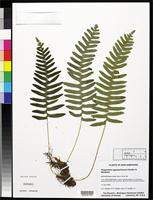
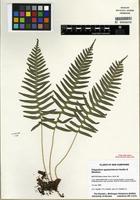
Isotype of Polypodium appalachianum Haufler, C.H. & Windham, M. 1991 [family POLYPODIACEAE]
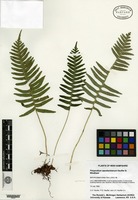
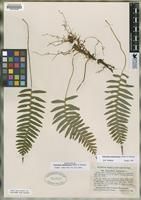
Isotype of Polypodium appalachianum Haufler & Windham [family POLYPODIACEAE]
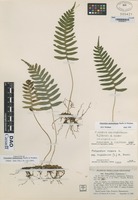
Paratype of Polypodium appalachianum Haufler & Windham [family POLYPODIACEAE]
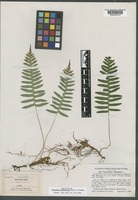
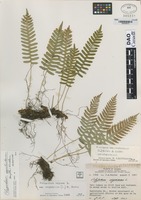
Isotype of Polypodium appalachianum Haufler & Windham [family POLYPODIACEAE]
Paratype of Polypodium appalachianum Haufler & Windham [family POLYPODIACEAE]
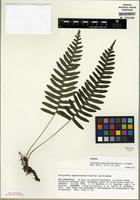
Isotype of Polypodium appalachianum Haufler & Windham [family POLYPODIACEAE]
Previous
Next

Name

Identification
Isotype of Polypodium appalachianum Haufler & Windham [family POLYPODIACEAE ] (stored under name); Verified by Not on sheet,
Related name
  • Polypodium appalachianum
Common name
  • polypode des Appalaches, Flora of North America Vol. 2
  • Appalachian polypody, Flora of North America Vol. 2

Flora

Entry for Polypodium appalachianum Haufler & Windham [family POLYPODIACEAE]
Herbarium
Flora of North America (FNA)
Collection
Flora of North America
Resource Type
Reference Sources
Entry From
Flora of North America, Vol 2,
Names
Polypodium appalachianum Haufler & Windham [family POLYPODIACEAE], Amer. Fern J., 81: 18. 1991
Treatment Author(s)
Christopher H. Haufler
Michael D. Windham
Frank A. Lang
S. A. Whitmore
Information
Stems often whitish pruinose, slender, to 6 mm diam., acrid-tasting; scales concolored to weakly bicolored, uniformly golden brown or slightly darker near apex, lanceolate, contorted distally, margins denticulate. Leaves to 40 cm. Petiole slender, ± 1.5 mm diam. Blade elongate-deltate, rarely oblong, pinnatifid, usually widest at or near base, to 9 cm wide, herbaceous to somewhat leathery; rachis sparsely scaly to glabrescent abaxially, glabrous adaxially; scales lanceolate-ovate, usually more than 6 cells wide. Segments linear to oblong, less than 8 mm wide, margins entire to crenulate; apex acute to narrowly rounded; midrib glabrous adaxially. Venation free. Sori midway between margin and midrib to nearly marginal, less than 3 mm diam., circular when immature. Sporangiasters present, usually more than 40 per sorus, heads densely covered with glandular hairs. Spores less than 52 µm, verrucose, projections less than 3 µm tall. 2 n = 74.
Phenology
Sporulating summer--fall
Altitude range
0--1800 m
Distribution
USA Ala.USA Conn.USA Del.USA D.C.USA Ga.USA Ky.USA MaineUSA Md.USA Mass.USA N.H.USA N.J.USA N.Y.USA N.C.USA OhioUSA Pa.USA R.I.USA S.C.USA Tenn.USA Vt.USA Va.USA W.Va.Canada N.B.Canada Nfld.Canada N.S.Canada Ont.Canada P.E.I.Canada Que.
Discussion
Polypodium appalachianum is a newly recognized species traditionally identified as the diploid cytotype of P . virginianum (A. M. Evans 1971; I. Manton and M. Shivas 1953). Because the tetraploid cytotype is an allopolyploid (C. H. Haufler and Wang Z. R. 1991), and the type specimen of P . virginianum is tetraploid (R. Cranfill and D. M. Britton 1983), the diploid is recognized here as a distinct species, P . appalachianum . Some collections of P . appalachianum can be difficult to distinguish from P . virginianum , but the latter species has spores averaging more than 52 µm, and P . appalachianum has spores less than 52 µm. Frequent hybridization between P . appalachianum and P . virginianum forms morphologically intermediate, triploid individuals with misshapen spores. Particularly confusing is the frequent occurrence of the triploid sympatric with only one parent or with neither parent nearby.

Related Materials

  • Terms and Conditions
  • Privacy Policy
  • Cookie Policy
  • Cookie Settings
  • Accessibility
  • Help
  • Contact Us
  • Facebook
  • Twitter
ITHAKA

JSTOR is part of ITHAKA, a not-for-profit organization helping the academic community use digital technologies to preserve the scholarly record and to advance research and teaching in sustainable ways.

©2000-2026 ITHAKA. All Rights Reserved. JSTOR®, the JSTOR logo, JPASS®, Aluka®, and ITHAKA® are registered trademarks of ITHAKA.

╳