

Compilation
Polygonum microspermum
2 Images see all
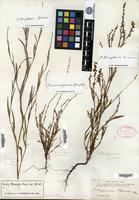
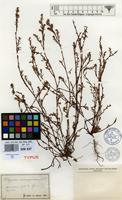
Name
Identification
Polygonum microspermum Jord. ex Boreau [family POLYGONACEAE ] Verified by Not on sheet, Polygonum aviculare L. [family POLYGONACEAE ] (stored under name); Verified by Not on sheet,
Related name
- Polygonum tenue
- Polygonum aviculare
- Polygonum microspermum
- Polygonum engelmannii
Common name
- Common or oval-leaf knotweed, Flora of North America Vol. 5
- renouée à petits fruits, Flora of North America Vol. 5
Flora
Entry for Polygonum aviculare Linnaeus subsp. depressum (Meisner) Arcangeli [family POLYGONACEAE]
Herbarium
Flora of North America (FNA)
Collection
Flora of North America
Resource Type
Reference Sources
Entry From
Flora of North America, Vol 5,
Names
Polygonum aviculare Linnaeus subsp. depressum (Meisner) Arcangeli [family POLYGONACEAE], Comp. Fl. Ital., 583. 1882
Polygonum aviculare var. depressum Meisner [family POLYGONACEAE], in A. P. de Candolle and A. L. P. P. de Candolle, Prodr., 14: 98. 1856
Polygonum aequale Lindman [family POLYGONACEAE]
Polygonum arenastrum Boreau [family POLYGONACEAE]
Polygonum aviculare subsp. aequale (Lindman) Ascherson & Graebner [family POLYGONACEAE]
Polygonum aviculare subsp. calcatum (Lindman) Thellung [family POLYGONACEAE]
Polygonum aviculare subsp. microspermum (Jordan ex Boreau) Berher [family POLYGONACEAE]
Polygonum calcatum Lindman [family POLYGONACEAE]
Polygonum microspermum Jordan ex Boreau [family POLYGONACEAE]
Polygonum montereyense Brenckle [family POLYGONACEAE]
Treatment Author(s)
Mihai Costea
François J. Tardif
Harold R. Hinds†
Information
Plants green, homophyllous or subheterophyllous. Stems 3–15, prostrate to ascending, mat-forming, branched at most nodes, proximal branches divaricate, (5–)10–50(–100) cm. Leaves: ocrea with proximal part cylindric to funnelform, either short, 3–5.5 mm, with distal part soon disintegrating and leaving almost no fibrous remains, or long, 7–12 mm, with distal part with veins inconspicuous, membranous, margins ± lacerate, overlapping towards apices of stems and branches; petiole 0.5–3 mm; blade green, lateral veins visible but not raised abaxially, elliptic to narrowly elliptic or oblanceolate, (6.2–)8–27(–35) × (1.4–)2–7(–10) mm, 2.8–5.7(–6.5) times as long as wide, apex obtuse or acute, rarely longitudinally striate; stem leaves 1–2.3(–3.4) times as long as branch leaves. Cymes uniformly distributed or, sometimes, crowded at tips of branches, 2–7-flowered. Pedicels enclosed in ocreae, 1–2.5 mm. Flowers: perianth (1.8–)2–3.4(–4) mm, 1.5–2.9 times as long as wide; tube 40–57% of perianth length; tepals overlapping but spreading slightly in fruit, green or reddish brown with white margins, oblong, flat or obscurely cucullate in fruit, outer tepals not pouched at base; midveins unbranched, thin to moderately thickened; stamens 5–7. Achenes usually slightly exserted from perianth, dark brown, ovate, (2–)3-gonous, 1.5–2.7(–3) mm, faces evidently unequal, flat to concave, apex straight or slightly bent toward narrow face, almost smooth, roughened, or coarsely striate-tubercled; late-season achenes common, 2.5–4.5 mm. 2n = 40, 60.
Phenology
may (spring), jun-aug (summer), sep-nov (fall)
Altitude range
0–2500 m;
Distribution
Europe.USA Ala.USA AlaskaUSA Ariz.USA Ark.USA Calif.USA Colo.USA Conn.USA Del.USA Fla.USA Ga.USA IdahoUSA Ill.USA Ind.USA IowaUSA Kans.USA Ky.USA La.USA MaineUSA Md.USA Mass.USA Mich.USA Minn.USA Mo.USA Mont.USA Nebr.USA Nev.USA N.H.USA N.J.USA N.Mex.USA N.Y.USA N.C.USA N.Dak.USA OhioUSA Okla.USA Oreg.USA Pa.USA R.I.USA S.C.USA S.Dak.USA Tenn.USA Tex.USA UtahUSA Vt.USA Va.USA Wash.USA W.Va.USA Wis.USA Wyo.Canada Alta.Canada B.C.Canada Man.Canada N.B.Canada Nfld. and Labr.Canada N.W.T.Canada N.S.Canada Ont.Canada P.E.I.Canada Que.Canada Sask.
Discussion
Polygonum montereyense is a distinctive morphotype that may deserve infraspecific recognition. Plants referable to it have ocreae 8–13 mm, with distal parts silvery, persistent, entire or slightly lacerate, overlapping, and few-veined. Apparently, this type is restricted to California. Plants referable to P. arenastrum in the narrow sense are the most commonly encountered form of the subspecies in North America.
Subspecies depressum has been reported from Greenland and St. Pierre and Miquelon; those reports have not been confirmed.
Native/Introduced
introduced;