JSTOR Global Plants Home
  • Home
  • Browse
  • About
  • Access
  • Account
    • Saved Items
    • Profile
  • Log in

Global Plants

Skip to Main Content
  • JSTOR Global Plants Home
  • Global Plants

    • Browse
    • About
    • Access
    • Account
      • Saved Items
      • Profile
Log in
  • Browse
  • About
  • Access
  • Account
    • Saved Items
    • Profile
Advanced Search

Compilation
Polygonum limbatum

3 Images see all

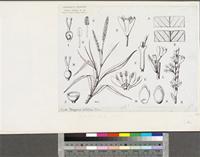
Polygonum limbatum Meisn.; original illustration from FWTA
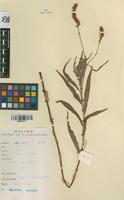
Filed as Polygonum limbatum Meisn. [family POLYGONACEAE]
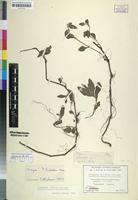
Holotype of Polygonum piliferum Tikovsky [family POLYGONACEAE]
Previous
Next

Name

Identification
Polygonum limbatum Meisn. [family POLYGONACEAE ]
Related name
  • Polygonum limbatum
Common name
  • bìì-dà-rúwá (JMD) (NIGERIA, HAUSA), Burkill, H.M. 1985. The useful plants of west tropical Africa, Vol. 4

Flora

Entry for Polygonum limbatum Meisn. [family POLYGONACEAE]
Herbarium
Royal Botanic Gardens, Kew (K)
Collection
Flora of Tropical East Africa
Resource Type
Reference Sources
Entry From
Flora of Tropical East Africa, page 1, (1958) Author: R. A. GRAHAM
Names
Polygonum limbatum Meisn. [family POLYGONACEAE], in DC, Prodr. 14: 123 (1856); F.T.A. 6 (1): 108 (1909); F.C.B. 1: 414 (1948); F.W.T.A., ed. 2, 1: 140, fig. 51 (1954). Types:? Senegal River, Lelièvre (B, syn. †) & Nile Delta, Ehrenberg (B, syn. †)
Information
An erect perennial herb. Stems branched, green or red, basally decumbent and rooting at the nodes, usually with ascending, appressed hairs in the upper parts, or more rarely ± glabrous throughout or thickly covered with long white hairs. Ocreae glabrous to hispid, membranous, brown, terminating in a spreading, green, foliaceous, undulating limb, 1–9 mm. broad, with a ciliate margin. Leaves sessile or subsessile, variable in shape but often narrow-lanceolate, sometimes dotted with glands, 8–11 (–15) × 0.8–1.8 (–3.5) cm., apically acute, narrowed to the base, sometimes crisped on the margins, usually pubescent, sometimes covered with silky hairs on both faces. Inflorescence a dense raceme, 2–6 cm. long, on long, pubescent peduncles arising in pairs from the uppermost ocreae (singly fide Meisn.). Bracts, at least the lower ones, usually pubescent with ciliate margins and a terminal fringe of cilia, but varying from glabrous and terminally non-ciliate to densely hirsute with long, silky hairs. Perianth pink 3.5–4.5 mm. Tepals 5, ovate-oblong, 2.5–3 mm. long. Styles 2, connate for approximately half their length. Nut ± rounded in outline, 2.5 × 2.5 mm., dark red-brown to black, shining, biconvex-lenticular. Fig. 4/7, p. 23.
Range
DISTR. U3; T2, 7–8 from Egypt to Rhodesia; and west from northern Nigeria to Senegal; also in tropical Asia
Altitude range
1000–1500 m.
Distribution
TANGANYIKA Moshi District Boloti swamp, Aug. 1928, Haarer 1473!;TANGANYIKA Iringa District Little Ruaha River, Mar. 1932, Lynes P.r .63!;TANGANYIKA Njombe District R. Ruhudje, near Lupembe, May 1931, Schlieben 827!UGANDA Teso District Soroti, Sept. 1954, Lind 330!
Notes
VARIATION. From the scanty East African material available for consultation it appears that this species is very variable in the degree and nature of hairiness. In Haarer 1473, the leaves and bracts are covered with silky, white hairs, those on the stem and ocreae being very thick, 3–4 mm. long and spreading at 45°. In Lind 330, the ocreae have a thick covering of brown hairs, 2–3 mm. long and spreading at all angles, while the leaves are closely covered throughout with very short setae, and the bracts with stiff bristles. The more usual form appears to be that with thinly pubescent leaves with stiffer hairs on the midribs, but until further material is available it is difficult to dogmatize. It is possible that Haarer 1471 and Lind 330 represent different taxa. P. schinzii C. H. Wright (in K.B. 1909: 187 (1909). Type: South West Africa, Amboland, Schinz 499 (K, holo.!)) non Schuster is a thinly hairy plant with crisped leaf margins apparently closely allied to P. limbatum, and perhaps conspecific with it, but for the reason set out in the foregoing paragraph it is considered that the matter is too uncertain at the moment to justify synonymy.

Related Materials

  • Terms and Conditions
  • Privacy Policy
  • Cookie Policy
  • Cookie Settings
  • Accessibility
  • Help
  • Contact Us
  • Facebook
  • Twitter
ITHAKA

JSTOR is part of ITHAKA, a not-for-profit organization helping the academic community use digital technologies to preserve the scholarly record and to advance research and teaching in sustainable ways.

©2000-2026 ITHAKA. All Rights Reserved. JSTOR®, the JSTOR logo, JPASS®, Aluka®, and ITHAKA® are registered trademarks of ITHAKA.

╳