JSTOR Global Plants Home
  • Home
  • Browse
  • About
  • Access
  • Account
    • Saved Items
    • Profile
  • Log in

Global Plants

Skip to Main Content
  • JSTOR Global Plants Home
  • Global Plants

    • Browse
    • About
    • Access
    • Account
      • Saved Items
      • Profile
Log in
  • Browse
  • About
  • Access
  • Account
    • Saved Items
    • Profile
Advanced Search

Compilation
Polygonum fusiforme

6 Images see all

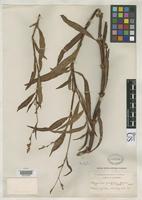
Polygonum fusiforme Greene [family POLYGONACEAE]
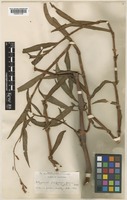
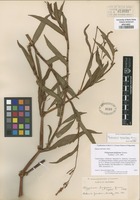
Isotype of Polygonum fusiforme Greene [family POLYGONACEAE]
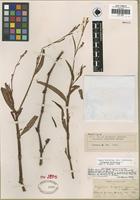
Original material of Polygonum fusiforme Greene [family POLYGONACEAE]
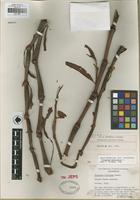
Isolectotype of Polygonum fusiforme Greene, E.L. 1893 [family POLYGONACEAE]
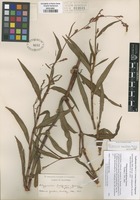
Original material of Polygonum fusiforme Greene [family POLYGONACEAE]
Isotype of Polygonum fusiforme Greene [family POLYGONACEAE]
Previous
Next

Name

Identification
Isotype of Polygonum fusiforme Greene [family POLYGONACEAE ] (stored under name); Verified by Robbins, G. Thomas, 1952 Polygonum persicaria L. [family POLYGONACEAE ] Verified by Hickman, James C., 1989
Related name
  • Polygonum persicaria
  • Polygonum fusiforme
Common name
  • Spotted lady’s-thumb, Flora of North America Vol. 5
  • redshank, Flora of North America Vol. 5
  • renouée persicaire, Flora of North America Vol. 5

Flora

Entry for Persicaria maculosa Gray [family POLYGONACEAE]
Herbarium
Flora of North America (FNA)
Collection
Flora of North America
Resource Type
Reference Sources
Entry From
Flora of North America, Vol 5,
Names
Persicaria maculosa Gray [family POLYGONACEAE], Nat. Arr. Brit. Pl., 2: 269. 1821
Polygonum persicaria Linnaeus [family POLYGONACEAE], Sp. Pl., 1: 361. 1753
Persicaria fusiformis (Greene) Greene [family POLYGONACEAE]
Persicaria vulgaris Webb & Moquin-Tandon [family POLYGONACEAE]
Polygonum fusiforme Greene [family POLYGONACEAE]
Polygonum persicaria var. ruderale (Salisbury) Meisner [family POLYGONACEAE]
Polygonum puritanorum Fernald [family POLYGONACEAE]
Treatment Author(s)
Harold R. Hinds†
Craig C. Freeman
Information
Plants annual, (0.5–)1–7(–13) dm; roots also often arising from proximal nodes; rhizomes and stolons absent. Stems procumbent, decumbent, ascending, or erect, simple or branched, without obvious ribs, glabrous or appressed-pubescent. Leaves: ocrea light brown, cylindric, 4–10(–15) mm, chartaceous, base inflated, margins truncate, ciliate with hairs 1–3.5(–5) mm, surface glabrous or strigose, rarely with spreading hairs, not glandular-punctate; petiole 0.1–0.8 cm, glabrous or strigose, leaves sometimes sessile; blade often with dark triangular or lunate blotch adaxially, lanceolate to narrowly ovate, (1–)5–10(–18) × (0.2–)1–2.5(–4) cm, base tapered or cuneate, margins antrorsely strigose, apex acute to acuminate, faces glabrous or strigose, especially along midveins, sometimes glandular-punctate abaxially. Inflorescences terminal and axillary, erect, usually uninterrupted, 10–45(–60) × 7–12 mm; peduncle 10–50 mm, glabrous or, rarely, pubescent; ocreolae overlapping or sometimes interrupted proximally, margins ciliate with bristles 0.2–1.3(–2) mm. Pedicels ascending, 1–2.5 mm. Flowers 4–14 per ocreate fascicle, homostylous; perianth greenish white proximally and roseate distally or entirely roseate, not glandular-punctate, scarcely accrescent; tepals 4–5, connate ca. 1/3 their length, obovate, 2–3.5 mm, veins prominent, not anchor-shaped, margins entire, apex obtuse to rounded; stamens 4–8, included; anthers yellow or pink, ovate; styles 2–3, connate proximally. Achenes included or apex exserted, brownish black to black, discoid or biconvex to 3-gonous, (1.9–)2–2.7 × (1.5–) 1.8–2.2 mm, shiny, smooth. 2n = 44.
Phenology
mar-may (spring), jun-aug (summer), sep-nov (fall)
Altitude range
0–2500 m;
Distribution
GreenlandSt. Pierre and MiquelonEurasiaAfricaPacific Islands (New Zealand).USA Ala.USA AlaskaUSA Ariz.USA Ark.USA Calif.USA Colo.USA Conn.USA Del.USA D.C.USA Fla.USA Ga.USA IdahoUSA Ill.USA Ind.USA IowaUSA Kans.USA Ky.USA La.USA MaineUSA Md.USA Mass.USA Mich.USA Minn.USA Miss.USA Mo.USA Mont.USA Nebr.USA Nev.USA N.H.USA N.J.USA N.Mex.USA N.Y.USA N.C.USA N.Dak.USA OhioUSA Okla.USA Oreg.USA Pa.USA R.I.USA S.C.USA S.Dak.USA Tenn.USA Tex.USA UtahUSA Vt.USA Va.USA Wash.USA W.Va.USA Wis.USA Wyo.Canada Alta.Canada B.C.Canada Man.Canada N.B.Canada Nfld. and Labr.Canada N.S.Canada Ont.Canada P.E.I.Canada Que.Canada Sask.Canada Yukon
Discussion
An allozyme study by L. L. Consaul et al. (1991) provided evidence of the allotetraploid origin of Persicaria maculosa, with P. lapathifolium as one of the parents. Plants with stems spreading-hairy and peduncles stipitate-glandular have been named P. maculosa subsp. hirsuticaulis (Danser) S. Ekman & Knutsson. Material referable to this subspecies has not been seen among North American specimens. Hybrids between P. maculosa and P. minor have been documented in Europe (R. H. Roberts 1977).
The Cherokee, Chippewa, and Iroquois prepared simple or compound decoctions of Persicaria maculosa, which they used as dermatological, urinary, gastrointestinal, and veterinary aids, for heart medicine, and as an analgesic (D. E. Moerman 1998).
Native/Introduced
introduced;

Related Materials

  • Terms and Conditions
  • Privacy Policy
  • Cookie Policy
  • Cookie Settings
  • Accessibility
  • Help
  • Contact Us
  • Facebook
  • Twitter
ITHAKA

JSTOR is part of ITHAKA, a not-for-profit organization helping the academic community use digital technologies to preserve the scholarly record and to advance research and teaching in sustainable ways.

©2000-2026 ITHAKA. All Rights Reserved. JSTOR®, the JSTOR logo, JPASS®, Aluka®, and ITHAKA® are registered trademarks of ITHAKA.

╳