JSTOR Global Plants Home
  • Home
  • Browse
  • About
  • Access
  • Account
    • Saved Items
    • Profile
  • Log in

Global Plants

Skip to Main Content
  • JSTOR Global Plants Home
  • Global Plants

    • Browse
    • About
    • Access
    • Account
      • Saved Items
      • Profile
Log in
  • Browse
  • About
  • Access
  • Account
    • Saved Items
    • Profile
Advanced Search

Compilation
Polygonum engelmannii

3 Images see all

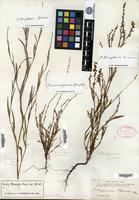
Type of Polygonum tenue Michaux var. microspermum Engelmann [family POLYGONACEAE]
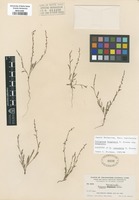
Original material of Polygonum consimile Greene [family POLYGONACEAE]
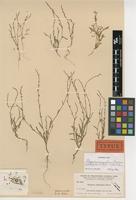
Type of Polygonum consimile Greene [family POLYGONACEAE]
Previous
Next

Name

Identification
Polygonum engelmannii Greene [family POLYGONACEAE ] (stored under name); Verified by K. N. Gandhi & W. T. Kittredge, 2010 Polygonum tenue Michaux [family POLYGONACEAE ] Verified by Engelm., 1863 Polygonum microspermum (Engelmann) Small [family POLYGONACEAE ] Verified by J. K. Small,
Related name
  • Polygonum tenue
  • Polygonum consimile
  • Polygonum microspermum
  • Polygonum engelmannii
Common name
  • Engelmann’s knotweed, Flora of North America Vol. 5

Flora

Entry for Polygonum engelmannii Greene [family POLYGONACEAE]
Herbarium
Flora of North America (FNA)
Collection
Flora of North America
Resource Type
Reference Sources
Entry From
Flora of North America, Vol 5,
Names
Polygonum engelmannii Greene [family POLYGONACEAE], Bull. Calif. Acad. Sci., 1: 126. 1885
Polygonum douglasii Greene subsp. engelmannii (Greene) Kartesz & Gandhi [family POLYGONACEAE]
Past names
engelmanni
Treatment Author(s)
Mihai Costea
François J. Tardif
Harold R. Hinds†
Information
Herbs. Stems erect, green or purplish brown, branched from base, not wiry, 4–30 cm, glabrous or minutely papillose-scabridulous. Leaves uniformly distributed, articulated to ocreae, basal leaves persistent, distal leaves abruptly reduced to bracts; ocrea 3–5 mm, papillose-scabridulous or glabrous, proximal part funnelform, distal part becoming lacerate with age; petiole 0.1–2 mm; blade 1-veined, not pleated, linear-oblanceolate, 10–20(–25) × 1–3(–4) mm, margins revolute, smooth, apex acute to mucronate. Inflorescences axillary and terminal, spikelike, loosely floriferous nearly to base, elongate; cymes spaced along branches, (1–)2–4-flowered. Pedicels exserted from ocreae, reflexed, 1–3 mm. Flowers closed; perianth 1.5–2(–2.5) mm; tube 18–26% of perianth length; tepals initially overlapping and cucullate, later forced apart by developing achene, greenish or sometimes purple, with white margins, petaloid or sepaloid, oblong, ± flat or navicular, apex rounded; midveins unbranched; stamens 5–8. Achenes exserted from perianth, black, elliptic, 1.2–2.3 mm, faces subequal, shiny, smooth.
Phenology
jun-aug (summer), sep (fall)
Altitude range
1000–1500 m;
Distribution
USA Colo.USA IdahoUSA Mont.USA Nev.USA S.Dak.USA UtahUSA Wyo.Canada Alta.Canada B.C.

Related Materials

  • Terms and Conditions
  • Privacy Policy
  • Cookie Policy
  • Cookie Settings
  • Accessibility
  • Help
  • Contact Us
  • Facebook
  • Twitter
ITHAKA

JSTOR is part of ITHAKA, a not-for-profit organization helping the academic community use digital technologies to preserve the scholarly record and to advance research and teaching in sustainable ways.

©2000-2026 ITHAKA. All Rights Reserved. JSTOR®, the JSTOR logo, JPASS®, Aluka®, and ITHAKA® are registered trademarks of ITHAKA.

╳