JSTOR Global Plants Home
  • Home
  • Browse
  • About
  • Access
  • Account
    • Saved Items
    • Profile
  • Log in

Global Plants

Skip to Main Content
  • JSTOR Global Plants Home
  • Global Plants

    • Browse
    • About
    • Access
    • Account
      • Saved Items
      • Profile
Log in
  • Browse
  • About
  • Access
  • Account
    • Saved Items
    • Profile
Advanced Search

Compilation
Polygonum densiflorum

8 Images see all

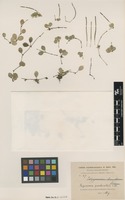
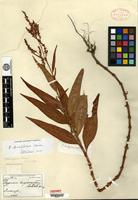
Type of Peperomia pseudoreflexa C.DC. [family PIPERACEAE]
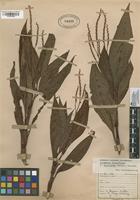
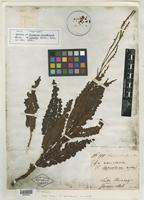
Filed as Polygonum densiflorum Blume forma ciliolatum (Meisn. ex A. DC.) Fassett [family POLYGONACEAE]
Filed as Polygonum densiflorum Blume var. imberbe Meisn. ex A. DC. [family POLYGONACEAE]
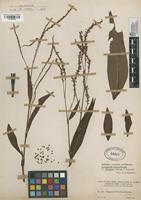
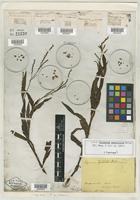
Type? of Polygonum punctatum Elliott var. eciliatum Small [family POLYGONACEAE]
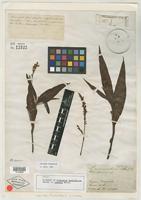
Type of Polygonum longiocreatum Bartlett [family POLYGONACEAE]
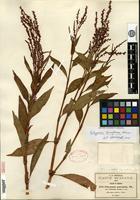
Syntype of Polygonum densiflorum var. imberbe Meisn. [family POLYGONACEAE]
Syntype of Polygonum densiflorum subsp. imberbe Meisn. [family POLYGONACEAE]
Syntype of Polygonum densiflorum Meisn. [family POLYGONACEAE]
Previous
Next

Name

Identification
Polygonum densiflorum Blume [family POLYGONACEAE ] (stored under name); Verified by Jaramillo ,R., Polygonum punctatum Elliott [family POLYGONACEAE ] Verified by Pérez Arbelaez,E., Polygonum densiflorum Blume [family POLYGONACEAE ] Verified by Not On Sheet,
Related name
  • Peperomia pseudoreflexa
  • Polygonum punctatum
  • Polygonum portoricense
  • Polygonum densiflorum
  • Polygonum longiocreatum
Common name
  • Smooth smartweed, Flora of North America Vol. 5

Flora

Entry for Persicaria glabra (Willdenow) M. Gómez [family POLYGONACEAE]
Herbarium
Flora of North America (FNA)
Collection
Flora of North America
Resource Type
Reference Sources
Entry From
Flora of North America, Vol 5,
Names
Persicaria glabra (Willdenow) M. Gómez [family POLYGONACEAE], Anales Inst. Segunda Enseñ., 2: 278. 1896
Polygonum glabrum Willdenow [family POLYGONACEAE], Sp. Pl., 2: 447. 1799
Persicaria densiflora (Meisner) Moldenke [family POLYGONACEAE]
Persicaria portoricensis (Bertero ex Small) Small [family POLYGONACEAE]
Polygonum densiflorum Meisner [family POLYGONACEAE]
Polygonum portoricense Bertero ex Small [family POLYGONACEAE]
Treatment Author(s)
Harold R. Hinds†
Craig C. Freeman
Information
Plants perennial, 3–15 dm; roots also often arising from proximal nodes; rhizomes present. Stems decumbent to erect, usually branched distally, without noticeable ribs, glabrous or, rarely, pubescent distally, sometimes glandular-punctate. Leaves: ocrea light brown, cylindric, 12–23 mm, chartaceous, base inflated, margins truncate, eciliate, surface glabrous, usually obscurely glandular-punctate; petiole 0.2–2 cm, scabrous; blade without dark triangular or lunate blotch adaxially, lanceolate, (10–)15–30 × (1.5–)2–5.4 cm, base tapered, margins glabrous or antrorsely strigose, apex acute to acuminate, faces glabrous or scabrous along midveins, sometimes glandular-punctate. Inflorescences mostly terminal, sometimes also axillary, erect to slightly nodding, usually uninterrupted, 30–100 × 5–9 mm; peduncle 10–50 mm, glabrous or scabrid, glandular-punctate; ocreolae usually overlapping, margins eciliate. Pedicels erect to spreading, 2–5 mm. Flowers (1–)3–8 per ocreate fascicle, homostylous; perianth greenish white to white or pink, glabrous, not glandular-puncate or glandular-punctate with punctae ± uniformly distributed, scarcely accrescent; tepals 5, connate ca. 1/3 their length, obovate, 3–3.6 mm, veins not prominent, not anchor shaped, margins entire, apex obtuse to rounded; stamens 5–7, included; anthers pink or red, ovate; styles 2, connate proximally. Achenes included, dark brown to brownish black, biconvex, 2–2.2 × 1.3–1.6 mm, shiny, smooth.
Phenology
aug (summer), sep-nov (fall)
Altitude range
0–300;
Distribution
Central AmericaSouth AmericaAsiane AfricaPacific Islands (Hawaii).Pacific Islands (Philippines).USA Ala.USA Ark.USA Del.USA Fla.USA Ga.USA Ky.USA La.USA Md.USA Miss.USA Mo.USA N.J.USA N.C.USA S.C.USA Tenn.USA Tex.USA Va.
Discussion
American plants here included in Persicaria glabra often have been treated as distinct and called P. densiflora. The morphological differences between them and Asian and Pacific P. glabra are minor. Regional tendencies exist but do not appear sufficient to warrant separation of the species (K. L. Wilson 1990b).
An infusion made from pounded whole plants was used by the Hawaiians as a blood medicine (D. E. Moerman 1998).

Related Materials

  • Terms and Conditions
  • Privacy Policy
  • Cookie Policy
  • Cookie Settings
  • Accessibility
  • Help
  • Contact Us
  • Facebook
  • Twitter
ITHAKA

JSTOR is part of ITHAKA, a not-for-profit organization helping the academic community use digital technologies to preserve the scholarly record and to advance research and teaching in sustainable ways.

©2000-2026 ITHAKA. All Rights Reserved. JSTOR®, the JSTOR logo, JPASS®, Aluka®, and ITHAKA® are registered trademarks of ITHAKA.

╳