JSTOR Global Plants Home
  • Home
  • Browse
  • About
  • Access
  • Account
    • Saved Items
    • Profile
  • Log in

Global Plants

Skip to Main Content
  • JSTOR Global Plants Home
  • Global Plants

    • Browse
    • About
    • Access
    • Account
      • Saved Items
      • Profile
Log in
  • Browse
  • About
  • Access
  • Account
    • Saved Items
    • Profile
Advanced Search

Compilation
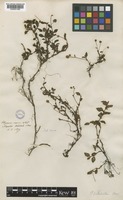
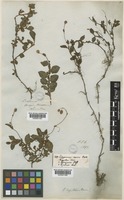
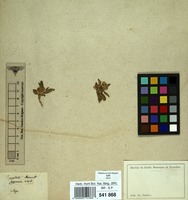
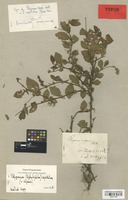
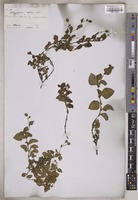
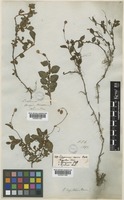
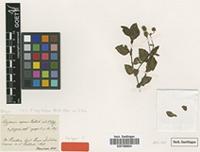
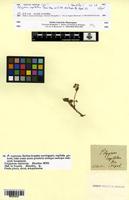
Polygonum capitatum

8 Images see all

Persicaria capitata (Buch.-Ham. ex D.Don) H.Gross [family POLYGONACEAE]
Filed as Polygonum capitatum Buch.-Ham. ex D.Don [family POLYGONACEAE]
Type of Polygonum capitatum D. Don [family POLYGONACEAE]
Polygonum repens Wall. subsp. pingue Meisn. [family POLYGONACEAE]
Persicaria capitata (Buch.-Ham. ex D.Don) H.Gross [family POLYGONACEAE]
Syntype of Polygonum repens Wall. var. pingue Meisn. [family POLYGONACEAE]
Type? of Polygonum capitatum Don [family POLYGONACEAE]
Previous
Next

Name

Identification
Polygonum capitatum Buch.-Ham. ex D.Don [family POLYGONACEAE ] (stored under name); Verified by Not on sheet, Polygonum repens Wall. [family POLYGONACEAE ] Verified by Not on sheet,
Related name
  • Polygonum capitatum
  • Polygonum repens
Common name
  • Pink-head knotweed, Flora of North America Vol. 5

Flora

Entry for Persicaria capitata (Buchanan-Hamilton ex D. Don) H. Gross [family POLYGONACEAE]
Herbarium
Flora of North America (FNA)
Collection
Flora of North America
Resource Type
Reference Sources
Entry From
Flora of North America, Vol 5,
Names
Persicaria capitata (Buchanan-Hamilton ex D. Don) H. Gross [family POLYGONACEAE], Bot. Jahrb. Syst., 49: 277. 1913
Polygonum capitatum Buchanan-Hamilton ex D. Don [family POLYGONACEAE], Prodr. Fl. Nepal., 73. 1825
Treatment Author(s)
Harold R. Hinds†
Craig C. Freeman
Information
Plants annual or perennial, 0.5–5 dm; roots also often arising from proximal nodes. Stems prostrate, glabrous or glandular-pubescent. Leaves: ocrea brown or reddish brown, cylindric to funnelform, 5–12 mm, chartaceous, base inflated or not, margins oblique, eciliate or ciliate with bristles to 1.5 mm, surface lanate, sometimes also glandular-pubescent; petiole 2–5 mm, winged distally; blade ovate to elliptic, 1.5–4(–6) × 0.6–2.5(–3.3) cm, base cuneate or tapering, margins ciliate with reddish, multicellular hairs, apex acute, faces glandular-pubescent abaxially and adaxially, not glandular-punctate. Inflorescences terminal, 5–20 × 7-18 mm; peduncle 10–40 mm, glabrous or stipitate-glandular in distal 1/5; ocreolae overlapping, margins eciliate. Pedicels spreading, 0.5–1 mm. Flowers 1–5 per ocreate fascicle; perianth greenish white proximally, pinkish distally, urceolate, glabrous, nonaccrescent; tepals 5, elliptic, 2–3 mm, apex acute to obtuse; stamens 8, filaments distinct, free; anthers pink to red, elliptic; styles 3, connate to middle or distally. Achenes included, reddish brown to brownish black, 3-gonous, 1.5–2.2 × 1–1.5 mm, shiny, smooth or minutely punctate.
Phenology
jun-aug (summer), sep (fall)
Altitude range
0–500 m;
Distribution
Asia (Bhutan)Asia (w China)Asia (n India)Asia (Nepal)introduced also in the Pacific Islands (Hawaii).USA Calif.USA La.USA Oreg.
Discussion
Persicaria capitata is planted as a garden groundcover. It escapes infrequently in the flora area; once established outside of cultivation it can be difficult to eradicate.
Native/Introduced
introduced;

Related Materials

  • Terms and Conditions
  • Privacy Policy
  • Cookie Policy
  • Cookie Settings
  • Accessibility
  • Help
  • Contact Us
  • Facebook
  • Twitter
ITHAKA

JSTOR is part of ITHAKA, a not-for-profit organization helping the academic community use digital technologies to preserve the scholarly record and to advance research and teaching in sustainable ways.

©2000-2026 ITHAKA. All Rights Reserved. JSTOR®, the JSTOR logo, JPASS®, Aluka®, and ITHAKA® are registered trademarks of ITHAKA.

╳