JSTOR Global Plants Home
  • Home
  • Browse
  • About
  • Access
  • Account
    • Saved Items
    • Profile
  • Log in

Global Plants

Skip to Main Content
  • JSTOR Global Plants Home
  • Global Plants

    • Browse
    • About
    • Access
    • Account
      • Saved Items
      • Profile
Log in
  • Browse
  • About
  • Access
  • Account
    • Saved Items
    • Profile
Advanced Search

Compilation
Polygonum bungeanum

3 Images see all

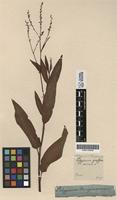
Holotype of Polygonum bungeanum Turcz. [family POLYGONACEAE]
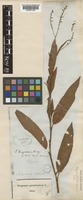
Persicaria bungeana Nakai [family POLYGONACEAE]
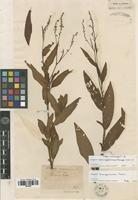
Type of Polygonum pennsylvanicum Bunge [family POLYGONACEAE]
Previous
Next

Name

Identification
Polygonum bungeanum Turcz. [family POLYGONACEAE ] (stored under name); Verified by Turczaninow, N.S., Polygonum pensylvanicum Bunge [family POLYGONACEAE ] Verified by Not on sheet,
Related name
  • Polygonum bungeanum
  • Polygonum pensylvanicum
  • Polygonum pennsylvanicum
Common name
  • Prickly smartweed, Flora of North America Vol. 5

Flora

Entry for Persicaria bungeana (Turczaninow) Nakai [family POLYGONACEAE]
Herbarium
Flora of North America (FNA)
Collection
Flora of North America
Resource Type
Reference Sources
Entry From
Flora of North America, Vol 5,
Names
Persicaria bungeana (Turczaninow) Nakai [family POLYGONACEAE], in T. Mori, Enum. Pl. Corea, 131. 1922
Polygonum bungeanum Turczaninow [family POLYGONACEAE], Bull. Soc. Imp. Naturalistes Moscou, 13: 77. 1840
Treatment Author(s)
Harold R. Hinds†
Craig C. Freeman
Information
Plants annual, 3–8 dm; roots not also arising from proximal nodes. Stems ascending to erect, ribbed or obscurely so, glabrous or glandular-pubescent distally; prickles 1–1.5 mm. Leaves: ocrea brownish, cylindric, 8–14 mm, chartaceous, base inflated or not, without prickles, margins truncate, ciliate with bristles 2–4 mm, surface with appressed bristles along veins; petiole 0.5–1.5 cm; blade lanceolate to narrowly elliptic, 5–12.5 × 1.5–3.5 cm, base acute, margins entire, antrorsely ciliate, apex acute acuminate, rarely obtuse, faces glabrous or pubescent and, usually, with antrorse prickles along midvein abaxially and adaxially. Inflorescences racemelike, uninterrupted or interrupted proximally, 20–45 × 5–10 mm; peduncle 20–40 mm, usually stipitate-glandular at least proximally; ocreolae usually overlapping, sometimes not overlapping proximally, margins eciliate. Pedicels mostly ascending, 2–3 mm. Flowers 2–4 per ocreate fascicle; perianth pale green, often tinged red, glabrous, accrescent, not becoming blue and fleshy in fruit; tepals 5, connate 1/4–1/3 their length, petaloid, elliptic to broadly elliptic, 3–4 mm, apex obtuse; stamens 8, filaments distinct, free; anthers pink, ovate; styles 2, connate to middle. Achenes included, black, biconvex, 2.5–3 × 2.3–2.8 mm, dull, rugose.
Phenology
jul-aug (summer), sep (fall)
Altitude range
300–400 m;
Distribution
e Asia (n China).e Asia (Japan).e Asia (Korea).e Asia (Manchuria).USA Ill.USA IowaUSA Minn.
Discussion
Persicaria bungeana is a weed of soybean fields (R. N. Andersen et al. 1985). It is not known how or when it was introduced into the midwestern United States.
Native/Introduced
introduced;

Related Materials

  • Terms and Conditions
  • Privacy Policy
  • Cookie Policy
  • Cookie Settings
  • Accessibility
  • Help
  • Contact Us
  • Facebook
  • Twitter
ITHAKA

JSTOR is part of ITHAKA, a not-for-profit organization helping the academic community use digital technologies to preserve the scholarly record and to advance research and teaching in sustainable ways.

©2000-2026 ITHAKA. All Rights Reserved. JSTOR®, the JSTOR logo, JPASS®, Aluka®, and ITHAKA® are registered trademarks of ITHAKA.

╳