

Compilation
Polygala asperifolia
1 Images see all
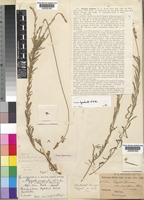
Name
Identification
Polygala asperifolia Chodat [family POLYGALACEAE ] Verified by Burtt Davy, J., Polygala producta N.E.Br. [family POLYGALACEAE ] Verified by Burtt Davy, Polygala producta N.E.Br. [family POLYGALACEAE ] (stored under name); Verified by Paiva, J.,
Related name
- Polygala asperifolia
- Polygala producta
Flora
Entry for Polygala stenopetala Klotzsch [family POLYGALACEAE]
Herbarium
Royal Botanic Gardens, Kew (K)
Collection
Flora Zambesiaca
Resource Type
Reference Sources
Entry From
FZ, Vol 1, Part 1, page 303, (1960) Author: A. W. Exell
Names
Polygala asperifolia Chod. [family POLYGALACEAE], tom. cit.: 323 (1912). Type from the Transvaal (Galpin 844, the same gathering as the lectotype of P. producta).
Polygala viminalis forma brachyptera Chod. apud R.E.Fr. [family POLYGALACEAE], tom. cit.: 114 (1914). Type: N. Rhodesia, Abercorn, Fries 1257 (UPS, holotype).
Polygala viminalis Gürke [family POLYGALACEAE], in Engl., Pflanzenw. Ost-Afr. C: 234 (1895). — R.E.Fr. in Wiss. Ergebn. Schwed. Rhod.–Kongo-Exped. 1: 113 (1914). — Exell & Mendonça, C.F.A. 1, 1: 104 (1937). — Milne-Redh. in Mém. N.Y. Bot. Gard. 8, 3: 220 (1953). Type from Tanganyika.
Polygala rarifolia [family POLYGALACEAE], sensu Chod. in Mém. Soc. Phys. Hist. Nat. Genève, 31, 2: 367 (1893) pro parte quoad syn. P. stenophylla Klotzsch.
Polygala stenopetala Klotzsch [family POLYGALACEAE], in Peters Reise Mossamb. Bot. 1: 114, t. 23 (\"stenophylla\") (1861). TAB. 57 fig. 1. Type: Mozambique, Inhambane, Peters (B, holotype †, not seen).
Information
Perennial herb (sometimes annual ?) or shrublet up to 1.5 m. tall with slender, erect, slightly winged, glabrous stems. Leaves 15–50 x 1–5 mm., linear, grasslike, pointed at the apex, glabrous. Flowers blue or greenish with purple-brown veining, pedicels 3–4 mm. long, in elongated, terminal racemes up to 20 cm. long with glabrous rhachis and small caducous bracts 1 mm. long and bracteoles 0.8 mm. long. Posterior sepal 2 mm. long; wing sepals 5–6.5 x 4–5.5 mm., obliquely suborbicular or rotund; anterior sepals 1.8 mm. long, connate. Upper petals 3 x 2.5 mm., obliquely and irregularly obovate; carina 6.5 x 3.5 mm., crest 2 mm. long. Stamens 8. Capsule 5–6 x 3.5–4.5 mm., obliquely oblong, glabrous. Seeds 2.5 x 1.5 mm., ellipsoid, with rather short, brownish, appressed hairs; caruncular appendages absent.
Habitat
In Brachystegia woodland, wooded grassland and submontane grassland.
Distribution
Mozambique Z Quelimane Distr., Mgulumi Mission, Faulkner 62 (K).Malawi S Zomba Mt., fl. & fr. 22.ii.1956, Banda 179 (BM; LISC).Zambia W Solwezi Dambo, fl. 20.ix.1930, Milne-Redhead 1161 (K).Malawi N Vipya, fl. & fr. iv.1956, Chapman 279 (BM).Mozambique N Metónia, fl. & fr. 10.x.1942, Mendonça 706 (BM; LISC).Zambia N Upper Luangwa R., fl. & fr. x.1897, Nicholson (K).
Distribution (external)
Angola
Tanganyika
Notes
The record from N. Rhodesia (W), Milne-Redhead 1161, is doubtful as the specimen is an immature one from a dense tuft which has been much burnt. It has, however, the characteristic, slightly winged stems. Klotzsch (loc. cit.) employed the epithet \"stenopetala\" in his text but \"stenophylla\" on his figure. P. stenophylla would have been a more appropriate name and may have been originally intended; but Klotzsch no doubt discovered that it was preoccupied by P. stenophylla A. Gray (1854) and made the minimum alteration in his text but was perhaps unable to, or forgot to, alter the name on the figure.