

Compilation
Polanisia microphylla
1 Images see all
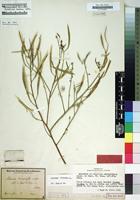
Name
Identification
Polanisia microphylla Eichler [family CAPPARACEAE ] Verified by Iltis, H.H., Cleome viscosa L. [family CAPPARACEAE ] (stored under name); Verified by Not on sheet.,
Related name
- Cleome viscosa
- Polanisia microphylla
Common name
- yellow cleome, Flora of North America Vol. 7
- tickweed, Flora of North America Vol. 7
- Wild mustard, Flora of North America Vol. 7
Flora
Entry for Arivela viscosa (Linnaeus) Rafinesque [family ]
Herbarium
Flora of North America (FNA)
Collection
Flora of North America
Resource Type
Reference Sources
Entry From
Flora of North America, Vol 7,
Names
Arivela viscosa (Linnaeus) Rafinesque [family ], Sylva Tellur., 110. 1838
Cleome viscosa Linnaeus [family CAPPARACEAE], Sp. Pl., 2: 672. 1753
Polanisia icosandra (Linnaeus) Wight & Arnott [family CAPPARACEAE]
Polanisia microphylla Eichler [family CAPPARACEAE]
Polanisia viscosa (Linnaeus) de Candolle [family CAPPARACEAE]
Treatment Author(s)
Gordon C. Tucker
Information
Plants (10–)30–100(–160) cm. Stems viscid. Leaves: petiole 1.5–4.5(–8) cm, glandular-hirsute; leaflet blade ovate to oblanceolate-elliptic, (0.6–)2–6 × 0.5–3.5 cm, margins entire and glandular-ciliate, apex acute to obtuse, surfaces glandular-hirsute. Racemes 5–10 cm (10–15 cm in fruit); bracts (often deciduous), trifoliate, 10–25 mm, glandular-hirsute. Pedicels 6–30 mm, glandular-hirsute. Flowers: sepals green, lanceolate, 5–10 × 0.8–1.2 mm, glandular-hirsute; petals arranged in adaxial semicircle before anthesis, radially arranged at anthesis, bright yellow, sometimes purple basally, oblong to ovate, 7–14 × 3–4 mm; stamens dimorphic, 4–10 adaxial ones much shorter with swelling proximal to anthers, green, 5–9 mm; anthers 1.4–3 mm; ovary 6–10 mm, densely glandular; style 1–1.2 mm. Capsules dehiscing only partway from apex to base, 30–100 × 2–4 mm, glandular-hirsute. Seeds light brown, 1.2–1.8 × 1–1.2 mm, finely ridged transversely. 2n = 20.
Phenology
jun-aug (summer)
Altitude range
0–50 m;
Distribution
sse AsiaAfricaintroduced also in MexicoWest IndiesCentral AmericaSouth America.USA Fla.USA Ga.USA La.USA N.J.USA Pa.USA S.C.
Discussion
Arivela viscosa seeds have a high oil content (26%), are rich in linoleic acid, and are eaten in India. The leaves and seeds have been used medicinally in Asia (southern China, Guam, India) for the eyes and intestines, and as a poultice for headaches and rheumatism (R. N. Chopra et al. 1986; N. D. Mandahar 2002). Records from New Jersey and Pennsylvania are based on non-persistent ballast plants from the late 1800s.
Native/Introduced
introduced;