JSTOR Global Plants Home
  • Home
  • Browse
  • About
  • Access
  • Account
    • Saved Items
    • Profile
  • Log in

Global Plants

Skip to Main Content
  • JSTOR Global Plants Home
  • Global Plants

    • Browse
    • About
    • Access
    • Account
      • Saved Items
      • Profile
Log in
  • Browse
  • About
  • Access
  • Account
    • Saved Items
    • Profile
Advanced Search

Compilation
Pogononeura biflora

6 Images see all

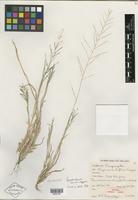
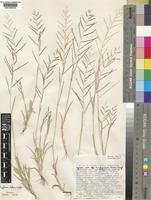
Isotype of Pogononeura biflora Napper [family POACEAE]
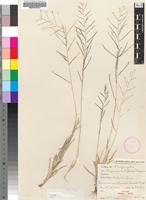
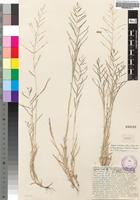
Holotype of Pogononeura biflora Napper [family GRAMINEAE]
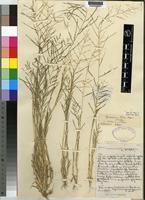
Isotype of Pogononeura biflora Napper [family POACEAE]
Previous
Next

Name

Identification
Pogononeura biflora Napper [family GRAMINEAE ] (stored under name); Verified by Napper D, 1963
Related name
  • Pogononeura biflora

Flora

Entry for POGONONEURA biflora Napper [family POACEAE]
Herbarium
Royal Botanic Gardens, Kew (K)
Collection
Flora of Tropical East Africa
Resource Type
Reference Sources
Entry From
Flora of Tropical East Africa, Part (Part 2), page 177, (1974) Author: W. D. CLAYTON, S. M. PHILLIPS AND S. A. RENVOIZE
Names
POGONONEURA biflora Napper [family POACEAE], in Kirkia 3: 112 (1963); G.T.: 26 (1965). Type: Tanzania, 80 km. from Seronera via Musabi Guard Post, Greenway 10091 (EA, holo.!, K, iso.!)
Information
Slender tufted annual; culms 28–70 cm. high, spreading and branching near the base, then ascending, leafy. Leaf-blades up to 12 cm. long, 3–5 mm. wide, usually folded, tough, glaucous, conspicuously nerved on the lower surface, pilose on the upper surface, sometimes sparsely, the margins cartilaginous and pectinate-ciliate. Inflorescence 12–28 cm. long, elliptic to narrowly elliptic-oblong; racemes 12–25, straight, ascending, up to 6.5 cm. long. Spikelets narrowly fusiform, 2-flowered, often with a third minute vestigial floret, 5–6 mm. long, overlapping by up to a third of their length, greyish green or olive-green; glumes glabrous, scabrid on the nerve, the tips subacute; lower glume narrowly lanceolate-oblong, 4.5–5.1 mm. long, almost encircling the spikelet at the base, persistent; upper glume linear-oblong, 5.4–5.9 mm. long, falling at the same time as the florets; lemmas elliptic-oblong, 2.7–3.2 mm. long, sericeous on the back around the midnerve with hyaline very closely appressed hairs which obscure the 2-lobed tip, the margins densely fringed with soft erect grey-green hairs reaching 0.75 mm. in the upper half; awn 1 mm. long; palea-keels close together and glabrous in the lower third, then spreading apart and densely fringed in the same manner as the lemma-margins. Caryopsis 1.3–1.6 mm. long. Fig. 83.
Range
DISTR. U1; T1 not known elsewhere
Altitude range
1230–1830 m.
Distribution
TANZANIA Mwanza District Ukiriguru, 15 Mar. 1968, Kihongo 3715!TANZANIA Kwimba District Ngudu, 1934, Lewys-Lloyd 311!TANZANIA Musoma District Musabi-Nyamuma Guard Post, 20 Apr. 1962, Greenway, Turner & Watson 10620 !UGANDA Karamoja District Moroto, J. Wilson 44! & May 1954, J. Wilson 25 ! & J. Wilson 190 !
Notes
A rather rare grass, readily recognizable by its narrow spikelets with their long encircling glumes, and by the very characteristic long dense grey-green hairs on the lemma-margins and palea-keels.

Related Materials

  • Terms and Conditions
  • Privacy Policy
  • Cookie Policy
  • Cookie Settings
  • Accessibility
  • Help
  • Contact Us
  • Facebook
  • Twitter
ITHAKA

JSTOR is part of ITHAKA, a not-for-profit organization helping the academic community use digital technologies to preserve the scholarly record and to advance research and teaching in sustainable ways.

©2000-2026 ITHAKA. All Rights Reserved. JSTOR®, the JSTOR logo, JPASS®, Aluka®, and ITHAKA® are registered trademarks of ITHAKA.

╳