JSTOR Global Plants Home
  • Home
  • Browse
  • About
  • Access
  • Account
    • Saved Items
    • Profile
  • Log in

Global Plants

Skip to Main Content
  • JSTOR Global Plants Home
  • Global Plants

    • Browse
    • About
    • Access
    • Account
      • Saved Items
      • Profile
Log in
  • Browse
  • About
  • Access
  • Account
    • Saved Items
    • Profile
Advanced Search

Compilation
Plicosepalus kalachariensis

6 Images see all

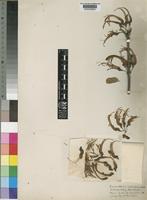
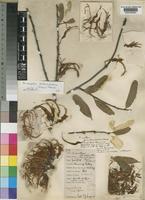
Plicosepalus kalachariensis (Schinz) Danser [family LORANTHACEAE]
Filed as Plicosepalus kalachariensis (Schinz) Danser [family LORANTHACEAE]
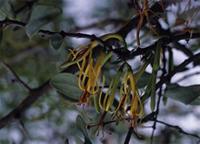
Plicosepalus kalachariensis
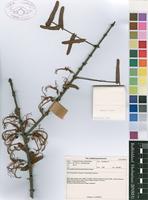
Holotype of Loranthus pentheri Schltr. [family LORANTHACEAE]
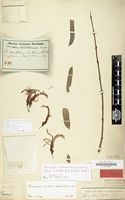
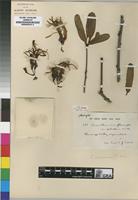
Type of Loranthus splendens N.E.Br. [family LORANTHACEAE]
Isotype of Loranthus splendens N.E.Br. [family LORANTHACEAE]
Previous
Next

Name

Identification
Plicosepalus kalachariensis (Schinz) Danser [family LORANTHACEAE ]
Related name
  • Plicosepalus kalachariensis

Flora

Entry for Plicosepalus kalachariensis [family LORANTHACEAE]
Herbarium
South African National Biodiversity Institute, Compton Herbarium, Cape Town (SAM)
Collection
Flora of Southern Africa
Resource Type
Reference Sources
Entry From
Flora of South Africa, (2003) Author: Dr J.P. Roux
Names
Plicosepalus kalachariensis [family LORANTHACEAE]
Common names
Loranthus kalachariensis Schinz in Bull. Herb. Boissier, ser. 1, 4, App. 3: 53 (1896); Sprague in F.T.A. 6, 1: 280 (1910); in F C. 5, 2: 105 (1915); Burtt Davy, Fl. Transv. 465 (1932). L. dinteri Schinz in Bull. Herb. Boissier, ser. 2, 1: 869 (1901). Type: South West Africa, Grootfontein, Dinter 698 (not traced; "identical with type of L. kalachariensis" fide N.E. Br. in lit., 25/11/1909). L. splendens N.E. Br. in Kew Bull. 1909: 136 (1909). Type: Botswana, Okavango, Lugard 232 (K!). L. acaciaedetinentis Dinter in Reprium nov. Spec. Regni veg. 18: 441 (1922). Plicosepalus acaciae­detinentis (Dinter) Danser in Verh. K. Akad. Wet., sect. 2, 29, 6: 100 (1933). Syntypes: South West Africa, Etosha Pan, Dinter 2265 (SAM!); Grootfon­tein and Outjo, Dinter s.n. (not traced). Plicosepalus curviflorus sensu Balle in F.S.W.A. 22: 8 (1969), non (Benth.) v. Tieghem.
Information
Shrubs of moderate to large size, often 1 m or higher. Leaves oblong-linear to elliptic (highly variable in size), (25-) 40-60 (-85) x 7-20 mm, basinerved, the 3-5 veins sometimes faint. Inflorescence: umbels mostly 2-4 (-6)-fiowered, borne singly or in pairs, axillary, often on swollen nodes of older branches; pe­dicels 8-11 mm long. Corolla pink to reddish orange, usually darker toward base, colours often uneven, mottled, or variegated. Fila­ments and style pinkish apically. Style with single bend toward base. Berries red, smooth. Flowering at least April through August and probably longer; n=9. Fig. 14.
Use
1. Plicosepalus kalachariensis (Schinz) Danser in Verh. K. Akad. Wet., sect. 2, 29, 6: 100 (1933). Syntypes: Botswana, Oka-vango, Fleck 307 (not traced); Lake N garni, Fleck 314a (not traced; in Z fide N.E. Br. in lit., 25/11/1909).
Range
Parasitic apparently only on Acacia species. Widespread in the northern half of South West Africa, in northern Botswana, northern and eastern Transvaal as well as Swaziland and northern Natal (Map 12).

Related Materials

  • Terms and Conditions
  • Privacy Policy
  • Cookie Policy
  • Cookie Settings
  • Accessibility
  • Help
  • Contact Us
  • Facebook
  • Twitter
ITHAKA

JSTOR is part of ITHAKA, a not-for-profit organization helping the academic community use digital technologies to preserve the scholarly record and to advance research and teaching in sustainable ways.

©2000-2026 ITHAKA. All Rights Reserved. JSTOR®, the JSTOR logo, JPASS®, Aluka®, and ITHAKA® are registered trademarks of ITHAKA.

╳