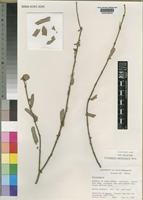
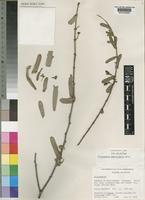
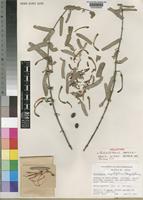
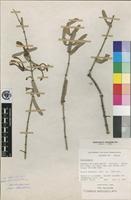
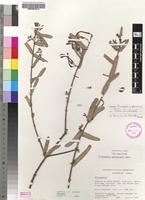
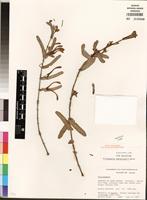
Plicosepalus amplexicaulisWiens [family LORANTHACEAE ] (stored under name); Verified by Wiens, D., Plicosepalus sagittifolius(Sprague) Danser [family LORANTHACEAE ]
Related name
Plicosepalus sagittifolius
Plicosepalus amplexicaulis
Flora
Entry for Plicosepalus amplexicaulis [family LORANTHACEAE]
Herbarium
South African National Biodiversity Institute, Compton Herbarium, Cape Town (SAM)
Collection
Flora of Southern Africa
Resource Type
Reference Sources
Entry From
Flora of South Africa, (2003) Author: Dr J.P. Roux
Names
Plicosepalus amplexicaulis [family LORANTHACEAE]
Information
Moderate-sized shrubs up to about 1 m high. Branches buff to brown; internodes 30-40 mm. Leaves sessile, linear to linear-oblong, 40-50x6-10 mm, usually 3-nerved, light grey-green, basal lobes sagittate, 6-8 mm long, amplexicaul. Inflorescence: umbels 3-4-fiowered, axillary, borne singly or in pairs; peduncles and pedicels approximately equal, 7-9 mm long. Corolla at anthesis 45-50 mm long, dull white basally; lobes bright red, (dull purplish in older buds). Filaments, style and stigma bright red (as the lobes); style with a single basal bend. Berries ellipsoid at maturity, 11x7 mm. Flowering in June and July (possibly longer); n=9. fig. 14.
Habitat
This species is clearly distinguished from P. kalachanensis by the amplexicaul, sagittate leaves and the basally whjtish coroila. The species is also distinct from P. sagittifolius of eastern and north-eastern Africa which has a differently coloured corolla and differently shaped, often fascicled leaves.
Use
3. Plicosepalus amplexicaulis Wiens in Bothalia 12: 422 (1978). Type: Transvaal, Kruger National Park, Balule Camp, Wiens 4681 (K, holo.!; PRE!; UT!).
Range
A parasite on Acacia species, apparently restricted to the lowveld of the eastern Transvaal in the Kruger National Park and adjoining areas (Map 11).