JSTOR Global Plants Home
  • Home
  • Browse
  • About
  • Access
  • Account
    • Saved Items
    • Profile
  • Log in

Global Plants

Skip to Main Content
  • JSTOR Global Plants Home
  • Global Plants

    • Browse
    • About
    • Access
    • Account
      • Saved Items
      • Profile
Log in
  • Browse
  • About
  • Access
  • Account
    • Saved Items
    • Profile
Advanced Search

Compilation
Pleiocarpa tubicina

4 Images see all

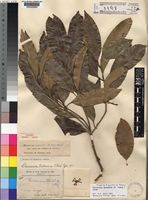
Pleiocarpa pycnantha (K.Schum.) Stapf [family APOCYNACEAE]
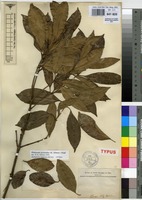
Isotype of Pleiocarpa tubicina Stapf [family APOCYNACEAE]
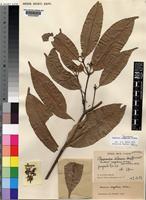
Isotype of Hunteria congolana Pichon ex Pichon [family APOCYNACEAE]
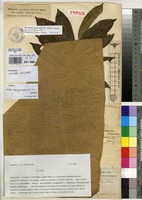
Holotype of Pleiocarpa tubicina Stapf [family APOCYNACEAE]
Previous
Next

Name

Identification
Isotype of Pleiocarpa tubicina Stapf [family APOCYNACEAE ] Verified by Not on sheet, Pleiocarpa pycnantha (K.Schum.) Stapf [family APOCYNACEAE ] (stored under name); Verified by Omino E.A., 1995
Related name
  • Pleiocarpa tubicina
  • Pleiocarpa pycnantha
  • Hunteria congolana

Flora

Entry for PLEIOCARPA tubicina Stapf [family APOCYNACEAE]
Herbarium
Royal Botanic Gardens, Kew (K)
Collection
Flora of Tropical Africa
Resource Type
Reference Sources
Entry From
Flora of Tropical Africa, Vol 4, Part 1, page 24, (1904) Author: (By Otto Stapf.)
Names
PLEIOCARPA tubicina Stapf [family APOCYNACEAE], in Kew Bulletin, 1898, 304. —Stapf ex De Wild. & Durand. Contrib. Fl. Congo in Ann. Mus. Congo, Bot. sér. 2, i. fasc. 1, 37; fasc. 2, 40. De Wild. & Durand, Reliq. Dewevr. in Ann. Mus. Congo, Bot. sér. 3, fasc. ii. 150. Stapf in De Wild. Ill. Fl. Congo, i. 91, t. 46. De Wild. Études Fl. Katanga, i. 107.
Hunteria pycnantha Hallier f. [family APOCYNACEAE], Kautschuklianen in Jahrb. Hamburg. Wissensch. Anstalt. xvii. (1899), 3. Beih. 191 partly, not of K. Schum.
Information
A shrub; branches greyish-brown; bark breaking up longitudinally. Leaves ternate, oblong, shortly and more or less obtusely acuminate, acute at the base, 3 1/2–5 1/2 in. long, 1 to nearly 2 in. broad, coriaceous, glossy above; secondary nerves 12–20 on each side, very faint below, more distinct above, alternating with and often indistinguishable from the tertiary nerves; veins quite obscure below, slightly raised above; petiole 6–8 lin. long. Flowers sessile, 12–20 in compact axillary clusters, often from the axils of former leaves. Calyx 3/4 lin. long; sepals ovate or broad-oblong, obtuse. Corolla white; tube slender, 3–3 1/2 lin. long; lobes oblong, obtuse, up to 3/4 lin. long. Carpels 2, 2-ovuled.
Distribution
Congo South Central Basoko, Demeuse; Katanga; Lukofu, Verdick, 594! Kasongo, Dewèvre, 945!
Notes
The Ikwangoulas, according to Dewèvre, use the leaves for poisoning animals.

Related Materials

  • Terms and Conditions
  • Privacy Policy
  • Cookie Policy
  • Cookie Settings
  • Accessibility
  • Help
  • Contact Us
  • Facebook
  • Twitter
ITHAKA

JSTOR is part of ITHAKA, a not-for-profit organization helping the academic community use digital technologies to preserve the scholarly record and to advance research and teaching in sustainable ways.

©2000-2026 ITHAKA. All Rights Reserved. JSTOR®, the JSTOR logo, JPASS®, Aluka®, and ITHAKA® are registered trademarks of ITHAKA.

╳