JSTOR Global Plants Home
  • Home
  • Browse
  • About
  • Access
  • Account
    • Saved Items
    • Profile
  • Log in

Global Plants

Skip to Main Content
  • JSTOR Global Plants Home
  • Global Plants

    • Browse
    • About
    • Access
    • Account
      • Saved Items
      • Profile
Log in
  • Browse
  • About
  • Access
  • Account
    • Saved Items
    • Profile
Advanced Search

Compilation
Plectronia brieyi

4 Images see all

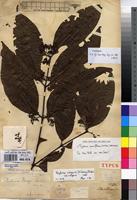
Holotype of Plectronia brieyi De Wild. [family RUBIACEAE]
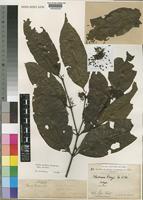
Isotype of Plectronia brieyi De Wild. [family RUBIACEAE]
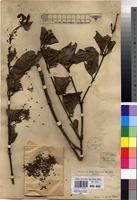
Holotype of Plectronia brieyi De Wild. [family RUBIACEAE]
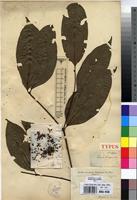
Isotype of Plectronia brieyi De Wild. [family RUBIACEAE]
Previous
Next

Name

Identification
Isotype of Plectronia brieyi De Wild. [family RUBIACEAE ] Verified by Not on sheet, Psydrax parviflora (Afzel.) Bridson [family RUBIACEAE ] (stored under name); Verified by Not on sheet,
Related name
  • Psydrax parviflora
  • Plectronia brieyi

Flora

Entry for Psydrax parviflora subsp. parviflora [family RUBIACEAE]
Herbarium
Royal Botanic Gardens, Kew (K)
Collection
Flora Zambesiaca
Resource Type
Reference Sources
Entry From
FZ, Vol 5, Part 2, (1998) Author: D. Bridson
Names
Canthium mutiflorum [family RUBIACEAE], sensu Hepper in F.W.T.A. ed. 2, 2: 182 (1963), pro parte, quoad C. afzelianum in syn.
Psydrax parviflora subsp. parviflora [family RUBIACEAE], —Bridson in Kew Bull. 40: 701 (1985). —Bridson & Troupin in Fl. Rwanda 3: notes nomenclaturales, corrigenda for page 152 (1985). —Bridson in F.T.E.A., Rubiaceae: 897 (1991). —Beentje, Kenya Trees, Shrubs Lianas: 539 (1994).
Canthium afzelianum Hiern [family RUBIACEAE], in F.T.A. 3: 142 (1877), pro parte, nom. nov. for P. parviflora. Type as above.
Plectronia vulgaris K. Schum. [family RUBIACEAE], in Engler, Pflanzenw. Ost-Afrikas C: 386 (1895). —K. Krause in Mildbraed, Wiss. Ergebn. Deutsch. Zentr.-Afrika Exped., Bot., part 4: 326 (1911). Neotype from Tanzania.
Canthium golungensis Hiern [family RUBIACEAE], Cat. Afr. Pl. Welw. 1: 478 (1898). Type from Angola.
Plectronia golungensis Hiern K. Schum. [family RUBIACEAE], in Just’s Bot. Jahresber., 26th year, part 1: 393 (1900).
Canthium golungensis var. parviflorum S. Moore [family RUBIACEAE], in J. Linn. Soc., Bot. 37: 161 (1905). Type from Uganda.
Plectronia brieyi De Wild. [family RUBIACEAE], in Repert. Spec. Nov. Regni Veg. 13: 380 (1914). Type from Zaire (Dem. Rep. Congo).
Canthium vulgare K. Schum. Bullock [family RUBIACEAE], in Bull. Misc. Inform., Kew 1932: 374 (1932). —Brenan, Check-list For. Trees Shrubs Tang. Terr.: 488 (1949). —F. White, F.F.N.R.: 403 (1962). —Hepper in F.W.T.A. ed. 2, 2: 184 (1963). —Bridson & Troupin in Fl. Pl. Lign. Rwanda: 552, fig. 183.4 (1982).
Canthium vulgare subsp. vulgare [family RUBIACEAE], —Bridson & Troupin in Fl. Rwanda 3: 152 (1985).
Canthium giordanii Chiov. [family RUBIACEAE], in Atti Reale Accad. Italia, Mem. Cl. Sci. 11: 35 (1941). —Cufodontis in Bull. Jard. Bot. État 35, Suppl. [Enum. Pl. Aethiop. Sperm.]: 1009 (1965). Syntypes from Ethiopia.
Information
Shrub or tree 2–20 m tall.Leaves drying green; blades 2–8 cm wide, narrowly elliptic, elliptic, oblong-elliptic or ovate, acuminate at apex, obtuse to rounded or occasionally acute at base; midrib pale; domatia glabrous; petioles 4–8 mm long.Corymbs 30–100-flowered.Calyx pubescent; limb 0.25–1.25 mm long, shorter or longer than the tube.Corolla tube 2–2.75 mm long.Fruit 8–11 mm wide.
Habitat
In evergreen woodland or mushitu, sometimes on tetmite-mounds
Distribution
Zambia W Solwezi Distr., Mlulungu Stream near Mutanda Bridge; fr. 28.vi.1930, Milne-Redhead 618 (K).
Distribution (external)
West Africa
Sudan
Ethiopia
Uganda
Kenya
Tanzania
Rwanda
Zaire (Dem. Rep. Congo)
Angola
Notes
This species is very variable and to a certain extent the variation can be grouped into geographical units. However, the character disjunctions between them do not seem sufficiently clear-cut for the recognition of additional subspecies. The specimens from Zambia, together with an odd specimen from western Tanzania (Ufipa District) are characterised by thickly coriaceous leaves which dry yellow-green. These may perhaps represent an ecotype associated with certain metallic deposits.

Related Materials

  • Terms and Conditions
  • Privacy Policy
  • Cookie Policy
  • Cookie Settings
  • Accessibility
  • Help
  • Contact Us
  • Facebook
  • Twitter
ITHAKA

JSTOR is part of ITHAKA, a not-for-profit organization helping the academic community use digital technologies to preserve the scholarly record and to advance research and teaching in sustainable ways.

©2000-2026 ITHAKA. All Rights Reserved. JSTOR®, the JSTOR logo, JPASS®, Aluka®, and ITHAKA® are registered trademarks of ITHAKA.

╳