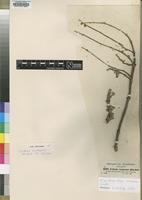
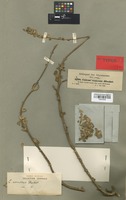
Coleus comosusHochst. ex Gurke [family LAMIACEAE ] Plectranthus ornatusCodd [family LAMIACEAE ] (stored under name); Verified by Ryding,O.,
Related name
Coleus comosus
Plectranthus ornatus
Flora
Entry for Plectranthus ornatus [family LAMIACEAE]
Herbarium
South African National Biodiversity Institute, Compton Herbarium, Cape Town (SAM)
Collection
Flora of Southern Africa
Resource Type
Reference Sources
Entry From
Flora of South Africa, (2003) Author: Dr J.P. Roux
Names
Plectranthus ornatus [family LAMIACEAE]
Common names
Coleus comosus Hochst. ex Giirke in Bot. Jb. 19: 212 (1894); Bak. in F.T.A. 5: 426 (1900); Bruce in Hooker's Icon. PI. 34: t.3374 (1938); non Plectranthus comosus Sims (1822). C. spicatus sensu A. Rich., Tent. Fl. Abyss. 2: 183 (1851), as to syn. and spec, cited. C caninus sensu Vatke in Linnaea 37: 318 (1871); sensu Engl., Hochgebirgsfl. Trop. Afr. 359 (1892).
Information
Perennial decumbent to trailing succuÂlent herb, branching freely at the base, up to 0,3 m tall. Leaves shortly petiolate; blade succulent, drying thick-textured, obovate to broadly obovate, 20-30 x 15-25 mm, sparingly to fairly densely pubescent, under-surface with orange gland-dots, strongly veined, apex rounded, base cune-ate, margin finely crenate-dentate in the upper half; petiole 2—10 mm long. InfloreÂscence a terminal dense spike-like raceme 40—60 (—90) mm long; bracts forming a 4-angled apical coma, greenish white tipped with purple, early deciduous; flowers in 3-flowered sessile cymes, forming 6-flowered verticils; verticils crowded except for 1—3 shortly spaced below; pedicels erect. Calyx 6 mm long in fruit, similar to P. tetensis (no. 11). Corolla bluish mauve with purple mottling on the upper lip, 20 — 25 mm long; tube slightly geniculate and expanding towards the throat; upper lip 6 mm long, lower lip boat-shaped, 12—15 mm long, sometimes bifurcate at the apex. Stamens 12—14 mm long, united at the base for 3—4 mm.
Habitat
Related to P. neochilus (above) but may be separated by the shorter, more compact inflorescence and the longer corolla, especially the longer upper lip of the corolla, while the lower lip is often split longitudinally at the apex. The leaves are unpleasantly scented.
Use
14. Plectranthus ornatus Codd in BoÂthalia 11: 393 (1975). Type: Ethiopia, Schimper II. 1328 (P!).
Range
Indigenous in Ethiopia to Tanzania at relatively high altitudes, growing among rocks in semi-shade. Cultivated and semi-naturalized in Southern Africa.