JSTOR Global Plants Home
  • Home
  • Browse
  • About
  • Access
  • Account
    • Saved Items
    • Profile
  • Log in

Global Plants

Skip to Main Content
  • JSTOR Global Plants Home
  • Global Plants

    • Browse
    • About
    • Access
    • Account
      • Saved Items
      • Profile
Log in
  • Browse
  • About
  • Access
  • Account
    • Saved Items
    • Profile
Advanced Search

Compilation
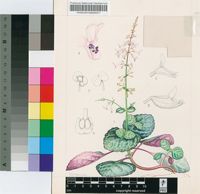
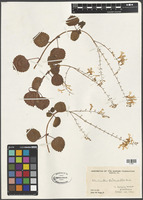
Plectranthus oertendahlii

2 Images see all

Plectranthus oertendahlii T.C.E.Fr.
Filed as Plectranthus oertendahlii T.C.E. Fr. [family LAMIACEAE]
Previous
Next

Name

Identification
Plectranthus oertendahlii T.C.E.Fr. [family LAMIACEAE ]
Related name
  • Plectranthus oertendahlii

Flora

Entry for Plectranthus oertendahlii [family LAMIACEAE]
Herbarium
South African National Biodiversity Institute, Compton Herbarium, Cape Town (SAM)
Collection
Flora of Southern Africa
Resource Type
Reference Sources
Entry From
Flora of South Africa, (2003) Author: Dr J.P. Roux
Names
Plectranthus oertendahlii [family LAMIACEAE]
Information
Perennial semi-succulent herb, freely branched, up to 0,2 m tall; stems decum­bent, rooting at the lower nodes, glandular-tomentose. Leaves petiolate; blade semi-succulent, broadly ovate to suborbicular, 30-40 (-45) X 25-40 (-45) mm, sparingly villous, upper surface light-veined, lower surface purple with colourless gland-dots, apex acute to obtuse, base abruptly cuneate, margin crenate-dentate, ciliate; petiole 15—40 mm long. Inflorescence simple or branched, racemes 70—200 mm long, flowers in sessile, usually 3-flowered cymes, forming 6-flowered verticils 10—15 mm apart. Calyx up to 8 mm long in fruiting stage, glandular-hispidulous. Corolla whit­ish or suffused with pale mauve; tube 8—13 mm long, expanding and forming a saccate base 4 mm deep then narrowing gradually to about 1,75 mm at the throat; upper lip 5 mm long; lower lip concave, 4—5 mm long. Stamens free, 2—3 mm long. Fig. 28:4.
Habitat
Described originally from a cultivated plant in Sweden, said to have been introduced in the early part of this century. Some plants from the wild state may tend to have smallish leaves and the corolla tube about 8—10 mm long and may be confused with P. verticillatus (no. 22) but they may be distinguished by the shorter lower lip of the corolla and the very shortly exserted stamens. Also the leaves are distinctly lighter veined on the upper surface and the under-surface has colourless gland-dots, not red as in P. vrrriciltatus. P. oertendahlii makes an attractive, free-flowering pot-plant.
Use
25. Plectranthus oertendahlii Th. Fries jun. in Acta Hort. Gothoburg. 1: 253 (1924); Codd in Bothalia 11: 411 (1975); Flower. PI. Afr. 44: t.1729 (1977). Type: Cult. Uppsala (UPS, holo.).
Range
Recorded only from the Port Shepstone district, Natal; in wooded river valleys near the coast. Map 86.

Related Materials

  • Terms and Conditions
  • Privacy Policy
  • Cookie Policy
  • Cookie Settings
  • Accessibility
  • Help
  • Contact Us
  • Facebook
  • Twitter
ITHAKA

JSTOR is part of ITHAKA, a not-for-profit organization helping the academic community use digital technologies to preserve the scholarly record and to advance research and teaching in sustainable ways.

©2000-2026 ITHAKA. All Rights Reserved. JSTOR®, the JSTOR logo, JPASS®, Aluka®, and ITHAKA® are registered trademarks of ITHAKA.

╳