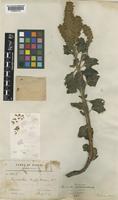
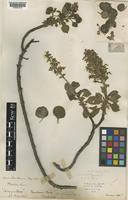
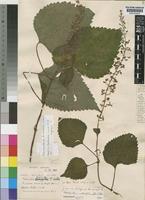
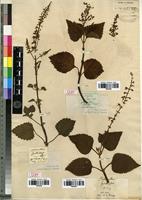
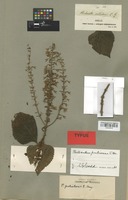
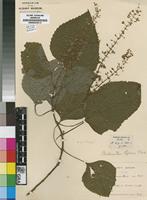
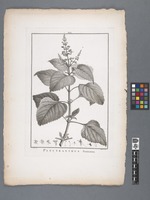
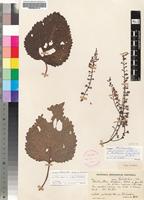
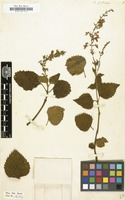
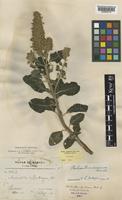
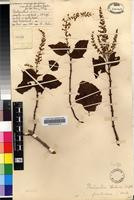
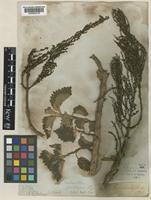
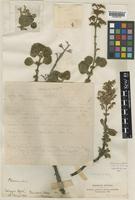
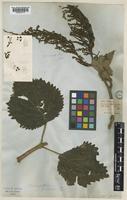
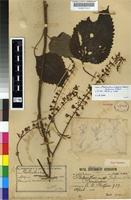
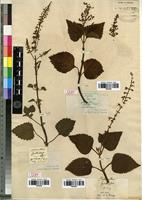
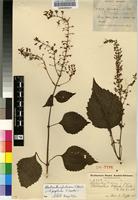
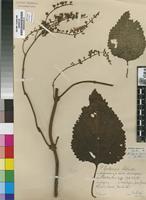
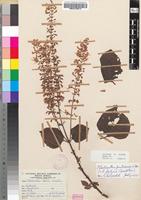
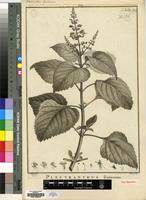
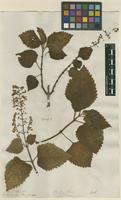
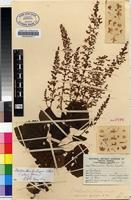
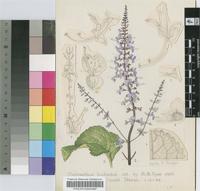
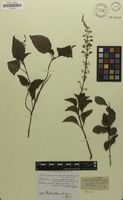
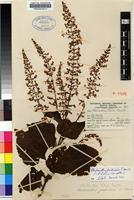
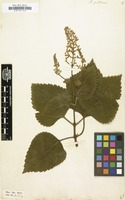
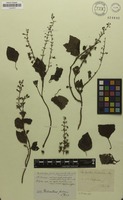
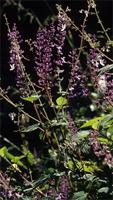
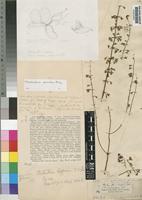
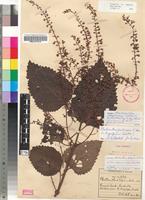
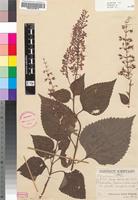
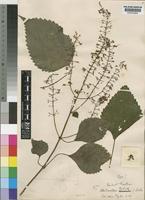
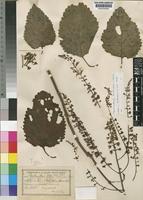
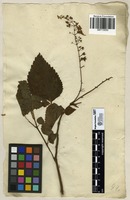
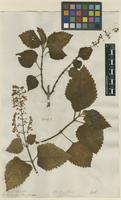
a shrub 3–4 ft. high; stems, petioles and nerves of the leaves pubescent or villous with adpressed rufous hairs; leaves opposite, 3–6 in. long, 2–3 1/4 in. broad, ovate, acute, coarsely doubly crenate-serrate, the younger hispid above with scattered hairs, at length glabrate, punctate, base subcordate, truncate or cuneate; petioles 3/4–1 in. long; inflorescence a lax sparingly-branched panicle 6–9 in. long, often with 2–4 opposite spreading racemes near the base, sometimes an unbranched raceme; verticils about 6-flowered, distant; bracts foliaceous, ovate, acuminate, the lower rather large, reaching 1/2 in. long, becoming smaller upwards; pedicels slender, up to 3/8 in. long; fruiting calyx reaching 4 1/2 lin. long; tube nearly glabrous, with a reflexed upper tooth; flowering calyx 2 lin. long, hairy; upper tooth 1 lin. long, 3/4 lin. broad, ovate, acute; 4 other teeth lanceolate, subulate, 2 lower 1 lin. long, connate below, 2 lateral 1/2 lin. long; corolla blue, nearly 1/2 in. long; tube 3 lin. long, with a spur 1/2 lin. long at the base on the upper side; upper lip 2–2 1/2 lin. long, 4-lobed, 2 upper lobes large, suborbicular, 1 1/2 lin. broad, 2 lateral lobes small, 1/2 lin. long and broad, rounded; lower lip 2 lin. long, 1/2 lin. deep, boat-shaped; upper pair of stamens 2 lin. long; lower pair 3 lin. long; style a little shorter than the lower stamens; stigma equally shortly 2-fid; nutlets ovoid, 1 lin. long, 1/2 lin. broad, brown, dull. null