JSTOR Global Plants Home
  • Home
  • Browse
  • About
  • Access
  • Account
    • Saved Items
    • Profile
  • Log in

Global Plants

Skip to Main Content
  • JSTOR Global Plants Home
  • Global Plants

    • Browse
    • About
    • Access
    • Account
      • Saved Items
      • Profile
Log in
  • Browse
  • About
  • Access
  • Account
    • Saved Items
    • Profile
Advanced Search

Compilation
Platanthera convallariifolia

5 Images see all

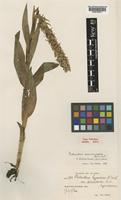
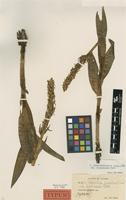
Type of Platanthera hyperborea (L.) Lindl. var. dilatatoides Hultén [family ORCHIDACEAE]
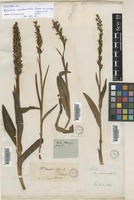
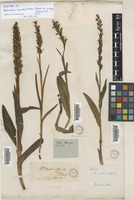
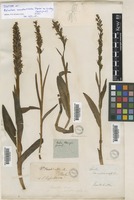
Platanthera convallariifolia (Fisch. ex Lindl.) Lindl. [family ORCHIDACEAE]
Isotype of Platanthera convallariifolia (Fisch. ex Lindl.) Lindl. [family ORCHIDACEAE]
Platanthera convallariifolia (Fisch. ex Lindl.) Lindl. [family ORCHIDACEAE]
Type of Platanthera hyperborea (L.) Lindl. var. dilatatoides Hultén [family ORCHIDACEAE]
Previous
Next

Name

Identification
Platanthera convallariifolia (Fisch. ex Lindl.) Lindl. [family ORCHIDACEAE ] (stored under name); Platanthera hyperborea (L.) Lindl. [family ORCHIDACEAE ] Platanthera koenigii (Gunnerus) Lindl. [family ORCHIDACEAE ]
Related name
  • Orchis koenigii
  • Platanthera koenigii
  • Orchis convallariifolia
  • Platanthera convallariifolia
  • Platanthera hyperborea

Flora

Entry for Platanthera convallariifolia Fischer ex Lindley [family ORCHIDACEAE]
Herbarium
Flora of North America (FNA)
Collection
Flora of North America
Resource Type
Reference Sources
Entry From
Flora of North America, Vol 26,
Names
Platanthera convallariifolia Fischer ex Lindley [family ORCHIDACEAE], Gen. Sp. Orchid. Pl., 287. 1835
Limnorchis convallariifolius (Fischer ex Lindley) Rydberg [family ORCHIDACEAE]
Past names
convallariaefolia
Treatment Author(s)
Charles J. Sheviak
Information
Plants 15–27 cm. Leaves few–several, ascending to rather wide spreading, scattered along stem or commonly loosely clustered on distal portion, gradually reduced to bracts distally; blade elliptic-lanceolate to elliptic-oblong, 4.5–12 × 0.7–2.5 cm. Spikes moderately dense. Flowers resupinate, not showy, sometimes conspicuous, whitish green, perhaps more yellowish on lip; lateral sepals spreading; petals ovate-falcate, margins entire; lip descending, linear to lance-linear, without basal thickening, 4–9 × 1–2 mm, margins entire; spur slenderly to markedly clavate, rarely more slender, 4–8 mm, apex obtuse; rostellum lobes widely divergent, directed downward, slightly angular, very small, obscure; pollinaria straight; pollinia remaining enclosed in anther sacs but apparently often fragmenting; viscidia oblong to oblong-spatulate or elliptic-suborbiculate; ovary slender to stout, mostly 6–10 mm.
Phenology
jun-aug (summer)
Altitude range
0–400 m;
Distribution
Asia (Kamchatka to Hokkaido).USA Alaska
Discussion
Platanthera convallariifolia is commonly reported from the Aleutians and adjacent coastal Alaska based on short, very broad-leaved plants with rather large flowers in dense, thick inflorescences. Those plants, however, apparently represent robust, maritime phenotypes of P. huronensis or in some cases P. stricta or P. dilatata comparable to those seen in Piperia elegans and Spiranthes romanzoffiana. In fact, typical Asiatic Platanthera convallariifolia is a slender-leaved plant entirely comparable in habit to P. huronensis. The two species are very similar, and they share a tetraploid chromosome number. Typical Asiatic P. convallariifolia is characterized by a linear lip and clavate spur about 2/3 to nearly the length of the lip. The lip occasionally varies to slightly lanceolate and the spur to somewhat saccate. The column appears somewhat broader than in P. huronensis, and viscidia also are apparently rather broad. A few specimens from the Aleutians and Alaskan peninsula exhibit these floral characteristics. Vegetatively, however, some Alaskan material is distinctive in the position and orientation of the leaves. In floral and vegetative characters, Alaskan plants furthermore intergrade with P. huronensis. Whether Alaskan plants are truly referable to P. convallariifolia is uncertain, and the status of the Asiatic species also needs study. Both P. convallariifolia and the Alaskan plants here referred to it appear to combine features of P. huronensis and P. stricta. Platanthera convallariifolia may have arisen through hybridization of these two species, or of P. stricta and P. dilatata, thus accounting for the difficulty in identification. The description presented here is based on few Alaskan plants and is apt to be too restrictive; therefore the poor understanding of the plant makes the present delimitation and distinctions from P. huronensis rather arbitrary.

Related Materials

  • Terms and Conditions
  • Privacy Policy
  • Cookie Policy
  • Cookie Settings
  • Accessibility
  • Help
  • Contact Us
  • Facebook
  • Twitter
ITHAKA

JSTOR is part of ITHAKA, a not-for-profit organization helping the academic community use digital technologies to preserve the scholarly record and to advance research and teaching in sustainable ways.

©2000-2026 ITHAKA. All Rights Reserved. JSTOR®, the JSTOR logo, JPASS®, Aluka®, and ITHAKA® are registered trademarks of ITHAKA.

╳