

Compilation
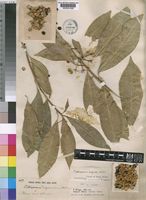
Pittosporum dalzielii
1 Images see all
Name
Identification
Pittosporum dalzielii Hutch. [family PITTOSPORACEAE ] (stored under name); Verified by Hutchinson; Dalziel, Pittosporum abyssinicum Delile [family PITTOSPORACEAE ]
Related name
- Pittosporum abyssinicum
- Pittosporum dalzielii
Flora
Entry for PITTOSPORUM mannii (J. Léon) Cuf. subsp. ripicola [family PITTOSPORACEAE]
Herbarium
Royal Botanic Gardens, Kew (K)
Collection
Flora of Tropical East Africa
Resource Type
Reference Sources
Entry From
Flora of Tropical East Africa, page 1, (1966) Author: G. Cufodontis (University of Vienna)
Names
PITTOSPORUM mannii (J. Léon) Cuf. subsp. ripicola [family PITTOSPORACEAE], in F.Z. 1: 302, t. 54/D (1960) & in Bol. Soc. Brot., sér. 2, 34: 168 (1960); K.T.S.: 380 (1961). Type: Congo Republic, Ubangi-Uele, Dakwa on R. Dolo, Germain 718 (BR, holo. !)
PITTOSPORUM abyssinicum [family PITTOSPORACEAE], [sensu auct. pro parte, quoad Aethiopiam, Sudan, Uganda, non Del.]
PITTOSPORUM mannii [family PITTOSPORACEAE], [sensu auct. pro parte, exceptis Fernando Po et Mt. Cameroon, non Hook. f. sensu stricto]
PITTOSPORUM fragrantissimum [family PITTOSPORACEAE], [sensu De Wild., Pl. Bequaert. 2 : 47 (1923), pro parte max., excepto specim. Battiscombe 644, non Engl.]
PITTOSPORUM dalzielii [family PITTOSPORACEAE], [sensu A. Chev. in Bull. Soc. Bot. Fr. 93: 206 (1946), pro parte max. excepto specim. Dalziel 417, non Hutch.]
PITTOSPORUM ripicola J. Léon [family PITTOSPORACEAE], (as “ ripicolum ”) in B.J.B.B. 20: 47, fig. 7 (1950); Cuf. in Oest. Bot. Zeitschr. 98: 129 (1951); J. Léon, in F.C.B. 2: 579, fig. 9 (1951); Cuf. in F.R. 55: 77, fig. 5/d,e & 8 (1952); I.T.U., ed. 2 : 314 (1952); Tisserant & Sillans in Not. Syst. 15: 92 (1954); E.P.A.: 173 (1954); F.F.N.R.: 66 (1962)
PITTOSPORUM ripicola J. Léon. subsp. katangense [family PITTOSPORACEAE], in B.J.B.B. 20: 227 (1950) & in F.C.B. 2: 580 (1951) prob. huc
Information
Lateral nerves and reticulation of old leaves turning pale but mostly very little or not at all prominulous beneath. Pedicels 3–5.8–10 mm. long. Sepals free, deciduous, up to 3 × 1 mm. (average 1.5 mm. long). Petals 4.5–5.9–7 mm. long, erect with slightly spreading tips. Fertile stamens 4–5.2–6.5 mm. long with 1–1.6–2.5 mm. long anthers; sterile stamens ± 3.5 mm. long with 0.75 mm. long anthers. Fertile gynoecium ± 4.75 mm. long; sterile gynoecium ± 4.5 mm. long. Fig. 1/6, p. 6 & 2/8,9, p. 11.
Range
DISTR. U1–4; K3,5; T1, 4 Ethiopia, Sudan Republic (White Nile District), NE. and SE. Congo Republic, Rhodesia, Central African and Cameroun Republics, S. Nigeria and probably extending into Dahomey, Ivory Coast and Guinée Republic
Altitude range
1140–1650(–2100) m.
Distribution
KENYA Trans-Nzoia District Kitale, June 1942, Webster in Herb. Amani 8741 !KENYA N. Kavirondo District Kakamega, June 1933, Dale in F.D. 3081 !KENYA Kericho, Sept. 1933, Napier 5356 !TANGANYIKA Ngara District Bushubi, Keza, 20 May, 1960, Tanner 4938 !TANGANYIKA Kigoma District Mahali Mts., Sisaga, 29 Aug. 1958, Newbould & Jefford 1923 !UGANDA Busoga District Bunya, Nov. 1937, Webb 46 !UGANDA Mengo District Nambigiluwa [Nambigiruwa] Swamp, Jan. 1932, Eggeling 155 in F.H. 367 ! & 19 km. on Kampala– Entebbe road, Apr. 1932, Eggeling 395 in F.H. 677 !
Notes
Subsp. mannii (fig. 1/5) seems to be restricted to Fernando Po and the Cameroun Republic (Cameroon Mt., Bamenda and the adjacent higher parts of the Bambutos). It differs from subsp. ripicola mainly in the dimensions of the flowers, of which the main features and average measurements are as follows: pedicels 4.9 mm. long; sepals connate at the base and persistent, 1.8 mm. long; petals strongly reflexed, 4.8 × 1.7 mm.; fertile stamens 3.6 mm. long with 1.3 mm. long anthers; sterile stamens (like subsp. ripicola) 3.5 mm. long; fertile gynoecium 3 mm. long; sterile gynoecium 3.5 mm. long. Some difference in ecological requirements must be associated with the noticeably higher altitude records of 915–2600 m. with an average of 1880 m. In the absence of flowers the two subspecies cannot be reliably distinguished, and for this reason all the specimens collected from west of Nigeria cannot be certainly placed. P. mannii replaces P. viridiflorum in the middle and western parts of northern tropical Africa and these closely related species overlap only in Uganda, Kenya and Ethiopia.