JSTOR Global Plants Home
  • Home
  • Browse
  • About
  • Access
  • Account
    • Saved Items
    • Profile
  • Log in

Global Plants

Skip to Main Content
  • JSTOR Global Plants Home
  • Global Plants

    • Browse
    • About
    • Access
    • Account
      • Saved Items
      • Profile
Log in
  • Browse
  • About
  • Access
  • Account
    • Saved Items
    • Profile
Advanced Search

Compilation
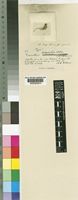
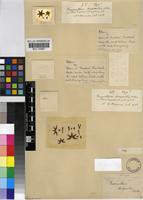
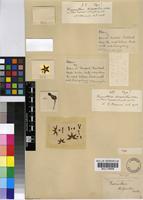
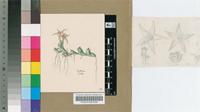
Piaranthus disparilis

4 Images see all

Type of Piaranthus disparilis N.E.Br. [family ASCLEPIADACEAE]
Type of Piaranthus disparilis N.E.Br. [family APOCYNACEAE]
Piaranthus disparilis N.E.Br.
Previous
Next

Name

Identification
Piaranthus disparilis N.E.Br. [family APOCYNACEAE ]
Related name
  • Piaranthus disparilis

Flora

Entry for PIARANTHUS disparilis N. E. Br. [family ASCLEPIADACEAE]
Herbarium
Royal Botanic Gardens, Kew (K)
Collection
Flora Capensis
Resource Type
Reference Sources
Entry From
Flora Capensis, Vol 4, page 518, (1909) Author: By N. E. BROWN.
Names
PIARANTHUS disparilis N. E. Br. [family ASCLEPIADACEAE]
Information
stems not seen, “almost cylindrical, same colour as the flowers” (Pillans), probably similar to those of P. comptus or P. geminatus; pedicels 1/4– 1/2 in. long, glabrous; sepals 1 lin. long, lanceolate, acuminate, recurved at the tips, glabrous; corolla rotate, without a distinct tube, 9–10 lin. in expanse; lobes 1/3 in. long, 1 3/4 lin. broad at the base, lanceolate, acuminate, convex from the margins being slightly recurved, glabrous on the back, velvety-puberulous on the inner face, not ciliate, “pale pinkish-purple, finely marked with transverse pale yellow lines” (Pillans); corona-lobes 3/4 lin. long, closely incumbent upon the backs of the anthers and shortly exceeding them, with the tips very slightly turned up, yellow, without markings, lanceolate or linear-oblong, entire or more or less distinctly 3-toothed at the apex, with the middle tooth much the longest and acute, dorsally produced at the base into a subquadrate crest, truncate and distinctly toothed at the top. null
Distribution
CENTRAL REGION Laingsburg Div.; under bushes between Ladismith and Laingsburg, Pillans, 57! 617!
Notes
The flowers of this species are similar to those of P. Pillansii, but are very much smaller and the crest of the corona-lobes is distinctly toothed, not merely minutely tuberculate. They emit an “odour like bad vinegar,” according to Mr. Pillans.

Related Materials

  • Terms and Conditions
  • Privacy Policy
  • Cookie Policy
  • Cookie Settings
  • Accessibility
  • Help
  • Contact Us
  • Facebook
  • Twitter
ITHAKA

JSTOR is part of ITHAKA, a not-for-profit organization helping the academic community use digital technologies to preserve the scholarly record and to advance research and teaching in sustainable ways.

©2000-2026 ITHAKA. All Rights Reserved. JSTOR®, the JSTOR logo, JPASS®, Aluka®, and ITHAKA® are registered trademarks of ITHAKA.

╳