JSTOR Global Plants Home
  • Home
  • Browse
  • About
  • Access
  • Account
    • Saved Items
    • Profile
  • Log in

Global Plants

Skip to Main Content
  • JSTOR Global Plants Home
  • Global Plants

    • Browse
    • About
    • Access
    • Account
      • Saved Items
      • Profile
Log in
  • Browse
  • About
  • Access
  • Account
    • Saved Items
    • Profile
Advanced Search

Compilation
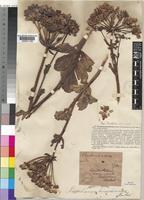
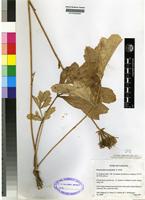
Physotrichia heracleoides

2 Images see all

Physotrichia muriculata (Welw. ex Hiern) S.Droop; C.C. [family UMBELLIFERAE]
Isotype of Physotrichia heracleoides H. Wollf [family UMBALLIFERAE]
Previous
Next

Name

Identification
Isotype of Physotrichia heracleoides H. Wollf [family UMBALLIFERAE ] (stored under name);
Related name
  • Physotrichia heracleoides

Flora

Entry for Physotrichia heracleoides H. Wolff [family UMBELLIFERAE]
Herbarium
Royal Botanic Gardens, Kew (K)
Collection
Flora Zambesiaca
Resource Type
Reference Sources
Entry From
FZ, Vol 4, Part 0, page 553, (1978) Author: M. L. Gonçalves
Names
Physotrichia heracleoides H. Wolff [family UMBELLIFERAE], in Engl., Bot. Jahrb. 48: 273 (1912). TAB. 159. Type from Zaire.
Information
Robust to wiry biennial or perennial herbs up to 80 cm. high, with scattered short bristly hairs which often become dense on the peduncles and rays. Rootstock woody; stem terete with regular rather coarse grooves. Leaves mostly basal, those on the stem much reduced and present on the inflorescence only as sheathing bases with small appendages. Basal leaves simple with 3–5 broadly rounded subpalmate lobes up to 15 × 20 cm., to 2-ternate with leaflets similar to the lobes of the simple leaves; apex broadly to slightly emarginate, base cordate; margins ± regularly denticulate; petioles up to 20 cm. long, with slightly sheathing bases. Umbels terminal and lateral on long peduncles. Terminal umbels with 20–30 rays up to 4 cm. long; bracts and bracteoles very well developed and often conspicuous. Bracts 10–15, 2–2·5 cm. long, linear to narrowly lanceolate, bracteoles similar, up to 1·25 cm. long; both are either entire or may be markedly fimbriate (see notes). Partial umbels with 9–30 flowers on pedicels 5–12 mm. long. Calyx teeth well developed, narrowly triangular to subulate; petals white to pale cream. Fruit 5–3 mm. long, ellipsoid to ovoid, slightly dorsiventrally compressed, covered with vesicular hairs especially on the ribs. Stylopodium conical; styles short and often shed from the maturing fruit. Ribs obtuse; vittae well developed, 1 in each interval, obvious externally and occupying most of the space between the ribs, and 2 in the commissural space. Carpophore divided to the base, seed very slightly concave on the commissural face.
Habitat
In open Brachystegia woodland
Altitude range
1500–2000 m.
2000
1500
Distribution
Malawi N 8 km. N. of Chisenga, fl. & fr. 22.ii.1970, Drummond & Williamson 9920 (BM; SRGH).Zambia N Danger Hill, 29 km. NNE. of Mpika, fl. & fr. 18.ii.1970, Drummond & Williamson 9704 (BM; SRGH).
Distribution (external)
Zaire
Tanzania
Notes
A rather poorly-known species which, as treated here, includes two distinct elements. One has slender stems, with entire bracts and bracteoles, the other is a more robust plant with fimbriate bracts and bracteoles. The former includes the type; the latter, which is illustrated in tab. 159, has only been collected in Zambia, round Mbala, e.g. Siame 67a (BM; SRGH), E. M. & W. 1234 (BM; SRGH) and Richards (SRGH). Although superficially the plants look strikingly different, some intergradation is apparent and in view of the limited information available it seems best for the present to draw attention to the Abercorn plants without according formal recognition.

Related Materials

  • Terms and Conditions
  • Privacy Policy
  • Cookie Policy
  • Cookie Settings
  • Accessibility
  • Help
  • Contact Us
  • Facebook
  • Twitter
ITHAKA

JSTOR is part of ITHAKA, a not-for-profit organization helping the academic community use digital technologies to preserve the scholarly record and to advance research and teaching in sustainable ways.

©2000-2026 ITHAKA. All Rights Reserved. JSTOR®, the JSTOR logo, JPASS®, Aluka®, and ITHAKA® are registered trademarks of ITHAKA.

╳