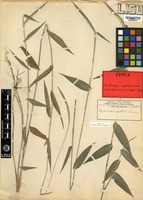
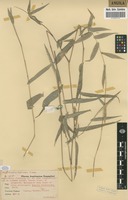
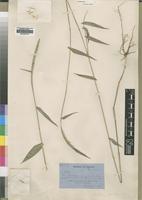
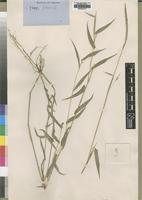
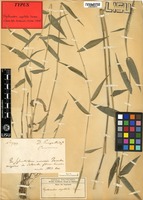
Perennial; innovations extravaginal, like the base of the culm bearing short straw-coloured coriaceous cataphylls. Culms geniculate at the base, 2 1/4–3 1/2 ft. long, terete, stiff, branched from about the middle with the branches erect, 9–10-noded, glabrous and smooth. Leaf-sheaths from one-third to half the length of the internodes, terete, moderately loose, striate, ciliolate on the margins, smooth or usually loosely tuberculate upwards; ligule reduced to a very short obscurely ciliolate rim; blade ovate-lanceolate from a deeply sagittate base with the lobes obtuse and about 1/4 in. long, tapering to an acute or subacute tip, 1 3/4–3 in. long, up to 9 lin. wide, folded or at length flat, spreading or becoming deflexed, firm, glabrous, smooth except for a few minute prickles or tubercles on the midrib (beneath) towards the base and spinously scabrid on the margins; midrib very slender, lateral nerves somewhat obscure, 3–4 on each side of the midrib. False spike at length exserted from the uppermost leaf-sheath, up to 4 1/2 in. long, slightly curved, green; rhachis thin, up to 4 1/2 lin. wide when flattened, tapering to a subacute tip, glabrous and smooth, finely nerved with parallel close slanting nerves, midrib moderately slender, bearing the very short stumps of the 12–20 clusters at intervals of 2–2 1/2 lin.; clusters about 1/2 in. long, their rhachis oblong, flat or slightly convex, minutely lobed at the apex, 3 1/2–4 lin. long, up to 1 lin. wide, smooth except for the minutely scaberulous margins. Female spikelet 6 1/2–7 lin. long; lower glume about 1/2 lin. long, scaberulous; upper glume 2–2 1/2 lin. long; lower valve obscurely scaberulous on the nerves, minutely ciliolate on the margins; upper valve very slightly shorter than the lower, glabrous and smooth; lodicules 3/4 lin. long; rudimentary anthers about 1/20 lin. long, borne on capillary filaments 1/4 lin. long; grain 3 lin. long. Male spikelets 3 1/2–4 lin. long; lower glume about 1/4 lin. long; upper glume lanceolate, 1–1 1/4 lin. long; lower valve lanceolate and obtuse when flattened, scaberulous; upper valve ciliolate on the keel; filaments capillary, up to 3 1/2 lin. long. Axillary inflorescence with the peduncle up to 2 1/2 in. long, thickened and minutely hairy towards the apex; rhachis 1–1 1/2 lin. long. Spikelets 9 1/2–10 lin. long, green; lower glume 3 1/2–4 lin. long, scaberulous upwards; upper glume, 4 1/2 lin. long, ciliolate on the margins.