JSTOR Global Plants Home
  • Home
  • Browse
  • About
  • Access
  • Account
    • Saved Items
    • Profile
  • Log in

Global Plants

Skip to Main Content
  • JSTOR Global Plants Home
  • Global Plants

    • Browse
    • About
    • Access
    • Account
      • Saved Items
      • Profile
Log in
  • Browse
  • About
  • Access
  • Account
    • Saved Items
    • Profile
Advanced Search

Compilation
Philippia excelsa

3 Images see all

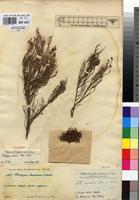
Isotype of Philippia excelsa Alm. & T.C.E.Fr. [family ERICACEAE]
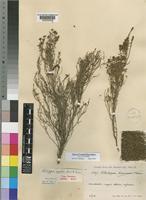
Type of Philippia excelsa Alm & T.C.E.Fr. [family ERICACEAE]
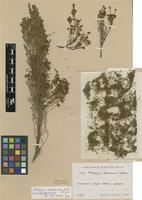
Isotype of Philippia excelsa Alm & T.C.E.Fr. [family ERICACEAE]
Previous
Next

Name

Identification
Isotype of Philippia excelsa Alm. & T.C.E.Fr. [family ERICACEAE ] Verified by Not on sheet, Erica rossii Dorr [family ERICACEAE ] (stored under name); Verified by Not on sheet,
Related name
  • Erica rossii
  • Philippia excelsa
  • Philippia keniensis

Flora

Entry for Erica rossii Dorr [family ERICACEAE]
Herbarium
Royal Botanic Gardens, Kew (K)
Collection
Flora of Tropical East Africa
Resource Type
Reference Sources
Entry From
Flora of Tropical East Africa, page 1, (2006) Author: HENK BEENTJE
Names
Erica rossii Dorr [family ERICACEAE], in Novon 4: 220 (1994). Type: Kenya, Mt Kenya, Fries & Fries 1387 (UPS, holo.; BR, K!, S, iso.)
Philippia johnstonii Engl. [family ERICACEAE], P.O.A. C: 302 (1895); Z.A.E.: 511 (1914); A.V.P.: 143, 301 (1957); Hamilton, Uganda For. Trees: 80 (1981). Type: Congo-Kinshasa, Ruwenzori, Stuhlmann 2374 & 2458 (B†, syn.), non Erica johnstoniana Britten; syn. nov.
Philippia excelsa Alm & T.C.E.Fr. [family ERICACEAE], in K. Svenska Vetensk.-Akad. Handl. ser. 3, 4 (4): 41 (1927); T.T.C.L.: 193 (1949); A.V.P.: 143 (1957); K.T.S.: 180 (1961); Hamilton, Uganda For. Trees: 80 (1981)
Erica excelsa (Alm & T.C.E.Fr.) Beentje [family ERICACEAE], in Utafiti 3, 1: 13 (1990); K.T.S.L.: 444, map (1994)
Information
Shrub or tree 0.3– 15 m high, trunk up to 15 cm in diameter with brittle wood; much branched; bark dark brown; branchlets pubescent with minute simple hairs to 0.4 mm long. Leaves in whorls of 3, erect, porrect or spreading, fleshy, narrowly ovate or linear, 1.2– 4.8 mm long, 0.3– 0.9 mm wide, apex obtuse, sulcate beneath, often shiny with resinous exudate, glabrous but for the margins which have minute hairs and/or glands when young; petiole 0.3– 0.7 mm long, glabrous. Flowers 3– 9 in fascicles or umbels at branch apices; pedicel pink, 1.2– 4 mm long, glabrous or with very few hairs near base. Calyx (apparent calyx; all three lobes are really recaulescent bract + bracteoles) 0.6– 1.2 mm long, connate to 1/4 or 1/2, glabrous, three lobes ovate, 0.3– 0.7 mm wide, acute, glabrous or minutely ciliolate, one free (the bract), longer and wider at base, 1– 2.5 mm long, 0.4– 0.6 mm wide, sometimes with green apex. Corolla reddish or pink to greenish white, 3-merous, shortly campanulate, 1.2– 1.9 mm long, 1.3– 1.9 mm in diameter, widest at mouth, glabrous, lobes 0.4– 0.7 mm long, rounded, glabrous. Anthers red, 6– 7, 0.9– 1 mm long, the tips usually slightly exserted. Ovary 3– locular; style 0.4– 2 mm long, glabrous, stigma crimson, flat and peltate, circular, 0.2– 0.7 mm long, 0.6– 1.3 mm diameter. Fruit loculicidal, 1– 1.8 mm long, glabrous. 
Range
DISTR. U 2, 3; K 3, 4; T 2 endemic to Ruwenzori and Virunga Mts, Elgon, the Nyandarua/ Aberdares, Mt Kenya, Mt Hanang, Mt Meru and Kilimanjaro; presumably also in Congo-Kinshasa and Rwanda
Altitude range
(1800– )2300– 4050 m
Distribution
KENYA Elgon, Apr. 1954, Tweedie 1154!KENYA Kiambu District S Kinangop, Kibata, Nov. 1959, Kerfoot 1460!KENYA Mt Kenya, near Naro Moru Lodge, July 1971, Hedberg 5022!TANZANIA Mbulu District Mt Hanang, Oct. 1968, Carmichael 1525!TANZANIA Arusha District Mt Meru, W slopes above Olkakola, Oct. 1948, Hedberg 2356!TANZANIA Kilimanjaro, above Mandera Hut, Sep. 1993, Grimshaw 93/691!UGANDA Ruwenzori Mts, Nyabitaba Hut, Jan. 1967, Perdue & Kibuwa 8430!UGANDA Kigezi District Mt Muhavura, Oct. 1948, Hedberg 2259! & Echuya Forest Reserve, Apr. 1970, Katende 217!
Notes
USES. None recordedCONSERVATION Least concern (LC), widespread in a common habitat range See Hemp & Beck on this species as a fire-tolerating component of forests on Kilimanjaro in Phoetocoenologia 31, 4: 449– 475 (2001). Dale 1000 from K 3: Kenya, Equator, Mar. 1957, is close, but has a minute reddish tomentum on stems, leaves and flowers.I have added Philippia johnstonii to the synonymy. There are no distinguishing characters. Hedberg already considered this taxon very close to P. excelsa. Engler in the protologue has Ph. johnstonii (Schweinf.) Engl. but there is no indication what the basionym would have been, nor have I been able to trace any.

Related Materials

  • Terms and Conditions
  • Privacy Policy
  • Cookie Policy
  • Cookie Settings
  • Accessibility
  • Help
  • Contact Us
  • Facebook
  • Twitter
ITHAKA

JSTOR is part of ITHAKA, a not-for-profit organization helping the academic community use digital technologies to preserve the scholarly record and to advance research and teaching in sustainable ways.

©2000-2026 ITHAKA. All Rights Reserved. JSTOR®, the JSTOR logo, JPASS®, Aluka®, and ITHAKA® are registered trademarks of ITHAKA.

╳