JSTOR Global Plants Home
  • Home
  • Browse
  • About
  • Access
  • Account
    • Saved Items
    • Profile
  • Log in

Global Plants

Skip to Main Content
  • JSTOR Global Plants Home
  • Global Plants

    • Browse
    • About
    • Access
    • Account
      • Saved Items
      • Profile
Log in
  • Browse
  • About
  • Access
  • Account
    • Saved Items
    • Profile
Advanced Search

Compilation
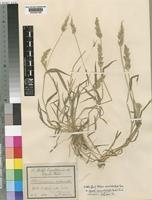
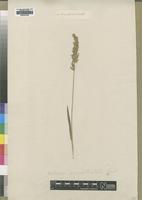
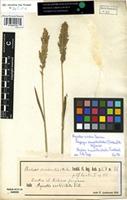
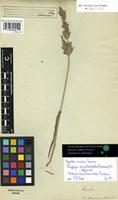
Phalaris semiverticillata

4 Images see all

Polypogon viridis (Gouan) Breistr. [family POACEAE]
Syntype of Phalaris semiverticillata Forssk. [family GRAMINEAE]
Type of Phalaris semiverticillata Forssk. [family POACEAE]
Previous
Next

Name

Identification
Phalaris semiverticillata Forssk. [family POACEAE ] Polypogon semiverticillatus (Forssk.) Hyl. [family POACEAE ] (stored under name);
Related name
  • Phalaris semiverticillata
  • Phalaris disticha
  • Agrostis semiverticillata
  • Polypogon viridis
  • Polypogon semiverticillatus
  • Agrostis viridis
  • Agrostis verticillata

Flora

Entry for AGROSTIS semiverticillata C. Christ. [family POACEAE]
Herbarium
Royal Botanic Gardens, Kew (K)
Collection
Flora of Tropical Africa
Resource Type
Reference Sources
Entry From
Flora of Tropical Africa, Vol 10, page 1, (1937) Author: (By C. E. HUBBARD.)
Names
AGROSTIS semiverticillata C. Christ. [family POACEAE], in Dansk Bot. Arkiv. iv. no. 3, 12, (1922).
AGROSTIS verticillata Vill. [family POACEAE], Prosp. Fl. Dauph. 16 (1779), and Hist. Pl. Dauph. ii. 74; Trin. Sp. Gram. Ic. i. t. 36, and in Mém. Acad. Pétersb. Sér. 6, vi. pt. 2, 358; Reichb. Ic. Fl. Germ. i. t. 35, fig. 1435; Schmidt, Beitr. Fl. Cap. Verd. Ins. 143; Steud. Syn. Pl. Glum. i. 169; Boiss. Fl. Orient. v. 513; Penzig in Atti Congr. Bot., Genova, 364 (1892); Durand & Schinz, Consp. Fl. Afr.v. 829; Schweinf. in Bull. Herb. Boiss. ii. App. 2, 30, 98; Battand. & Trab. Fl. Algér. Monocot. 150; Henriq. in Bol. Soc. Brot. xiii. 133; Hook. f. Fl. Brit. Ind. vii. 254; Aschers. & Graebn. Syn. Mitteleurop. Fl. ii. I. 177; Stapf in Dyer, Fl. Cap. vii. 546; Chiov. in Ann. Istit. Bot. Roma, viii. 52, 341; Muschl. Man. Fl. Egypt, i. 89; Rouy, Fl. France, xiv. 59; Maire in Mém. Soc. Hist. Nat. Afr. Nord, no. 3, I. II. 64; Chevalier in Rev. Bot. Appl. Agric. Trop. 1934, 45.
AGROSTIS aquatica Pourr. [family POACEAE], in Mém. Acad. Toul. iii. 306 (1788).
AGROSTIS rivularis Brot. [family POACEAE], Fl. Lusit. i. 75 (1804).
AGROSTIS alba Pers. var. verticillata [family POACEAE], Syn. i. 76 (1805).
AGROSTIS densa Bieb. [family POACEAE], Fl. Taur.-Cauc. i. 56 (1808).
AGROSTIS Villarsii Poir. [family POACEAE], in Lam. Encycl. Suppl. i. 251 (1810).
AGROSTIS decumbens Muhl. [family POACEAE], in Elliot, Sk. Bot. S. Carol. & Georg. i. 136 (1816).
AGROSTIS stolonifera St.-Amans var. verticillata [family POACEAE], Fl. Agen. 28 (1821).
AGROSTIS anatolica C. Koch [family POACEAE], in Linnæa, xxi. 379 (1848).
AGROSTIS stolonifera Parl. [family POACEAE], in Hook. Niger Fl. 187; Hitchc. in U.S. Dept. Agric. Bur. Pl. Industr. Bull. no. 68, 24; Chevalier in Rev. Bot. Appl. Agric. Trop. 1935, 1046; not of Linn.
AGROSTIS adscendens Lange [family POACEAE], Pug. Pl. Hisp. 33 (in Naturhist. Foren. Vidensk. Meddel. 1860).
AGROSTIS alba Engl. var. schimperiana [family POACEAE], Hochgebirgsfl. Trop. Afr. 128 (as to Schimper, 1086).
Phalaris semiverticillata Forsk. [family POACEAE], Fl. Ægypt.-Arab. 17 (1775).
Vilfa verticillata Beauv. [family POACEAE], Agrost. 182 (1812).
Agrestis verticillata Bubani [family POACEAE], Fl. Pyr. iv. 282 (1901).
Polypogon littoralis Hook. f. var. muticus [family POACEAE], Fl. Brit. Ind. vii. 246 (1896).
Information
A loosely tufted or creeping perennial, 1/3–2 ft. high. Culms usually geniculately ascending, sometimes from a prostrate base and rooting at the lower nodes, slender, 4- or more-noded, simple, glabrous and smooth; internodes finally exserted. Leaves glabrous; sheaths prominently striate, rather loose, smooth, or upwards scaberulous; ligule oblong, 1–2 lin. long, scarious, asperulous on the back; blade linear, tapering to an acute tip, 1–8 in. long, 1–4 1/2 lin. wide, flat, flaccid or rather stiff, spreading, green, finely nerved, scaberulous. Panicle erect, oblong to ovate-oblong, more or less spike-like, interrupted or lobed, dense, 1–4 in. long, 1/4–1 1/2 in. wide; rhachis relatively stout below, rigid, smooth; branches fascicled, unequal, divided from the base, densely spiculate, smooth or slightly scaberulous, the lowest up to 1 1/2 in. long; pedicels very short. Spikelets oblong, at length gaping, 3/4–1 lin. long, greenish; rhachilla not, or only very obscurely, produced. Glumes equal or subequal, narrowly oblong in profile, obtuse or subacute, firmly membranous, 1-nerved, scabrid, minutely ciliolate on the margins. Valve broadly oblong when flattened, 2/5– 1/2 lin. long, truncate, minutely denticulate, glabrous, smooth, thin, faintly 5-nerved, or almost nerveless, awnless; callus glabrous. Valvule oblong, obtuse, nearly as long as the valve, hyaline, obscurely 2-nerved. Anthers up to 1/3 lin. long. Grain obovoid, nearly 1/2 lin. long.
Range
Widely spread in the Mediterranean Region; introduced into South Africa, Southern Australia, North and South America.
Distribution
Eritrea Nile Land Saganeiti, Marakhat Valley, 7000–7300 ft., Schweinfurth & Riva, 838! Ocule Cusai; in the woods of Mt. Metaten, 8300 ft., Pappi, 1515! Also from various other localities in Eritrea, according to Schweinfurth (l.c.) and Chiovenda (l.c.).Abyssinia Nile Land rocky gorge near Anadehr, 7400 ft., Schimper, 1086! Lake Harimiya, Drake-Brockman, 46! Mulkajibri, floating in stream, 5400 ft., Gillet, 5082!Cape Verde Upper Guinea St. Vincent, Vogel, 94! Moseley ! St. Nicholas, Cardoso. St. Antonio; Pombas to Janela, Chevalier, 45304; Covao, Chevalier, 45451, 45525! without precise locality, Cardoso, 175!

Related Materials

  • Terms and Conditions
  • Privacy Policy
  • Cookie Policy
  • Cookie Settings
  • Accessibility
  • Help
  • Contact Us
  • Facebook
  • Twitter
ITHAKA

JSTOR is part of ITHAKA, a not-for-profit organization helping the academic community use digital technologies to preserve the scholarly record and to advance research and teaching in sustainable ways.

©2000-2026 ITHAKA. All Rights Reserved. JSTOR®, the JSTOR logo, JPASS®, Aluka®, and ITHAKA® are registered trademarks of ITHAKA.

╳