JSTOR Global Plants Home
  • Home
  • Browse
  • About
  • Access
  • Account
    • Saved Items
    • Profile
  • Log in

Global Plants

Skip to Main Content
  • JSTOR Global Plants Home
  • Global Plants

    • Browse
    • About
    • Access
    • Account
      • Saved Items
      • Profile
Log in
  • Browse
  • About
  • Access
  • Account
    • Saved Items
    • Profile
Advanced Search

Compilation
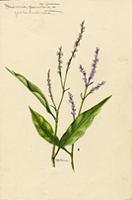
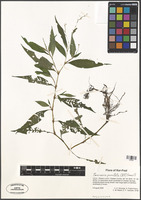
Persicaria punctata

10 Images see all

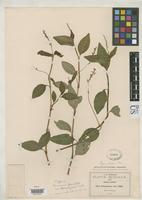
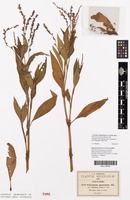
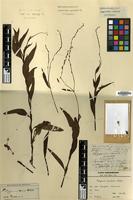
Holotype of Persicaria punctata var. tacubayana Nieuwland, J.A.A. 1913 [family POLYGONACEAE]
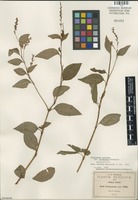
Isotype of Polygonum punctatum Small var. eciliatum [family POLYGONACEAE]
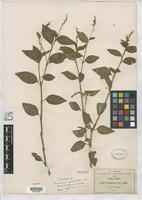
Isotype of Persicaria punctata var. tacubayana Nieuwl. [family POLYGONACEAE]
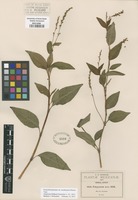
Isotype of Persicaria punctata var. tacubayana Nieuwland, J. A. 1913 [family POLYGONACEAE]
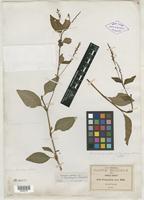
Type of Persicaria punctata (Elliott) Small var. tacubayana Nieuwl. [family POLYGONACEAE]
Isotype of Persicaria punctata var. tacubayana Nieuwl. [family POLYGONACEAE]
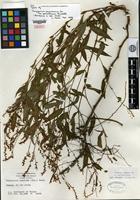
Isotype of Polygonum punctatum Elliott var. parviflorum Fassett [family POLYGONACEAE]
Type of Polygonum macrochaetum Miq. [family POLYGONACEAE]
Persicaria punctata
Filed as Persicaria punctata (Elliott) Small [family POLYGONACEAE]
Previous
Next

Name

Identification
Persicaria punctata (Elliott) Small [family POLYGONACEAE ]
Related name
  • Persicaria punctata
Common name
  • Dotted smartweed, Flora of North America Vol. 5
  • r enouée robuste, Flora of North America Vol. 5
  • r enouée ponctuée, Flora of North America Vol. 5
  • Stout smartweed, Flora of North America Vol. 5

Flora

Entry for Persicaria robustior ( Small) E. P. Bicknell [family POLYGONACEAE]
Herbarium
Flora of North America (FNA)
Collection
Flora of North America
Resource Type
Reference Sources
Entry From
Flora of North America, Vol 5,
Names
Persicaria robustior ( Small) E. P. Bicknell [family POLYGONACEAE], Bull. Torrey Bot. Club, 36: 455. 1909
Polygonum punctatum Elliott var. robustius Small [family POLYGONACEAE], Bull. Torrey Bot. Club, 21: 477. 1894
Persicaria punctata (Elliott) Small var. robustior (Small) Small [family POLYGONACEAE]
Polygonum punctatum var. majus (Meisner) Fassett [family POLYGONACEAE]
Polygonum robustius (Small) Fernald [family POLYGONACEAE]
Treatment Author(s)
Harold R. Hinds†
Craig C. Freeman
Information
Plants perennial, 3–20 dm; roots also sometimes arising from proximal nodes; rhizomes present, stolons sometimes present. Stems ascending, usually branched proximally, scarcely ribbed, glabrous, glandular-punctate; branches sometimes creeping and rooting at nodes. Leaves: ocrea light brown, cylindric, 10–15 mm, chartaceous, base inflated, margins truncate, ciliate with bristles 3–12 mm, surface strigose, glandular-punctate; petiole 0.2–2 cm, glandular-punctate; blade without dark triangular or lunate blotch adaxially, lanceolate to elliptic-lanceolate, 4–20 × 2–4.5 cm, base tapered, margins antrorsely strigose, apex acute to acuminate, faces glabrous or main veins scabrous, glandular-punctate. Inflorescences terminal and axillary, erect, uninterrupted, 20–80 × 5–10 mm; peduncle 5–40 mm, glandular-punctate; ocreolae usually overlapping, margins eciliate or proximal ones sometimes ciliate with bristles to 1 mm. Pedicels ascending to spreading, 2–5 mm. Flowers 2–4 per ocreate fascicle, homostylous; perianth greenish proximally, white distally, glandular-punctate with punctae ± uniformly distributed, slightly accrescent; tepals 5, connate ca.1/3 their length, obovate, 3.2–4.2 mm, veins prominent or not, not anchor-shaped, margins entire, apex obtuse to rounded; stamens 6–8, included; anthers pink or red, elliptic; styles 3, connate proximally. Achenes included or apex exserted, dark brown to brownish black, 3-gonous, 2.7–3.6 × 2–2.5 mm, shiny, smooth.
Phenology
jul-aug (summer), sep-oct (fall)
Altitude range
0–1500 m;
Distribution
West IndiesCentral AmericaSouth America.USA Conn.USA Del.USA Fla.USA Ind.USA Ky.USA MaineUSA Md.USA Mass.USA Mich.USA Mo.USA N.H.USA N.J.USA N.Y.USA OhioUSA Pa.USA R.I.USA Tex.USA Va.Canada N.S.Canada Ont.Canada Que.
Discussion
Persicaria robustior often is synonymized with P. punctata.

Related Materials

  • Terms and Conditions
  • Privacy Policy
  • Cookie Policy
  • Cookie Settings
  • Accessibility
  • Help
  • Contact Us
  • Facebook
  • Twitter
ITHAKA

JSTOR is part of ITHAKA, a not-for-profit organization helping the academic community use digital technologies to preserve the scholarly record and to advance research and teaching in sustainable ways.

©2000-2026 ITHAKA. All Rights Reserved. JSTOR®, the JSTOR logo, JPASS®, Aluka®, and ITHAKA® are registered trademarks of ITHAKA.

╳