JSTOR Global Plants Home
  • Home
  • Browse
  • About
  • Access
  • Account
    • Saved Items
    • Profile
  • Log in

Global Plants

Skip to Main Content
  • JSTOR Global Plants Home
  • Global Plants

    • Browse
    • About
    • Access
    • Account
      • Saved Items
      • Profile
Log in
  • Browse
  • About
  • Access
  • Account
    • Saved Items
    • Profile
Advanced Search

Compilation
Persicaria pensylvanica

9 Images see all

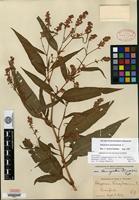
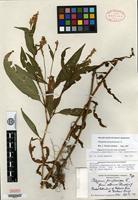
Holotype of Polygonum pensylvanicum Linnaeus var. laevigatum Fernald [family POLYGONACEAE]
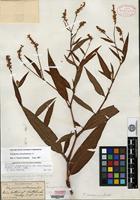
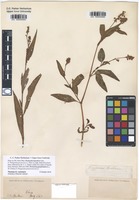
Holotype of Polygonum pensylvanicum Linnaeus var. durum Stanford [family POLYGONACEAE]
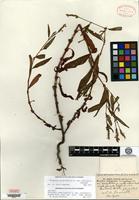
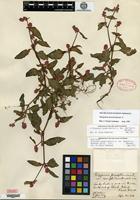
Isotype of Polygonum pensylvanicum Linnaeus var. viridialbum Farwell [family POLYGONACEAE]
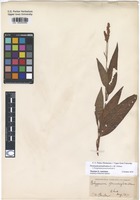
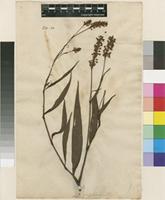
Filed as Persicaria pensylvanica (L.) M. Gómez [family POLYGONACEAE]
Holotype of Polygonum pensylvanicum Linnaeus f. albinum Fernald [family POLYGONACEAE]
Filed as Persicaria pensylvanica (L.) M. Gómez [family POLYGONACEAE]
Holotype of Polygonum pensylvanicum Linnaeus var. nesophilum Fernald [family POLYGONACEAE]
Lectotype of Polygonum pensylvanicum L. [family POLYGONACEAE]
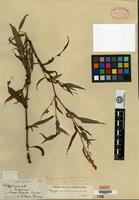
Holotype of Polygonum mississippiense Stanford [family POLYGONACEAE]
Previous
Next

Name

Identification
Persicaria pensylvanica (Linnaeus) M. Gomez [family POLYGONACEAE ] (stored under name); Verified by Not on Sheet, Polygonum mississippiense Stanford [family POLYGONACEAE ] Verified by Stanford, 1925 Polygonum mexicanum (Small) Small [family POLYGONACEAE ] Verified by C. A. Weatherby, 1922 Polygonum mississippiense Stanford [family POLYGONACEAE ] Verified by E. E. Stanford, 1924
Related name
  • Polygonum mexicanum
  • Polygonum pensylvanicum
  • Polygonum mississippiense
  • Persicaria pensylvanica
Common name
  • renouée de Pennsylvanie, Flora of North America Vol. 5
  • Pennsylvania smartweed, Flora of North America Vol. 5

Flora

Entry for Persicaria pensylvanica (Linnaeus) M. Gómez [family POLYGONACEAE]
Herbarium
Flora of North America (FNA)
Collection
Flora of North America
Resource Type
Reference Sources
Entry From
Flora of North America, Vol 5,
Names
Persicaria pensylvanica (Linnaeus) M. Gómez [family POLYGONACEAE], Anales Inst. Segunda Enseñ., 2: 278. 1896
Polygonum pensylvanicum Linnaeus [family POLYGONACEAE], Sp. Pl., 1: 362. 1753
Persicaria mississippiensis (Stanford) Small [family POLYGONACEAE]
Persicaria pensylvanica var. dura (Stanford) C. F. Reed [family POLYGONACEAE]
Polygonum omissum Greene [family POLYGONACEAE]
Polygonum pensylvanicum var. durum Stanford [family POLYGONACEAE]
Polygonum pensylvanicum var. eglandulosum Myers [family POLYGONACEAE]
Polygonum pensylvanicum var. laevigatum Fernald [family POLYGONACEAE]
Polygonum pensylvanicum var. nesophilum Fernald [family POLYGONACEAE]
Polygonum pensylvanicum var. rosiflorum Norton [family POLYGONACEAE]
Treatment Author(s)
Harold R. Hinds†
Craig C. Freeman
Information
Plants annual, 1–20 dm; roots also occasionally arising from basal nodes; rhizomes and stolons absent. Stems ascending to erect, simple or branched, ribbed, glabrous or appressed-pubescent distally, eglandular or stipitate-glandular distally. Leaves: ocrea brownish, cylindric, 5–20 mm, chartaceous, base inflated, margins truncate, eciliate or ciliate with bristles to 0.5 mm, surface glabrous or appressed-pubescent, eglandular; petiole 0.1–2(–3) cm, glabrous or appressed-pubescent; blade sometimes with dark triangular or lunate blotch adaxially, narrowly to broadly lanceolate, 4–17(–23) × (0.5–)1–4.8 cm, base tapered to cuneate, margins antrorsely scabrous, apex acuminate, faces glabrous or appressed-pubescent, eglandular or glandular-punctate abaxially and occasionally adaxially. Inflorescences terminal and axillary, erect or rarely nodding, uninterrupted, 5–50 × 5–15 mm; peduncle 10–55(–70) mm, glabrous or pubescent, usually stipitate-glandular; ocreolae overlapping, margins eciliate or ciliate with bristles to 0.5 mm. Pedicels ascending, 1.5–4.5 mm. Flowers 2–14 per ocreate fascicle, homostylous; perianth greenish white to roseate, glabrous, not glandular-punctate, accrescent; tepals 5, connate ca. 1/4–1/3 their length, obovate to elliptic, 2.5–5 mm, veins prominent, not anchor-shaped, margins entire, apex obtuse to rounded; stamens 6–8, included; anthers yellow, pink, or red, elliptic; styles 2(–3), connate at bases. Achenes included or apex exserted, brown to black, discoid or, rarely, 3-gonous, without central hump on 1 side, 2.1–3.4 × 1.8–3 mm, shiny, smooth. 2n = 88.
Phenology
may (spring), jun-aug (summer), sep-nov (fall), dec (winter)
Altitude range
0–1800 m;
Distribution
South America (Ecuador)Europe (England).Europe (Spain).USA Ala.USA AlaskaUSA Ariz.USA Ark.USA Calif.USA Colo.USA Conn.USA Del.USA D.C.USA Fla.USA Ga.USA Ill.USA Ind.USA IowaUSA Kans.USA Ky.USA La.USA MaineUSA Md.USA Mass.USA Mich.USA Minn.USA Miss.USA Mo.USA Mont.USA Nebr.USA Nev.USA N.H.USA N.J.USA N.Mex.USA N.Y.USA N.C.USA N.Dak.USA OhioUSA Okla.USA Pa.USA R.I.USA S.C.USA S.Dak.USA Tenn.USA Tex.USA UtahUSA Vt.USA Va.USA W.Va.USA Wis.USA Wyo.Canada N.B.Canada Nfld. and Labr. (Nfld.)Canada N.S.Canada Ont.Canada Que.
Discussion
Persicaria pensylvanica is a morphologically variable allotetraploid, with P. lapathifolia probably one of the parents (L. L. Consaul et al. 1991). Three or four varieties (under Polygonum) often have been accepted in North American floras; the characters on which these are based vary greatly within and among populations. J. W. Taylor-Lehman (1987) concluded that Polygonum pensylvanicum is best treated as a polymorphic species without infraspecific taxa, based on specimens primarily from Ohio. The heterostylous Persicaria bicornis often is included in P. pensylvanica. A single chromosome count of 2n = 22 reported by Á. Löve and D. Löve (1982), which could not be confirmed by Consaul et al. because the voucher could not be found, is excluded. Flowers with three styles and trigonous achenes are produced; they are exceedingly rare and probably mostly overlooked. Several Native American tribes prepared infusions and decoctions from P. pensylvanica, which they used as drugs for humans and horses (D. E. Moerman 1998).

Related Materials

  • Terms and Conditions
  • Privacy Policy
  • Cookie Policy
  • Cookie Settings
  • Accessibility
  • Help
  • Contact Us
  • Facebook
  • Twitter
ITHAKA

JSTOR is part of ITHAKA, a not-for-profit organization helping the academic community use digital technologies to preserve the scholarly record and to advance research and teaching in sustainable ways.

©2000-2026 ITHAKA. All Rights Reserved. JSTOR®, the JSTOR logo, JPASS®, Aluka®, and ITHAKA® are registered trademarks of ITHAKA.

╳