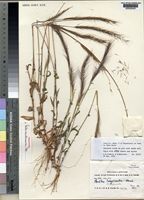
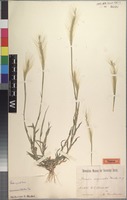
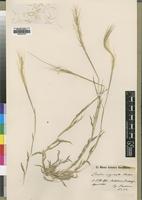
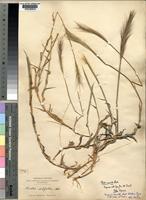
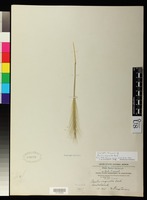
Perotis vaginataHack. [family POACEAE ] (stored under name);
Related name
Perotis acanthoneuron
Perotis vaginata
Perotis hildebrandtii
Perotis latifolia
Flora
Entry for PEROTIS vaginata Hack. [family POACEAE]
Herbarium
Royal Botanic Gardens, Kew (K)
Collection
Flora of Tropical East Africa
Resource Type
Reference Sources
Entry From
Flora of Tropical East Africa, Part (Part 2), page 177, (1974) Author: W. D. CLAYTON, S. M. PHILLIPS AND S. A. RENVOIZE
Names
PEROTIS vaginataHack. [family POACEAE], in Bull. Herb. Boiss., sér. 2, 6: 704 (1906); G.T.: 20 (1965). Type: South West Africa, Ondonga to Uukuanyama, Rautanen (Z, holo.)
Information
Loosely tufted annual; culms 12–40 cm. high, geniculately ascending, robust. Leaf-blades lanceolate, 1–4 cm. long, 1.5–6 mm. wide. Spike 3–15 cm. long, embraced below by the uppermost leaf-sheath, the spikelets densely packed and ascending. Spikelets 4–5.5 mm. long, with a slender stipitiform callus 0.7–1.5 mm. long; glumes irregularly appressed scaberulous to glabrescent, the midnerve of the upper glume broad, not depressed, ± scabrid; awns 13–25 mm. long, stiff. Caryopsis flattened.
Range
DISTR. T1, 4 Zaire to SW. Africa
Altitude range
700–1600 m.
Distribution
TANZANIA Ngara District Bushubi, 15 May 1960, Tanner 4977 !TANZANIA Kigoma District Ujiji, Mar. 1939, Loveridge 700 !
Notes
Recognized by the large spikelets, and lack of a depressed spinulose midnerve on the upper glume. It is related to P. scabra Trin. from W. Africa, which has smaller spikelets and the glume hairs arranged in longitudinal rows.